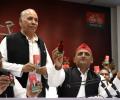
The Samajwadi Party (SP) said through a post on its official Twitter handle that the premises of its MLC Pushpraj alias Pampi Jain in Kannauj, Uttar Pradesh, have been raided.

Wearing black clothes, Congress leaders hit the streets on Friday to protest against price rise and unemployment with a host of them, including Rahul Gandhi and Priyanka Gandhi Vadra, being detained by police amid dramatic standoffs outside Parliament and the All India Congress Committee headquarters in New Delhi.
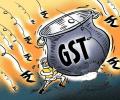
It is likely to be a stormy affair with divergent views on market borrowing. Centre will likely press states to borrow to make up for the shortfall, but states want either the Centre or the GST Council to do so.
If other states follow suit, it is going to become difficult for the GST Council to decide on the next stage of reforms.

The recurrent increases in fuel prices over the past 10 days are eating into the margins of transporters, who will be forced to pass on the hikes to their customers. This, in turn, is set to make the prices of daily consumables and other goods dearer, affect consumption, and slow economic growth, said transporters and analysts. Freight rates on grand trunk routes have shot up 3-4 per cent month-on-month in the past few days, according to the Indian Foundation of Transport Research & Training (IFTRT).

While seven of the suspended MPs belonged to the TMC, six were from the DMK, three from the Telangana Rashtra Samithi, two from the Communist Party of India-Marxist and one from the Communist Party of India.

Central government employees availing the LTC cash voucher scheme can purchase goods or services in the name of spouse or other family members eligible for LTC fare. The second set of FAQ issued by the Department of Expenditure also clarified that an employee can claim reimbursement for the purchase of goods and services, attracting GST of 12 per cent or more, on or after October 12 even if he/she has not formally exercised the option of availing the scheme.
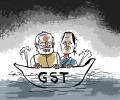
Agra has long been known for the Taj Mahal, but it is also a manufacturing hub filled with micro, small and medium enterprises (MSMEs) that make everything from electronic components to metal products, from paints and chemicals to footwear. And five years after the introduction of the Goods and Services Tax (GST), the MSMEs here complain that while the indirect tax regime has been transformative, cutting out the need to file multiple taxes, its biggest drawback has been the delay in credit refunds. Whoever you speak to - MSME owners, tax lawyers, or industry bodies like the National Chambers of Industries and Commerce (NCIC), Agra Footwear Manufacturers and Exporters Chamber (AFMEC) and Agra Shoe Manufacturers Association (ASMA) - they all emphasise that the GST continues to face some key challenges.

It's always been a struggle for economists and statisticians to forecast India's gross domestic product (GDP) correctly, and say where the economy is headed before the official numbers come out. If estimating the GDP is tough, forecasting it in real time is complicated. It involves looking at tens of indicators, such as industrial production, electricity consumption and exports, to arrive at a number.

After the Ukraine war, coke prices just soared and most units don't have money left to buy raw material. Customers are not absorbing the price escalation'

Indian companies are expecting generous tax incentives from the Union Budget that will help them invest more in building capacities in the coming years. While the productivity-linked incentives (PLIs) are a good start to spur local manufacturing, the government should also take steps to boost consumer demand, which is not showing encouraging signs, say chief executive officers (CEOs) of India Inc. Statistics released by the Reserve Bank of India (RBI) shows that Indian banks had sanctioned loans worth Rs 75,558 crore in 220 new projects - a record low - in the pandemic-hit financial year ending March 2021. This is not showing any signs of a significant pick up in the last nine months of the ongoing financial year.

Some states are taking a legal view on the state GST rate and the compensation rules ahead of the Goods and Services Tax (GST) Council meeting, which is likely to be held in mid-June, said people in the know. While the agenda is still being finalised, several states are likely to take up the matter related to GST compensation and may pitch for its continuation beyond the June 30 deadline. States would like to know how they would divide the compensation collected after June 2022 for payment of principal and interest of compensation shortfall borrowing and arrears to states, sources said.

Kerala Finance Minister K N Balagopal has sought systemic changes in the GST structure, saying every state and consumer has lost because of its basically flawed architecture that has also led to rampant revenue leakage for the states. The Goods and Services Tax (GST) regime came into force in July 2017. Even though the framework is focused on having a one-nation-one-tax model, quite a few items, including petroleum products and liquor are still out of the GST purview.

GST revenue remained above Rs 1 lakh crore for the second straight month in August at over Rs 1.12 lakh crore, 30 per cent higher than the collection in the year-ago period, the finance ministry said on Wednesday. "The gross GST revenue collected in the month of August 2021 is Rs 1,12,020 crore of which Central GST is Rs 20,522 crore, State GST is Rs 26,605 crore, Integrated GST is Rs 56,247 crore (including Rs 26,884 crore collected on import of goods) and Cess is Rs 8,646 crore (including Rs 646 crore collected on import of goods)," the finance ministry said in a statement. The mop up in August is, however, lower than Rs 1.16 lakh crore collected in July 2021.

Even as regulatory focus has zeroed in on foreign e-commerce giant Amazon, a domestic retail giant has been created almost below the radar in Reliance Retail (RR), one of the most crucial businesses for the group's future. From doorstep delivery of groceries, apparels to branded jewellery, medicines, toys, furniture to high street retailing, RR's presence in the world's fourth largest consumer market is just one part of the story.

India's current account slipped into a deficit of $9.6 billion or 1.3 per cent of GDP in the September quarter, the Reserve Bank said on Friday. The current account, which records the value of exports and imports of both goods and services along with international transfers of capital, was in a surplus mode both in the quarter-ago and year-ago periods. India's current account surplus had stood at $6.6 billion or 0.9 per cent of GDP in the April-June 2021 quarter, while in the year-ago period (Q2FY22), the surplus had stood at $15.3 billion or 2.4 per cent of the GDP, the data said.
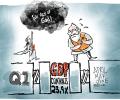
Dominic Xavier wonders whether the steep decline in GDP numbers should be considered as an act of God too.

Certain clarifications by the GST Council, such as tax rates on ice cream parlours and royalty paid to state governments over mineral rights, may turn out to be contentious and lead to litigation, feel some experts. The council, at its meeting in Lucknow on Friday, had clarified that ice cream parlours will attract goods and services tax (GST). The clarification said these parlours sell already manufactured ice cream and such supply would draw 18 per cent tax.
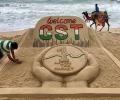
Agencies, whether public sector or private sector, may have to pay goods and services tax on the charges they collect on behalf of the government from clients. The authority for advance rulings (AAR), Telangana, has ruled that e-procurement transaction fee collected by an agency on behalf of the government is chargeable to GST, said Rajat Mohan, senior partner at AMRG & Associates. The AAR also ruled that neither services provided by the agency to the government, nor services provided on behalf of the government to the business entities are exempt from GST, he informed about the case.

Earlier in May, Ford India announced that it had dropped its plans to make electric vehicles (EVs) in India, which it intended to export, under the production-linked incentive scheme (PLI). Ford was among 20 companies that had signed a Champion OEM Incentive Scheme under the PLI project with the government in February this year. The decision comes as a blow for the 4,000-odd employees at Ford India's Maraimalai Nagar plant near Chennai and in Sanand, Gujarat. In September last year, the company had announced that it would exit the India market, which it had entered in 1995 through an on-again, off-again joint venture with Mahindra & Mahindra (they split in 1998, signed a JV in 2019 and split again in December 2020), retailing petrol and diesel brands such as the EcoSport, Figo, Aspire, and Endeavour.

The bidding for the two new Indian Premier League teams is set to take place on October 17. Interestingly, while the last day for queries in regards to bidding for the teams is September 21, the bids can be picked till October 5.

Macroeconomic data announcement, Omicron situation and global trends will be the major driving factors for the equity market in the first week of the new year 2022, according to analysts. In what turned out to be a historic year, the Indian stock indices went past multiple milestones and the 30-share Sensex made an annual gain of 10,502.49 points or 21.99 per cent in 2021. Religare Broking Vice-President (Research) Ajit Mishra said, "This week marks the beginning of a new month and participants will be closely eyeing some crucial high-frequency data like monthly auto sales, India manufacturing PMI and India services PMI. "Besides, updates on the COVID-19 situation and performance of global markets will also be critical."
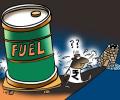
The GST Council might on Friday consider taxing petrol, diesel and other petroleum products under the single national GST regime, a move that may require huge compromises by both central and state governments on the revenues they collect from taxing these products. The Council, which comprises central and state finance ministers, in its meeting scheduled in Lucknow on Friday, is also likely to consider extending the time for duty relief on COVID-19 essentials, according to sources in the know of the development. GST is being thought to be a solution for the problem of near-record high petrol and diesel rates in the country, as it would end the cascading effect of tax on tax (state VAT being levied not just on the cost of production but also on the excise duty charged by the Centre on such output).

Deciding the goods and services tax rate on fryums papad could be a messy affair with the Appellate Authority for Advance Rulings (AAAR) of Gujarat now ruling that the ready-to-eat product would draw 18 per cent rate. In that connection, it slightly modified the ruling of the state-based Authority for Advance Rulings (AAR). The AAR had also ordered that these products would draw 18 per cent GST but under a different classification.
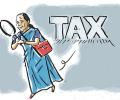
Finance Minister Nirmala Sitharaman on Thursday said taxpayer base has almost doubled to 1.28 crore in four years of rollout of the historic tax reform and the enhanced GST mop up in the recent months should now be the "new normal". In a written message to tax officers on the fourth anniversary of GST rollout, she said implementing any reform of this scale in a large and diverse country like India can be highly challenging, but GST has brought about ease in taxpayer compliance and reduced common man's tax burden.

It is in no way a government of the economic Right. The Right is limited to religion and nationalism. The rest is as Left as the Congress or any other party, observes Shekhar Gupta.

The 'yellow' alert restrictions stipulate that shops and establishments of non-essential goods and services and malls will open based on odd-even formula from 10 am to 8 pm.

With the COVID-19 positivity rate touching 0.55 percent, the Delhi government has decided to re-impose night curfew from Monday, according to sources.
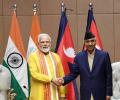
Modi and Deuba discussed ways to strengthen ongoing cooperation and develop new areas in the multifaceted bilateral partnership.

Amid record-high fuel prices, Finance Minister Nirmala Sitharaman on Monday said there is no proposal as of now to bring crude oil, petrol, diesel, jet fuel (ATF) and natural gas under the Goods and Services Tax (GST). When the GST was introduced on July 1, 2017, amalgamating over a dozen central and state levies, five commodities - crude oil, natural gas, petrol, diesel, and aviation turbine fuel (ATF) - were kept out of its purview given the revenue dependence of the central and state governments on this sector. This meant that the central government continued to levy excise duty on them while state governments charged VAT. These taxes, with excise duty, in particular, have been raised periodically.

The mop-up could have been much higher, but tax on imports fell 2 per cent y-o-y.

The government on Monday extended till July 21 the deadline for public comments on proposed amendments to the Consumer Protection (e-commerce) Rules, 2020. Earlier, the last date for public comments on the draft e-commerce rules was July 6. "It has now been decided to extend the timeline for receipt of comments/ suggestions on the draft e-commerce rules. "Views/ comments/ suggestions on the proposed amendments may be sent by July 21, 2021," a government notice said.

Unemployment rate for all ages in urban areas rose to 9.3 per cent in January-March 2021 from 9.1 per cent in the same month of the previous year, showed a periodic labour force survey by the National Statistical Office (NSO). Joblessness or unemployment rate (UR) is defined as the percentage of unemployed persons in the labour force. The UR for in CWS (current weekly status) in urban areas for persons of age 15 years and above was 10.3 per cent in October-December 2020, the ninth Periodic Labour Force Survey (PLFS) showed.

The finance minister could well be on her way to setting a record of achieving the biggest single-year reduction in the government's fiscal deficit, explains A K Bhattacharya.

The Maharashtra government on Sunday extended the lockdown-like curbs till June 15 and also announced that relaxations will be granted depending upon the Covid-19 positivity rate and availability of oxygen beds.

Businesses that have not filed GSTR-3B returns in the preceding two months will not be able to file details of outward supplies in GSTR-1 from September 1, GSTN has said. While businesses file GSTR-1 of a particular month by the 11th day of the subsequent month, GSTR-3B, through which businesses pay taxes, is filed in a staggered manner between 20th-24th day of the succeeding month. In an advisory to taxpayers, GSTN, which manages the technology backbone for Goods and Services Tax, said that Rule-59(6) of Central GST Rules which provides for restriction in filing of GSTR-1, will come into effect from September 1, 2021.

With the world's worst outbreak of COVID-19 severely straining the health system in the country, the government has made sweeping changes in the way departments procure medical supplies, including allowing procurement of the same item at different rates.

The government is also looking to earn 8 paise for every rupee from Union excise duty and 3 paise from customs duty. While, income tax will yield 14 paise to every rupee collection.
In the year-long crackdown on tax evasion, the GST authorities have unearthed over Rs 35,000 crore of tax fraud committed by misuse of input tax credit provision under the Goods and Services Tax (GST) regime. During the 2020-21 financial year, the CGST zones and the Directorate General of GST Intelligence (DGGI) booked about 8,000 cases involving fake ITC of over Rs 35,000 crore, a statement from CBIC said. Under the GST regime, at the time of paying tax on output, entities can reduce the tax they have already paid on inputs.

Hinting at further relaxation in the capital account convertibility norms, RBI Deputy Governor T Rabi Sankar on Thursday said the country is on the cusp of some fundamental shifts with regard to currency management. India has come a long way in achieving increasing levels of convertibility on the capital account and has broadly achieved the desired outcome for the policy choices in terms of achieving a stable composition of foreign capital inflow, Sankar said while addressing the Foreign Exchange Dealers' Association of India's (FEDAI) annual day meeting. Convertibility refers to the ability to convert domestic currency into foreign currencies and vice versa to make payments for balance of payments transactions.
 © 2026 Rediff.com - Advertise with us - Disclaimer - Privacy Policy - Sitemap - Feedback - About us - Terms of use - Grievances