
The Israel-Iran conflict has entered a 'decisive phase' after the United States bombed three major Iranian nuclear sites Sunday morning, feel strategic affairs experts with some of them arguing it was Washington, DC's 'responsibility' to not get involved in the military standoff.

India's economic growth forecast for 2025 has been revised downward to 6.3 per cent, and despite a projected moderation, the country remains one of the fastest-growing large economies, supported by resilient consumption and government spending, the United Nations has said.
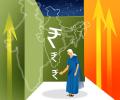
NITI Aayog member Arvind Virmani on Monday said India is set to become the fourth largest economy in the world by the end of 2025, an assertion which came days after NITI CEO BVR Subrahmanyam claimed India has already overtaken Japan to reach that spot. The International Monetary Fund (IMF), in its World Economic Outlook (WEO) report released in April had said that India is expected to be the fourth largest economy in the world with a GDP of $4.19 trillion in 2025, ahead of Japan.

Nayagam PP, a certified career counsellor and the founder of EduJob360, lists the top and emerging career streams in engineering.

India's Foreign Secretary Vikram Misri has underscored the importance of not equating the victims and perpetrators of terror attacks, highlighting the need for global unity in combating terrorism. Speaking at Raisina Tokyo 2025, Misri expressed appreciation for Japan's support following the recent terror attack in Pahalgam, India. He also cautioned against the trend of some Western countries hyphenating India and Pakistan in the context of their recent military confrontation. Misri further outlined India's economic aspirations and its commitment to becoming a factor of stability in a turbulent world.

Professionals will be required to either learn new tech skills that focus on AI, cloud computing, or risk becoming obsolete, says Arun Prakash M.

Moody's Ratings on Wednesday said US tariffs will weaken credit conditions and raise defaults risks especially for low-rated and speculative grade corporates. It said that an unpredictable US trade policy will lead to a deterioration in global credit conditions and macroeconomic impact will slow growth with a growing possibility of recession.
The World Bank on Wednesday lowered India's growth forecast for the current fiscal by 4 percentage points to 6.3 per cent amid global economic weakness and policy uncertainty. In its previous estimate, the World Bank had projected India's growth at 6.7 per cent for the fiscal year 2025-26.

Stock markets will be driven by further developments on the US-China tariff war front along with quarterly earnings announcements from IT majors Wipro and Infosys in a holiday-shortened week, analysts said. Global market trends and trading activity of foreign investors would also dictate market movement this week, experts noted.

After US President Donald Trump announced a 90-day tariff pause for several nations, including India, global manufacturers are in a rush to ensure that bulk of their goods reach the US during this window. "The 90-day suspension of tariffs will be welcomed by shippers, but it should not be a cause for celebration.


India's largest IT services firm Tata Consultancy Services on Thursday reported a 1.68 per cent dip in its consolidated net profit to Rs 12,224 crore for the March 2025 quarter. Tata Consultancy Services (TCS) - whose earnings marked the official start of IT results season - reported a total revenue of Rs 64,479 crore in Q4 FY25, up 5.3 per cent over the year-ago period.

The implication of April 2 reciprocal tariffs on global trade, trends in overseas markets and trading activity of foreign investors would dictate equity investors' sentiment in a holiday-shortened week ahead, according to analysts. Stock markets would remain closed on Monday for Eid-Ul-Fitr.

What's different this time is that global financial stress -- which has its genesis in four policy choices made in recent years -- is juxtaposed with a more resilient real economy, observes Sajjid Z Chinoy, chief India economist at J P Morgan.
This is the first case involving India and the US at the WTO after both sides decided to withdraw all seven pending cases at the WTO during the Biden administration.

Singapore's long-ruling People's Action Party (PAP), led by Prime Minister Lawrence Wong, has secured a landslide victory in the country's general election. The PAP won 87 of 97 seats, with voters endorsing the party's focus on stability and economic security amidst global uncertainties. Wong expressed gratitude for the strong mandate and vowed to tackle concerns about the cost of living and housing. The results mark a significant win for the PAP, which has been in power since Singapore's independence in 1965.
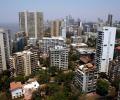
Average residential property prices in seven cities increased 10% to 34% due to new supplies in the luxury and ultra-luxury segments and overall demand.

India will need to grow at an average 7.8 per cent to become a high-income country by 2047, a World Bank report said on Friday. To achieve this goal India would require reforms in financial sector as well as in land and labour market, the World Bank said in its India Country Memorandum titled 'Becoming a High-Income Economy in a generation'.

In an eventful week ahead, stock markets may face volatile trends before the RBI's interest rate decision and the US inflation data announcements, as investors continue to assess the broader implications of US tariffs on global economy and inflation, analysts said. Investors fear that a full-blown trade war will impact global trade and economic growth, according to market experts.

Mumbai -- home to industry titans and Bollywood stars -- is witnessing a slow offtake of houses priced between Rs 10 crore and Rs 50 crore. Industry insiders and real estate watchers explain why.

Since October, FPIs have offloaded Indian equities worth Rs 2.1 trillion.

Export-led Indian IT sector is not directly hit by Trump's tariff order on goods, but there could be worrisome indirect bearings on it arising out of possible slowdown in decision-making and GDP growth in America over higher tariffs, which may then cloud demand from specific verticals, according to some analysts.
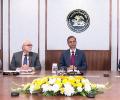
'We never waste a crisis. There will be learning and the supervisory tools will get better with each episode.'

The RBI on Wednesday slashed key interest rate by 25 basis points, for the second time in a row, to support a shuttering economy hit by reciprocal tariffs imposed by the US. Following the rate cut, the key policy rate eased to 6 per cent providing relief to home, auto and corporate loan borrowers.

'When Prime Minister Modi met President Trump, they agreed to initiate a bilateral trade dialogue.' 'It makes sense to give these negotiations a chance.'

Nine Indian universities and institutions have secured a place among the world's top 50 in the QS subject-wise rankings, with the Indian School of Mines (ISM) Dhanbad claiming the highest position at 20th globally for Engineering-Mineral and Mining. Despite the success, some top institutions, including three IITs, two IIMs and JNU, have experienced a drop in their rankings. The QS World University Rankings by Subject, in its 15th edition, highlight India's growing higher education ecosystem in terms of both size and quality.

Escalating trade tensions amid a tariff war after Donald Trump took over as President of the United States (US) could adversely impact global growth and fuel inflation, an article on the "State of the Economy" in the Reserve Bank of India (RBI) monthly bulletin said.
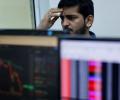
From Sensex shares, Larsen & Toubro, Tata Motors, Hindustan Unilever, Asian Paints, ITC, Power Grid, NTPC and Reliance Industries were the major laggards. Among the gainers, Bajaj Finance jumped over 5 per cent. Mahindra & Mahindra, Bajaj Finserv, Bharti Airtel and Maruti also ended higher.
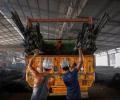
The "weaponisation" of economic activity - through tariffs and sanctions - is now a reality, with countries leveraging these tools strategically, External Affairs Minister S Jaishankar said at the Raisina Dialogue recently.

'As the global economy undergoes significant transformations in 2025, India's ability to navigate the complexities of trade wars, financial realignments, and emerging blocs will be pivotal,' explain Harsh V Pant and Soumya Bhowmik.
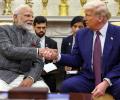
'I certainly hope the two can avoid a trade war and believe they will.' 'I expect some in India will push for retaliatory tariffs if the Trump administration applies significant reciprocal tariffs.'

While the US-Iran conflict leading to a spike in global oil prices and trade war between the US and the EU topped the chart with 25 per cent, other major risks to the global economy include coronavirus, debt burdens causing a recess across emerging markets and Hong Kong protests causing an exodus from Asia's biggest financial centre.

'Many of these issues will be resolved within 6 months because the US economy has started unravelling.'

Equity benchmark indices are facing massive corrections, with the NSE Nifty declining over 14 per cent from its lifetime high hit in September last year due to several negative triggers like stretched valuations, foreign fund exodus, disappointing quarterly earnings and rising global trade tensions dragging markets lower. The BSE benchmark Sensex hit its record peak of 85,978.25 on September 27 last year, and the Nifty also reached a lifetime high of 26,277.35 on the same day.

High frequency indicators, like vehicles sales, air traffic, steel consumption and GST E-way bills, point towards a sequential pickup in momentum of economic activity during the second half of the fiscal 2024-25 and sustain moving forward, RBI Bulletin said on Wednesday. However, a strong dollar, driven by US economic resilience and trade policy pivots, could exacerbate capital outflows from emerging economies, push risk premiums higher, and intensify external vulnerabilities, said an article on 'State of the Economy' published in RBI's February bulletin.

'Expect FPIs to continue selling for several months until the rupee stabilises.'
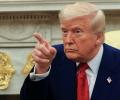
Trump's sweeping tariffs and penalties on China-built ships have turned global shipping into the front line of economic war, observes Shyam G Menon.

Led by a sharper-than-expected deceleration in industrial activity, economic growth in India slowed more than anticipated and is projected to remain at 6.5 per cent till 2026, the International Monetary Fund said on Friday. "Growth in India slowed more than expected, led by a sharper-than-expected deceleration in industrial activity," the IMF said in its latest update of the World Economic Outlook, according to which the global economy is holding steady. In 2023, India's growth rate was 8.2 per cent, which dropped to 6.5 per cent in 2024.
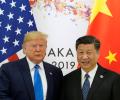
'If you compare the data from 2017 and 2023 of the US imports from the world and China, you will see that the US was a complete loser in the trade war, and China was a complete gainer.'

The Indian economy is expected to be "a little weaker" in 2025 despite steady global growth, IMF managing director Kristalina Georgieva has said. Georgieva also said she expects quite a lot of uncertainty in the world this year mainly around the trade policy of the US. In her annual media roundtable with a group of reporters on Friday, she said global growth is expected to be steady in 2025, but with regional divergence.
 © 2026 Rediff.com - Investor Information - Advertise with us - Disclaimer - Privacy Policy - Sitemap - Feedback - About us - Terms of use - Grievances