
India and the European Union are set to announce on January 27 the conclusion of negotiations and finalisation of a free trade agreement, which is aimed at boosting economic ties between the two regions amid disruptions in global trade due to US tariffs, an official said.

Latest GDP growth numbers a one-off development and not the beginning of a trend, says CEA V Anantha Nageswaran.

Retail inflation inched up to 0.71 per cent in November on rising prices of vegetables, protein-rich items, and fuel, government data showed on Friday. The consumer price index (CPI)-based retail inflation had fallen to a record low of 0.25 per cent in October, mainly due to lower prices helped by GST rate cuts and a favourable base.

After declining to a three-year low in FY24, the private sector investment is expected to fall further in the current financial year, India Ratings said in a research note.. The investments in the private sector are likely to plummet to below 11 per cent of the GDP in FY25, based on the trends from the latest national accounts data and company fillings, it noted.

Retail inflation rose to a three-month high of 1.33 per cent in December 2025 mainly due to higher prices of kitchen essentials, including vegetables and protein-rich items.

The Indian economy is growing at a robust pace, driven by strong domestic demand, low inflation, and the healthy balance sheets of banks, said a Reserve Bank report released on Wednesday.

The Ministry of Statistics and Programme Implementation (MoSPI) on Friday said it has advanced the release of macroeconomic data Gross Domestic Product (GDP) estimates by about 90 mins to 4 pm. As per the current practice, the press releases of GDP are scheduled at 5.30 pm on the specified release dates, a MoSPI statement said.

'The bigger unknown remains global geopolitics, which is inherently unpredictable, including developments in our neighbourhood.' 'Another concern is the increasing tilt of government finances towards welfare subsidies, especially at the state level.' 'This could constrain capital expenditure, which is critical for long-term growth.'

The shares of Titan Company hit its all-time high on the BSE and was the top gainer in the Sensex on Wednesday after the company released its business update for the third quarter of 2025-26 (Q3FY26). The stock closed at 4,272, up 3.94 per cent as compared to the Sensex, which was a tad down.

'An asset must generate income. Equities yield dividends, bonds pay coupons, deposits give interest, and real estate earns rent.' 'Gold, silver, and even Bitcoin produce no income, they merely store value. So, they should not be compared to productive assets.'

India needs to increase the investment rate to 34-35 per cent from 31-32 per cent currently to achieve a growth rate of 7 per cent and above, said S Mahendra Dev, chairman, economic advisory council (EAC) to the Prime Minister, on Wednesday.

'...a mix of asset classes.' 'Include equities for growth (across market caps), debt for stability and liquidity, gold as a hedge against macro and currency risk, and global assets for geographical and economic diversification.'
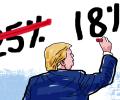
'Trump says India will buy over $500 billion of US goods.' 'At present, India's annual imports of goods and energy from the US are under $50 billion.' 'Reaching $500 billion would likely require more than 20 years, suggesting the figure refers to a long-term aspiration rather than a near-term commitment.'

'Calibrated depreciation will help rebalance external fundamentals, offset some of the tariff differentials with competitors, improve the competitiveness of domestic substitutes vis-a-vis Chinese imports, and contribute to the easing of financial conditions at a time when the inflation rate is unusually low,' explains Sajjid Z Chinoy, head of Asia Economics at JP Morgan.

Wholesale price inflation (WPI) came in at (-) 0.32 per cent in November, driven by an uptick in prices of food articles like pulses and vegetables on a month-on-month basis, government data showed on Monday.

From the Sensex firms, Adani Ports, Bharat Electronics, Eternal, Tata Motors Passenger Vehicles, State Bank of India and Kotak Mahindra Bank were among the biggest gainers. However, ITC, Bajaj Finance, Titan and Tech Mahindra were the laggards.

'Given that the population is almost evenly split, the Indian economy cannot grow without women participating in the workforce.' 'While women's participation has increased, it is still well below 40 per cent,' says Kartik Narayan, CEO of the professional networking and jobs platform, Apna.

Tata Sons Chairman N Chandrasekaran on Saturday said Air India, which is undergoing a transformation, is not just a business opportunity but a "responsibility" for the Tata Group.

Reserve Bank on Wednesday cut India's growth forecast to 6.5 per cent from 6.7 per cent estimated earlier for the current financial year on account of impact of global trade and policy uncertainties. Prospects of agriculture sector remain bright on the back of healthy reservoir levels and robust crop production in 2025-26, RBI Governor Sanjay Malhotra said while unveiling the outcome of the first bi-monthly Monetary Policy Committee meeting for the current financial year.

I am inclined to believe that the Venezuela adventure is not an indication of American strength, alas, but rather of American weakness, points out Rajeev Srinivasan.

Moody's Ratings on Tuesday cut India's GDP growth projections for 2025 to 6.3 per cent, from 6.5 per cent, saying economies globally will see a slowdown on account of heightened US policy uncertainty and trade restrictions.

Shrugging off concerns over the depreciation of rupee, the RBI has cut interest rate by 25 basis points to 5.25 per cent in a bid to further bolster economic growth, which rose to a six-quarter high of 8.2 per cent in the second quarter of the current financial year.

Shrugging off concerns over the depreciation of rupee, the RBI has cut interest rate by 25 basis points to 5.25 per cent in a bid to further bolster economic growth, which rose to a six-quarter high of 8.2 per cent in the second quarter of the current financial year.

Bengaluru is at a critical juncture, where its economic model, reliant on attracting and retaining skilled professionals, is directly threatened by a measurable decline in urban quality of life, point out Shishir Gupta and Rishita Sachdeva.

The rupee recovered 55 paise from its all-time low level to close at 90.38 against the US dollar after a volatile trade on Wednesday, amid suspected aggressive central bank intervention.

'The danger is that when the music stops, the fall will be sudden, faster, and deeper than anyone expects,' warns Debashis Basu.
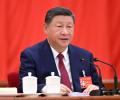
If Xi Jinping is dethroned in the future, the instrument for that may well be embedded within the PLA, notes former foreign secretary Shyam Saran.

India's economic growth rate is estimated to slip to a four-year low of 6.4 per cent in 2024-25, mainly on account of poor showing by the manufacturing and services sector, according to government data released on Tuesday. The gross domestic product (GDP) rate of 6.4 per cent will be the lowest since the Covid year (2020-21) when the country witnessed a negative growth of 5.8 per cent.

S&P Global Ratings on Tuesday cut India's GDP growth projections to 6.5 per cent for the next fiscal as it expects that economies in the APAC region will feel the strain of rising US tariffs and pushback on globalisation. In its Economic Outlook for Asia-Pacific (APAC), S&P said despite these external strains, it expects domestic demand momentum to remain solid in most emerging-market economies.
Deloitte on Thursday projected economic growth at 6.5-6.7 per cent for the current fiscal, as tax incentives provided in the Budget are expected to push domestic demand amid an uncertain global trade environment. Deloitte estimated India's GDP growth at 6.3-6.5 per cent for FY25 and said that the economic outlook for FY26 hinges on a delicate balance between evolving trade relations and government efforts to boost domestic consumer demand.

India's computer services exports have risen 30 per cent since the advent of ChatGPT in November 2022, even as overall services exports have plateaued, World Bank's South Asia Chief Economist Franziska Ohnsorge said, terming Artificial Intelligence (AI) and the conclusion of more trade agreements that can trigger a "manufacturing renaissance", as the two big investment opportunities for India in coming years.

Prime Minister Narendra Modi visited Ethiopia on a bilateral visit, engaging with Ethiopian leadership to strengthen partnerships in various sectors. He was warmly welcomed by Prime Minister Abiy Ahmed Ali and participated in cultural events, highlighting the strong ties between the two nations.

The power sector presents a puzzle. A fast-growing economy should be aligned to higher power demand but that hasn't been the case in the financial year 2026 till date (FY26TD).
India's economic growth slowed to near two-year low of 5.4 per cent in the July-September quarter of this fiscal due to poor performance of manufacturing and mining sectors, but the country continued to remain the fastest-growing large economy, data showed on Friday. The gross domestic product (GDP) had expanded by 8.1 per cent in the July-September quarter of 2023-24 fiscal. The previous low level of GDP growth at 4.3 per cent was recorded in the third quarter (October-December 2022) of financial year 2022-23.

'Some success has been achieved in raising the costs of terrorism for Pakistan.'
Despite a strong 7.8 per cent growth in the first quarter, the Indian economy is expected to grow at 6.5 per cent in the current financial year as the impact of US tariffs on Indian exports will reduce prospects, particularly in the second half, ADB said on Tuesday.

Foreign investors have pulled out Rs 11,820 crore ($1.3 billion) from Indian equities in the first week of this month, primarily driven by the sharp depreciation of the rupee. This sharp withdrawal follows a net outflow of Rs 3,765 crore in November, further pressuring markets.

Investors must account for currency depreciation in their financial plans and use instruments that can cushion the erosion in purchasing power.

'I don't see how a company like OpenAI can honestly expect to generate revenue significant enough to maintain its spending habits via John and Jane Q. Public,' points out Sree Sreenivasan.

The best course for the government at this time would be to tighten the seat belt a little more, without compromising on its investments in creating better infrastructure and giving a push to privatisation, points out A K Bhattacharya.
