
India's GST revenues experienced significant growth in March, reaching pre-tax cut levels, driven by increased imports and domestic sales. The report analyses the impact of tax rate changes and provides insights into future trends and economic stability.

Elevated global crude oil and natural gas prices, driven by geopolitical developments in West Asia, could significantly influence the Government of India's fiscal position for 2026-27, according to a report by ratings agency Icra.

Finance Minister Nirmala Sitharaman announced a fiscal deficit target of 4.3% of GDP for FY27, continuing the path of fiscal consolidation. The government aims to reduce the debt-to-GDP ratio to 55.6% by BE 2026-27 and further to around 50% by March 2031.

Deloitte India on Thursday projected India's economy to grow 6.7-6.9 per cent in the current fiscal amid buoyant demand and policy reforms. Indian economy grew 7.8 per cent in the April-June quarter of current fiscal.

The measures announced by it risk backfiring, disrupting the foreign exchange market, and intensifying the very pressures they seek to contain, with broader consequences for the economy points out Rajeswari Sengupta.

Fixed deposits from nationalised banks delivered higher returns than equities, outperforming both inflation and stock market benchmarks.

Here are the key numbers to watch out for in the Union Budget for 2025-26:

Global brokerage Bernstein has issued a cautionary note, stating that India risks 'under-delivering on its potential' unless it addresses key policy bottlenecks and structural risks, including employment challenges from AI, limited manufacturing gains, and rising welfare spending.

The forthcoming Budget could think of maintaining public capital expenditure at 3 per cent so that domestic resources are available for private investments, points out N R Bhanumurthy.

The benchmark BSE Sensex's trailing 12-month price-to-earnings (P/E) multiple has declined to 20.2x, its lowest since May 2020, driven by a record $42 billion FPI selloff since September 2024 and concerns over corporate earnings and economic growth.

A BJP government in Bengal inherits more problems than it might care to admit at its moment of triumph, points out Ramesh Menon

'Even if the war ends tomorrow, which is unlikely, and we go back to the pre-war status quo, the world will still need some time to get over the sudden shock of oil price increases.'
India is on track to exceed the $4 trillion milestone in 2025-26 (FY26), surpassing the $3.9 trillion gross domestic product (GDP) mark recorded at the end of March 2025, Chief Economic Adviser (CEA) V Anantha Nageswaran said on Tuesday.

The Indian rupee depreciated by 52 paise to settle at 93.35 against the US dollar, driven by failed US-Iran peace talks, surging crude oil prices due to a potential US blockade of Iranian ports, and a global flight to the greenback. This geopolitical uncertainty is also leading to foreign capital withdrawal from domestic equities.

Fitch Ratings on Friday said persistently higher oil prices could cause India's retail inflation to rise faster than the expected gradual pace, and lead to a slowdown in economic growth in the first half of financial year 2026-27 (FY27).

State-owned Indian Oil Corporation (IOC), Bharat Petroleum Corporation Ltd (BPCL), and Hindustan Petroleum Corporation Ltd (HPCL) are reportedly incurring losses of Rs 18 per litre on petrol and Rs 35 per litre on diesel, as they continue to absorb rising crude oil costs without increasing retail prices. This situation is leading to expectations of a fuel price hike after upcoming state elections.

Despite significant price differences, Indian farmers are increasingly adopting non-subsidised speciality fertilisers, which are seen as a potential solution to the rising fertiliser subsidy burden exacerbated by global supply shocks.

After years of rapid expansion, the Centre's capital spending growth eases as private investment shows early signs of revival, points out A K Bhattacharya.
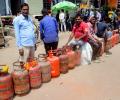
The Indian government has implemented several measures to mitigate external risks, support the balance of payments, and maintain macroeconomic stability amidst the ongoing West Asia crisis, according to Minister of State for Finance Pankaj Chaudhary.

Every week, hundreds of people line up to fill a plastic container with food in an unlikely place: the humble home where Argentine soccer legend Diego Armando Maradona was born.

The aggregate net worth of the country's 176 dollar billionaires dropped to $984.2 billion during 2025, down from a record $1,036.2 billion at the end of December 2024.

The Indian stock market is poised for a volatile week, influenced by the Reserve Bank of India's monetary policy decision, crucial global macroeconomic data, and the escalating geopolitical tensions in West Asia, according to market analysts.

China's latest defence budget surges to $275 billion, fueling its ambitious military modernisation program and intensifying geopolitical dynamics in the region.

India's services sector growth slowed in March, reaching a 14-month low, according to the HSBC India Services PMI. The slowdown reflects weaker new business intakes and rising input costs, particularly in fuel, transport, and logistics.

Analysts predict continued volatility in Indian equity markets due to domestic macroeconomic data, F&O expiry, global developments including US tariff policies, and geopolitical tensions.

The US' move to raise the tariff on most Indian goods to 50 per cent could drag India's GDP growth for FY26 by 35 to 60 basis points, according to various economists. One basis point (bp) is equal to 0.01 per cent.

India's retail inflation, which has stayed below the Reserve Bank of India's (RBI's) 4 per cent target in recent times, is likely to remain benign in the coming months, RBI Deputy Governor Poonam Gupta said in a speech, on Friday, which was uploaded on the central bank's website on Tuesday. Headline inflation dipped to multi-year lows of around 1.5-2.8 per cent in late 2025.

The modern war is about quality over quantity, points out Mihir S Sharma.

Reserve Bank Governor Sanjay Malhotra on Friday said the key policy rates will remain at low levels for a long period and may go down even further.

'After the Galwan clash, the rules of engagement changed with the army commanders allowed to use any means at their disposal as they deem fit for tactical operations.'

The Union Budget for 2026-27, presented by Finance Minister (FM) Nirmala Sitharaman on Sunday, which was a first, had an excellent domestic macro backdrop. According to the first advance estimates, gross domestic product (GDP) in constant prices is projected to grow 7.4 per cent in the current financial year, against 6.5 per cent in 2024-25.

The idea of back-loading the target of fiscal consolidation is perhaps guided by the government's desire to be prepared for any adverse developments in the coming year, points out A K Bhattacharya.
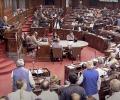
Opposition MPs in the Rajya Sabha criticised the Modi government's economic policies, citing the LPG crisis, lack of energy security, and concerns over the Economic Stabilisation Fund.

The logic of war plus the gathering storms in US politics as the midterms loom large leave him with no real alternative but to negotiate, points out Ambassador M K Bhadrakumar.
India's economic growth is expected to be lower at 6.3 per cent this fiscal compared to the RBI's projection of 6.5 per cent, a SBI Research Report said on Thursday. The report pegged the first quarter GDP estimate at around 6.8-7 per cent, mainly due to muted private capex.

Asian Development Bank (ADB) on Friday warned that India's limited crude oil reserves of about 100 million barrels - sufficient for only 40-45 days of consumption - leave the country particularly vulnerable to supply disruptions through the Strait of Hormuz amid the ongoing war in West Asia.

Remittances from West Asia in March rose sharply amid the conflict in the region, with industry insiders estimating inflows to be 20-30 per cent higher than what is usual in a month.

'More than becoming a unicorn, what truly satisfies us is seeing small businesses grow from Rs 10,000 a month to Rs 20 lakh after joining our platform.'

Of the donations, 48% is in kind -- such as food, clothing, or other household goods -- followed by cash (44%) and volunteering (30%) with non-profits, religious institutions, or community groups.

Among Sensex firms, Mahindra & Mahindra, Tata Motors, Trent, Eternal, Asian Paints and Infosys were the major gainers. However, Sun Pharma, ITC, Hindustan Unilever and Titan were among the laggards.
