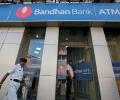
It is 10 years since Bandhan Financial Services became the first microfinance institution (MFI) to receive the universal bank licence. A year later, in 2015, it started operations. Bandhan's entry into banking was seen as a vote of confidence by the Reserve Bank of India (RBI) for the country's microfinance sector. Subsequently, the RBI awarded small finance bank licences to nine MFIs.

The currency in circulation (CIC) declined in the first half of this financial year and this is the first time this has happened in H1 in at least 10 years. The CIC on March 31, 2023, was Rs 33.78 trillion, which fell to Rs 33.01 trillion on September 22 -- a difference of about Rs 76,658 crore. In the first half of the last two financial years, the CIC went up by Rs 33,357 crore in FY23 and Rs 84,978 crore in FY22.

In times of global challenges, G-20 presidency gives an opportunity to strengthen India's role in the global order, she added. The government is implementing scheme to supply free foodgrains to poor under Pradhan Mantri Garib Kalyan Ann Yojana (PMGKAY) with expenditure of Rs 2 lakh crore from January 1, the finance minister said.

While Ambani, 66, drew nil salary from the company since the 2020-21 fiscal year, other executive directors including his cousins Nikhil and Hital are paid a salary, perquisites, allowances and commission. His three children - twins Akash and Isha (both 31) and Anant (28 years) - will get only a sitting fee and a commission on the profit earned by the firm.

A piece of slightly negative news can cause a serious setback, warns Debashis Basu.

The country's real GDP growth in the first quarter will be better than the Reserve Bank's estimate of 8 per cent, economists said on Tuesday. Economists at the country's largest lender SBI pegged the growth at 8.3 per cent while domestic rating agency Icra estimated it to come even higher at 8.5 per cent. The Reserve Bank of India (RBI), which expects the GDP to grow at 6.5 per cent in FY24, has estimated a growth of 8 per cent in the April-June period.

Reliance Industries may report a muted performance for the April-June quarter of FY24, with most brokerages expecting it to have witnessed a year-on-year (YoY) and quarter-on-quarter (QoQ) contraction in revenue and net profit during the period because of a poor showing by its oil-to-chemicals (O2C) division. The O2C division, which includes refining and petrochemical businesses, accounts for a little over half of RIL's revenue and profit. A muted showing by RIL in the first quarter of 2023-24 may weigh on the overall corporate earnings, as well as the equity markets.

Once stability returns to the secondary market, companies that have obtained approval from Sebi will start tapping the market.

The combined dividend payout by early-bird companies -- those that have declared their results for FY21 -- is up 8.9 per cent, lower than the 21.9 per cent rise in in FY20 but ahead of the underlying growth in India Inc business last year. Combined net sales of these early birds were down 1.8 per cent last financial year while net profit was up 27.3 per cent in FY21. Some top companies that have stepped up dividend payout in FY21 include Hindustan Unilever, Indus Towers, Tata Steel, Ultratech Cement, Larsen & Toubro, Dabur, Asian Paints, and UPL. In contrast, banks have skipped dividends under an RBI diktat while companies such as Marico, TCS, Maruti Suzuki, and Godrej Consumer are paying lower dividends for FY21.

Trouble started brewing after Cognizant announced that Ravi Kumar, former Infosys president, would take over as the Nasdaq-listed company's CEO.

Though retail investors accounted for a larger number of outstanding shares of the NSE-listed companies at 15.29 per cent, the combined value of their holding was Rs 9.16 trillion. This was much lower than the value of holding of FPIs and DIIs.

The Reserve Bank on Friday superseded the board of the city-based Abhyudaya Cooperative Bank on concerns emanating from "poor governance" and appointed an administrator to manage the affairs of the lender. In what can be seen as a step that should allay depositors' concerns, the central bank did not put any restrictions or moratorium on deposit withdrawals because of the comfort it gets on the bank's finances, according to people in the know. "(The) action is necessitated due to certain material concerns emanating from poor governance standards observed in the bank.

Beauty and Personal Care (BPC) e-retailer Honasa Consumer's initial public offering (IPO) has failed to find backing from analysts due to the company's weak financial track record and expensive valuation. T Manish, research analyst at Samco Securities suggests avoiding the IPO as the company's financial performance does not inspire confidence. "The profit has been inconsistent and advertising and marketing expenses are incredibly high at around 40 per cent of the revenues.

'Now that we are a pure-play India business, many investors are open to investing.'

'We are expected to grow at above 28 per cent this year, higher than the industry.'

The past 18 months have seen a resurgence in the real estate industry, with developers regaining the ground lost to the Covid-19 pandemic. But it is once again adding inventory at a pace faster than sales. The industry's inventory rose by 28 per cent year-on-year (Y-o-Y) in H1FY24, com-pared to a 25.5 per cent year-on-year increase in net sales during the same period.

A sudden surge in wealth because of stock market gains after the pandemic could be one of the factors behind the relatively lower share of philanthropy in total wealth.

'With this revamp the anonymous journey of the user will begin wherein he will not have to sign in every time he accesses the app.'

While Emami is still struggling to push growth, given weak rural demand, the sale of the group's stake in AMRI Hospitals should ease investor concerns about stake pledges by promoters. It has also carried a series of stake acquisitions which should enable the expansion of its brand portfolio. The Q2 results are likely to see flat volumes and low revenue growth alongside some gross margin expansion.

The Union government's revenue from securities transaction tax (STT) is on track to exceed its Budget projection for the current fiscal year, with the mop-up already surpassing 50 per cent of the annual estimate. Provisional figures reveal that the Centre has collected approximately Rs 14,000 crore in the first half of this fiscal year up to September, according to a government official. This amount exceeds half of the full-year target of Rs 27,625 crore set for FY24.

Outward remittances under the Reserve Bank of India's (RBI's) liberalised remittance scheme (LRS) made a strong comeback in the first quarter of FY23 as Indians increased spending on international travel, maintenance of close relatives, and gifts. The latest data for Q1FY23 released by the RBI shows that remittance by Indians under the scheme jumped 64.75 per cent to over $6.04 billion from $3.67 billion in Q1FY22. The amount remitted in Q1FY23 is even higher than that in Q4FY22, where outward remittance under LRS was to the tune of $5.8 billion. In April, about $2.02 billion was remitted, followed by $2.03 billion in May, and $1.98 billion in June, data released by RBI in the August bulletin shows.

Three major cities in south India -- Bengaluru, Hyderabad and Chennai -- dominate India's office market with the contribution of 66 per cent of the total demand for office space during the last financial year 2020-21, according to Anarock report. The consultant noted that the main southern office market has overtaken other regions in terms of new supply, net absorption, and even rental growth. Among the top-seven cities, Bengaluru, Hyderabad and Chennai saw their share of total office leasing increase to 66 per cent in the 2020-21 fiscal year as against 47 per cent in FY18.

Tata Sons, India's biggest promoter in the private sector, is expected to earn a record Rs 27,797 crore via equity dividend and proceeds through share buyback from its listed group companies for the financial year 2021-22. This amount is up 17.6 per cent from Rs 23,663 crore that it pocketed in FY21. Nearly two-thirds of these proceeds will show up in Tata Sons' financial results for FY22, thanks to the quarterly interim dividend by its cash cow Tata Consultancy Services (TCS).

Households may be feeling the pinch of higher inflation but corporate India is enjoying record high margins and profits. The combined quarterly net profit of listed companies scaled a new high in the April-June 2023 quarter owing to a sharp rise in operating and net profit. The expansion in margins more than compensated for the slowdown in revenue growth, which slipped into single digits in Q1FY24 after a gap of nine quarters.

Heightened volatility and lacklustre returns continue to make a dent in retail participation in the equities cash market segment. The percentage of retail participation in the average daily turnover in the National Stock Exchange's (NSE's) cash segment has come down to 40.8 per cent in February 2023, from 52 per cent a year ago. At the peak, retail investors accounted for nearly two-thirds of cash market volumes in July 2020.

After incurring losses for two years on the trot, German luxury automotive company Bayerische Motoren Werke AG (abbreviated as BMW) has posted net profit in India in 2021-22 (FY22), primarily due to high demand of its top-end vehicles, cost optimisation, and price hikes, Business Standard has learnt. BMW India said in its FY22 financial statement that the company is focusing on growth and achieving profitability through induction of new products in the market, strengthening its dealership network, and improving customer satisfaction while reducing costs. The company posted its highest-ever revenue in India in FY22 at Rs 4,365.8 crore.

Earnings growth, attractive valuations and change in FPI flows from negative to positive over the next 12 months are some of the key triggers for an upside. "A poor monsoon, high inflation and further rate hike are some of the key risks

Byju's, India's most-valued startup, has decided to put two of its key assets -- Epic and Great Learning -- on the block to generate $800 million-$1 billion in cash, with an aim to meet the edtech firm's various commitments, including repaying the entire $1.2 billion term loan B (TLB) within six months, according to sources. The cash-strapped company has proposed repaying $300 million of the $1.2 billion loan in the next three months, depending on whether the lenders accept Byju's amendment proposal, said the people familiar with the development. "This loan repayment proposal has been submitted to the lenders and conversations are going in the right direction," said a person in the know.

Private equity (PE) investment in real estate declined 5 per cent year-on-year in April-June to $1.9 billion because of high interest rates, according to Anarock. PE inflows stood at $2 billion in the year-ago period. Real estate consultant Anarock has come out with a report titled 'FLUX Q1 FY24 Market Monitor for Capital Flows in Indian Real Estate'.

Moody's said the government will face challenges in achieving its deficit target for the fiscal year ending March 2021, amid persistent structural and cyclical headwinds to growth.

TVS Motor Company has been one of the best-performing two-wheeler stocks in the current financial year (FY24), enriching investors with gains of 24 per cent. Among listed two-wheeler stocks, only Hero MotoCorp has done better in this period. New launches, market share gains, steady margins and expectations that its performance will continue in FY24 are expected to support TVS Motor's stock.

Unacademy may see a funding dry spell for at least next 12-18 months and even last till 24 months and will cut costs to weather the lean period, said the chief executive of the education technology unicorn that recently laid off more than 600 employees. "This is a test for all of us. We must learn to work under constraints and focus on profitability at all costs. We must survive the winter," said Unacademy's co-founder and CEO Gaurav Munjal in a letter to the employees. "Winter is here. We are looking at a time when the funding will dry up for at least 12-18 months.

The central government is on track to meet its fiscal deficit target of 6.4 per cent of the GDP for 2022-23 on the back of strong growth in revenue collections, the World Bank said in its India Development Update on Tuesday. High nominal GDP growth in the first quarter supported strong growth in revenue collection, especially Goods and Services Tax (GST), despite tax cuts on fuel. Notwithstanding an increase in spending due to expanded fertilizer subsidies and food subsidies for vulnerable households in response to the commodity price shock, the government is on track to meet its FY22/23 fiscal deficit target of 6.4 per cent of GDP and the general government deficit is projected to decline to 9.6 per cent from 10.3 per cent in FY21/22 and 13.3 per cent in FY20/21.

This is the first Budget in Amrit Kaal, she said.

Many CEOs said they plan to give special leave to women employees so as to encourage their participation in the workforce.

The cement industry continues to present a puzzle to investors.

Out of all the reported digital payment frauds in India, over half (55 per cent) were United Payments Interface (UPI)-related, a new report released on Tuesday revealed. Another 18 per cent are card related, 12 per cent are related to internet banking and nine per cent are from phishing calls. Most of the UPI-related frauds, however, have a low ticket size.

Indian IT services companies are likely to post a 9-12 per cent revenue growth in USD terms in FY22, helped by the strong demand for digital deals, a report said on Tuesday. However, the same will not translate into profits, because higher salaries will result in the operating profit margins for the same set of companies to come at 23 per cent from 24.2 per cent in FY21, domestic rating agency Icra said. The IT sector is one of the few sectors that have not been deeply impacted by the pandemic.

However, the SBI report said it will take almost seven-quarters from Q4 FY21 to reach the pre-pandemic level in nominal terms and there will be a permanent output loss of around 9 per cent of GDP.

Pakistan's current account deficit (CAD) increased to a 4-year high of $17.4 billion in the fiscal year of 2021-22, indicating more troubles for the ailing economy of the cash-strapped country. The State Bank of Pakistan (SBP) on Wednesday reported that the country recorded a CAD of $17.406 billion in FY22 compared to a gap of just $2.82 billion in FY21. According to Dawn newspaper, the massive CAD speaks a lot about the severe problem of the balance of payments.
 © 2026 Rediff.com - Investor Information - Advertise with us - Disclaimer - Privacy Policy - Sitemap - Feedback - About us - Terms of use - Grievances