
India's biggest non-bank finance company, Bajaj Finance (BAF), is set to raise capital after a gap of four years. On October 5, the board of directors will meet to approve the fund raise by way of preferential issue and/or qualified institutional placement (QIP) subject to regulatory and shareholder approvals. The move, analysts said, comes ahead of expectations, and could be in the wake of simmering competition in the consumer lending space, especially with the launch of Jio Financial Services (Jio Fin). "While we still do not have finer details on the game-plan of Jio Financial, it has plans to initially foray into consumer and merchant lending.

Poor earnings show in the September quarter (Q2FY24), with hints of likely weakness in asset quality going ahead, forced analysts to cut earnings estimates of SBI Cards and Payment Services (SBI Card). On the bourses, shares of the State bank of India arm tumbled 7.4 per cent to Rs 732 apiece on the BSE in the intraday trade as investors factord in near-term concerns. Analysts at Motilal Oswal Financial Services, for instance, slashed SBI Card earnings by 8 per cent and 10 per cent for FY24 and FY25, respectively, as they expect the company to face pesistent magin pressure.

India's economic growth slowed to 3.1 per cent in January-March and to an 11-year low of 4.2 per cent for the full fiscal 2019-20 amid a drop in consumption and investment. The Gross Domestic Product (GDP) growth stood at 5.7 per cent in the corresponding quarter of 2018-19, according to data released by National Statistical Office (NSO) on Friday.
The report said resilience of the banks has increased with a sharp improvement in the provision coverage ratio to 60.6 per cent in March 2019 from 52.4 per cent in September 2018 and 48.3 per cent in March 2018.

Wipro chief executive Abidali Z Neemuchwala saw his pay package grow 41 per cent to $ 3.9 million during 2018-19.

Assessment year 2020-2021 saw returns filed fall to 69.7 million and stood at 71.4 million in assessment year 2021-2022.
Taiwan in 1951 came up with an ingenious plan to improve tax compliance: citizens taking receipts for purchases could use them as lottery tickets. Customers were incentivized, and businesses found it hard to evade taxes. The plan's success prompted other countries, Slovakia and Greece among them, to launch similar initiatives. India doesn't seem to find the need yet for such schemes amid surging goods and services tax (GST) collections.

China, it said, is projected to grow at 6.6 per cent in the current year which will moderate to 6.4 per cent next year.
However, independent economists are not as gung-ho as the finance ministry over the likelihood of deficit target being met this time around, says Indivjal Dhasmana.

The question is: Will the company have a strong balance sheet to support this massive investment plan?

Revenue buoyancy of GST will be key to improve the resource position of both central and state governments.

For the first time in a decade, inflows into equity mutual funds (MFs) decoupled from the past performance of the equity market, as investors continued to pour money into the market unperturbed by lacklustre returns.

While commercial vehicles are expected to benefit from strong replacement demand, the two-wheeler and tractor segments are expected to gain from a recovery in the rural economy.

India's urban unemployment rate declined in Q4FY23 to 6.8 per cent - the lowest in over four years -- after it stagnated at 7.2 per cent in the previous October-December quarter, reflecting improvement in the labour market, according to the Periodic Labour Force Survey (PLFS) released by the National Statistical Office (NSO) on Monday. The unemployment rate in current weekly status (CWS) terms for all ages in the March quarter was the lowest recorded in more than four years, from the time the NSO released India's first quarterly urban jobless rate for the December quarter in 2018. The jobless rate in urban areas had been on a continuous decline since the peak of 20.8 per cent in the April-June quarter of FY21.

This is the second highest divestment proceeds in a financial year.

The BSE Healthcare Index is up 19 per cent as compared to BSE Sensex returns of 11 per cent during this period. Nitin Agarwal of DAM Capital highlighted this trend in a report last month. "After a sustained period of underperformance over FY21-23, the BSE Healthcare Index has once again captured the spotlight. "The recent uptick in performance has been driven by hospitals and emerging green shoots in pharmaceutical exports, particularly to the US, along with sustaining momentum in domestic branded formulations," he said.

The average time lag between the date of occurrence of a fraud and its detection is 23 months; for large frauds (Rs 100 crore and above), it was 57 months.

The government is set to earn an equity dividend of nearly Rs 13,800 crore from the listed public-sector banks (PSBs), all 12 of them, for FY23, up 50 per cent from Rs 9,210 crore in FY22. This will be the highest ever dividend for the government from PSBs. The 12 PSBs in our sample are paying an equity dividend of nearly Rs 21,000 crore for FY23, up 53 per cent from Rs 13,710 crore for FY22.

The price of petrol breached a three-year high on Monday at Rs 74.50 a litre, while the price of diesel was at its highest at Rs 65.75 a litre

The average top executive monthly compensation is Rs 1 crore. The median employee salary is now Rs 820,000.

There's a straightforward relationship between economic activity and power consumption. If economic activity increases, so does power consumption. Since the latest GDP (gross domestic product) data indicates India's growth rates exceeded expectations in the second half if the 2022-23 financial year (H2FY23) and GDP estimates of FY24 are strong, we would expect power consumption to rise as indeed it has. There is also a direct relationship between power consumption and National Thermal Power Corporation or NTPC's results since the public sector undertaking (PSU) is the largest power generator in India.

Rising oil prices and diminishing cash pile to limit capacity in 2018-19

After incurring losses for two years on the trot, German luxury automotive company Bayerische Motoren Werke AG (abbreviated as BMW) has posted net profit in India in 2021-22 (FY22), primarily due to high demand of its top-end vehicles, cost optimisation, and price hikes, Business Standard has learnt. BMW India said in its FY22 financial statement that the company is focusing on growth and achieving profitability through induction of new products in the market, strengthening its dealership network, and improving customer satisfaction while reducing costs. The company posted its highest-ever revenue in India in FY22 at Rs 4,365.8 crore.

Budget carrier IndiGo continued to be the largest player with a market share of 46.9 per cent ferrying 54 lakh passengers in March.

10 non-bank and non-finance stocks from the BSE500 Index universe that offer an optimal blend of low valuation, reasonably robust revenue and earnings growth in recent quarters, a strong balance sheet, and most importantly, positive cash flow from their operations.
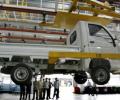
The country's top automaker in terms of revenue plans to launch a total of 50 products in the CV segment during 2018-19.

Domestic commercial-vehicle (CV) sales volume will witness significant growth over the next few years and the overall CV volume is likely to reach close to 1-million units by FY24, a report said on Wednesday. The report by credit ratings agency Fitch Ratings also expects growing demand and the resultant rise in operating leverage to boost the profitability of the domestic CV-focused original equipment manufacturers after FY22, despite elevated production costs. A recovery in medium and heavy CVs from multi-year lows, along with sustained growth in light CV categories, will help overall CV volume to reach close to 1-million units by FY24 - the level of the last cyclical peak recorded in FY19, it said.

The hiring scenario is for the batch that passes out in 2024. These are graduates who will be impacted, given 2022 graduates are not fully absorbed and 2023 onboarding still incomplete.

After the Insolvency and Bankruptcy Code came into force, which calls for an auction of assets of loan defaulting entities, recoveries have picked up, said Jaitley.

The stock of the retail chain Avenue Supermarts (Dmart) was the biggest loser in the BSE 100 Index shedding 4.35 per cent on Thursday and added to these losses on Monday by falling an additional 1.3 per cent. The Street was reacting to lower than expected operational performance by the company in the March quarter. The country's largest listed retailer by market capitalisation reported a 20 per cent year-on-year (y-o-y) growth in its top line to Rs 10,337 crore.

Spending on international travel tripled in April 2022 as Covid-related curbs were eased in various countries in FY22.

The government had breached its fiscal deficit target given in the Budget for 2017-18 in November itself, touching 112 per cent of the limit.

With a new chief executive officer (CEO) at the helm, the country's largest two-wheeler maker Hero MotoCorp is now looking to cut flab and move towards a leaner organisation. It has launched a voluntary retirement scheme (VRS) for its staff as it aims to make the organisation 'agile and future-ready'. Recently, the company's erstwhile chief financial officer (CFO) Niranjan Gupta was elevated as CEO.
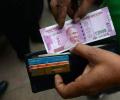
According to SBI Ecowrap, every $10/barrel increase in oil price results in additional import bill of $8 billion.

Many CEOs said they plan to give special leave to women employees so as to encourage their participation in the workforce.

RBI said the improvement in asset quality was driven by state-run lenders which saw a drop both in both GNPA and in the net NPA ratios.

The list of companies skipping dividends in FY19 includes some of the country's largest firms and industry leaders such Tata Motors, Avenue Supermart, Future Retail and Vodafone Idea, among others.

Clawing the economy back to an 8 per cent growth path will require bringing savings and investment rates closer to 35 per cent on a sustained basis, which were 30.2 and 29.6 per cent, respectively, in FY22, according to a report. As per India Ratings, a large part of investments will have to be in infrastructure, which can help revive private investments by easing supply constraints and offset the weakening of external demand due to global headwinds. Higher investments will have to be accompanied by higher domestic savings to keep the savings-investments gap under check.

Go-getter, ambitious, dynamic, workaholic are some of the adjectives that officials who worked closely with B V R Subrahmanyam use to describe him.

MEIL has become one of the fastest growing and most successful infrastructure and engineering, procurement, and construction companies in the country in recent times.
 © 2026 Rediff.com - Investor Information - Advertise with us - Disclaimer - Privacy Policy - Sitemap - Feedback - About us - Terms of use - Grievances