
India's banking system is expected to remain unscathed from the troubles in Credit Suisse as it has a very small presence in the country, experts said. Although Credit Suisse is more relevant to India's financial system than Silicon Valley Bank (SVB), it has very limited operations, according to a report by Jefferies India. The Switzerland-based bank, the report said, "has less than Rs 20,000 crore in assets (12th among foreign banks), presence in the derivatives market and funded 60 per cent of assets from borrowings, of which 96 per cent are up to two months.

China's forex reserves witnessed an increase of $509.7, a 12.8 per cent rise from 2012, People's Bank of China said.

A large number of public sector bank employees, as a matter of routine, do not "take" promotions so that they are not transferred out of their hometowns. The eastern region is famous for this, but it is a common practice everywhere, says Shyamal Majumdar.

Gold reserves increased $1.54 billion to $32.68 billion in the reporting week.

Benchmark interest rate hiked by 50 basis points to 3-year high at 5.90 per cent. Economic growth projection for FY23 cut to 7% from 7.2% estimated in August. GDP expected to grow at 6.3% in September quarter, 4.6% each in December and March quarters.

For the second time within a month, India's foreign exchange reserves soared by over $ 1 billion to cross a record high level of $72 billion in the week

The country's foreign exchange reserves increased by $1.739 billion to $582.037 billion in the week ended on March 12, the RBI data showed. In the previous week ended March 5, the reserves had declined by $4.255 billion to $580.299 billion. The reserves had touched a record high of $590.185 billion in the week ended January 29, 2021.

The ongoing conflict between Ukraine and Russia is unlikely to have any major impact on the Indian rupee and the forex volatility in the country (USD/INR) has been much less now as compared to the global financial crisis which took place in 2008, SBI said in its Ecowrap research report. The report said that though the conflict between the two CIS nations may drag on for now, it is expected that the USD/INR, the most tracked pair in the local forex market, will trade at an elevated zone. But ideally, the expected average range of the rupee is expected to be in the band Between Rs 76 to Rs 78 to the USD with an appreciated bias.

While the fiscal year has just begun, any windfall surplus will be welcomed by the government as it bids to meet the fiscal deficit target of 5.9 per cent of GDP, amidst lack of clarity on exactly to what extent will recession in the West impact India's trade and tax collections.

The rupee fell by 49 paise to close at 81.89 (provisional) against the US dollar on Monday as heavy selling pressure in the domestic equities and a spike in crude oil prices weighed on the local unit.

Sliding for the fifth straight session, the rupee fell 3 paise to close at a fresh lifetime low of 79.06 against the US dollar on Thursday amid a strong greenback overseas and unrelenting foreign fund outflows. At the interbank forex market, the local unit opened at 78.92 against the greenback and witnessed an intra-day high of 78.90 and a low of 79.07. It finally settled at 79.06, down 3 paise over its previous close of 79.03.

Gold reserves rose by $320 million to $31 billion.

The country's foreign exchange reserves fell by $249 million to $583.697 billion in the week ended February 12, RBI data showed on Friday. In the previous week, the reserves had declined by $6.24 billion to stand at $583.945 billion. It had touched a record high of $590.185 billion in the week ended January 29, 2021.

Gold reserves in the reporting week increased by $707 million to $33.52 billion.

India's macroeconomic fundamentals are strong to deal with global challenges and the central government is committed to sticking to the fiscal deficit target of 6.4 per cent of the GDP for the current fiscal, official sources said on Monday. The government is taking steps to deal with the spiralling crude oil prices in the international market, the sources said. India meets nearly 85 per cent of its oil demand through imports and a weaker rupee makes imports costlier.

The country's foreign exchange reserves touched a life time high of USD 555.12 billion after it surged by USD 3.615 billion in the week ended October 16, according to RBI data.

India's current account deficit is expected to deteriorate in the current fiscal on account of costlier imports and tepid merchandise exports, according to the Finance Ministry's monthly economic review. The review released on Thursday by the ministry also said that global headwinds would continue to pose a downside risk to growth as crude oil and edibles, which have driven inflation in India, remain major imported components in the consumption basket. For the present, it said, "their global prices have softened, as fears of recession have dampened prices somewhat. This would weaken inflationary pressures in India and rein in inflation."

The rupee appreciated 7 paise to 79.74 against the US dollar in early trade on Thursday as a positive trend in domestic equities supported the local unit. However, a strong American currency overseas and forex outflows restricted the rupee's gain, dealers said. At the interbank foreign exchange, the rupee opened at 79.72 against the American dollar, then went lower to trade at 79.74 against the greenback in early deals, registering a gain of 7 paise over the last close.

The government on Friday announced that no tax will be charged on overseas spending of up to Rs 7 lakh in a year using debit or credit as it looked to douse backlash from its earlier decision of levying TCS on all spending. The government had earlier this week brought overseas credit card spending under Liberalised Remittance Scheme (LRS). This meant that any spending using credit cards overseas would attract a 20 per cent tax from July 1.

Raghuram Rajan has described the fall in reserves as dip in valuation with appreciation of dollar against other currencies

Shares of most of the Adani group firms ended lower on Monday, with the group companies' combined mcap witnessing a sharp fall of Rs 9.5 lakh crore after US-based short-seller Hindenburg Research's adverse report.

Gold reserves rose by $321 million in the reporting week to $37.521 billion.

Dulat, however, pointedly said engagement with Pakistan has always been "influenced by domestic politics".

Going ahead iGate will have to maintain a healthy order book to sustain growth.
The rupee depreciated 31 paise to an all-time low of 80.15 against the US dollar in early trade on Monday tracking the strength of the American currency and firm crude oil prices. At the interbank foreign exchange, the rupee opened at 80.10 against the dollar, then lost ground to quote at 80.15, registering a fall of 31 paise from the last close. On Friday, the rupee closed at 79.84 against the dollar.

The country's foreign exchange reserves surged by $9.427 billion to record high of $620.576 billion in the week ended July 30, according to the latest RBI data. In the previous week ended July 23, the reserves had declined by $1.581 billion to $611.149 billion. In the reporting week ended July 30, the rise in the reserves was on the back of an increase in foreign currency assets (FCAs), a major component of the overall reserves, the Reserve Bank of India's (RBI) weekly data released on Friday showed.

The rupee tumbled 19 paise to close at a fresh lifetime low of 77.93 against the US dollar on Friday as rising crude oil prices and unabated foreign capital outflows soured sentiment. A sell-off in equity markets and stronger greenback overseas also weighed on the domestic unit, forex traders said. At the interbank foreign exchange market, the local currency opened at 77.81 and witnessed an intra-day high of 77.79 and a low of 77.93 against the US dollar.

The Reserve Bank of India (RBI) has announced a dollar-rupee two-year sell-buy swap auction for $5 billion on March 8, which will suck out rupee liquidity from the system. The swap will be in the nature of a simple sell/buy foreign exchange from the RBI side, in which a bank will buy US dollars from the central bank and simultaneously agree to sell the same amount of US dollars at the end of the swap period. "With a view to elongating the maturity profile of its forward book and smoothen the receivables relating to forward assets, it has been decided to undertake sell/buy swap auction of $5 billion on March 8, 2022," the RBI said in a statement. The auction cut-off will be based on the premium amount in paisa terms up to two decimal points.

Reserve Bank Governor Shaktikanta Das on Wednesday said in the wake of appreciating US dollar, the movement of rupee has remained least disruptive as compared to its peers, and the size of foreign exchange reserve is comfortable. On a financial year basis (from April to October 2022), the rupee has appreciated by 3.2 per cent in real terms, even as several major currencies have depreciated, he said while announcing the latest set of bi-monthly monetary policy. "The story of the rupee has been one of India's resilience and stability," the Governor said while pointing out that the appreciation of the US dollar this year, which precipitated large-scale depreciation of all major global currencies including the Indian rupee, has drawn wide attention.

The country's foreign exchange reserves swelled by USD 3.005 billion to a lifetime high of USD 490.044 billion in the week ending May 22, mainly on account of a rise in foreign currency assets, RBI data showed on Friday. In the previous week, the reserves had increased by USD 1.726 billion to USD 487.04 billion.

India's exports in April jumped nearly three-fold to USD 30.63 billion from USD 10.36 billion in the same month last year, according to government data released on Friday.

The foreign exchange kitty had crossed the half-a-trillion mark for the first time in the week ended June 5, 2020, after it had swelled by $8.223 billion to stand at $501.703 billion.

Finance minister Nirmala Sitharaman on Wednesday exuded confidence that inflation would further decline and the government is on track to meet its budgetary target for deficit and said that there is no fear of stagflation in India. Replying to the debate on first batch of Supplementary Demands for Grants 2022-23 in Lok Sabha, the finance minister said inflation has come down and it is now in the tolerable band of the RBI. Inflation has been declining since April 2022 and it is declining further, she said.

Sri Lanka on Tuesday deployed military personnel at State-run petrol pumps to monitor and manage fuel distribution amidst a shortage that led to serpentine queues of consumers outside filling stations.

Gold reserves were up by $1.525 billion in the reporting week to $37.625 billion.
Gold reserve also declined by $340 million to $30.55 billion.

The country's foreign exchange reserves rose $183 million to touch a record high of $560.715 billion in the week ended October 30, RBI data showed on Friday. In the previous week ended October 23, the reserves had jumped $5.412 billion to $560.532 billion.
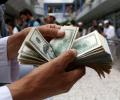
The country's foreign exchange reserves rose by $758 million to reach a record high of $586.082 billion in the week ended January 8, RBI data showed on Friday. In the previous week ended January 1, the reserves had increased by $4.483 billion to $585.324 billion.

The rupee depreciated 40 paise to an all-time low of 81.93 against the US dollar in early trade on Wednesday as the strengthening of the American currency and risk-averse sentiment among investors weighed on the local unit. Moreover, a negative trend in domestic equities and significant foreign fund outflows sapped investor appetite, forex traders said. At the interbank foreign exchange, the rupee opened at 81.90 against the greenback, then fell to 81.93, registering a fall of 40 paise over its previous closing.

High interest costs and a weak rupee may raise overall debt, even as refinancing may not be an issue.
