
India's reserve position with IMF rose by $ 7 million to $ 3.636 billion.
During the week, gold reserves declined by $443 million to $26.910 billion.

The country's foreign exchange reserves jumped from $68.435 billion to $69.508 billion in the reporting period, according to Reserve Bank of India's weekly statistical supplement.

Foreign currency assets rose $1.569 billion to $329.58 billion
Foreign exchange reserve, often taken as a yardstick to gauge a country's financial strength, are the foreign currency deposits and bonds held by central banks or monetary authorities (it is Reserve Bank in case of India).

The Reserve Bank of India may move forward to accumulating more gold as the yellow metal is expected to shine in the years to come. "A weaker dollar could diminish the value of India's foreign exchange reserves and hence this could lead to further accumulation of gold by the RBI. This move will help India's central bank to hedge its downside risk on the foreign exchange reserves front," Angel Commodities Broking analyst Amar Singh said.
In rupee terms, the country's foreign exchange reserves rose by Rs 19,809 crore (Rs 198.09 billion) to Rs 12,49,819 crore (Rs 12,498.19 billion) in the week ended June 12, according to the latest data released by the Reserve bank of India.
Foreign currency assets, a key component rose $1.6 bn to $304.9 bn.
Most of the Asia-Pacific economies would be cushioned by healthy foreign exchange reserves in the last quarter of the current calendar year, global ratings agency, Standard & Poor, said in a report.

Nepal's decision to ban the import of non-essential items amid depleting forex reserves may hit Indian exports. The country's central bank - Nepal Rastra Bank - last week instructed commercial banks not to open letters of credit (LCs) for importing non-essential items. This is to prevent further decline of the country's foreign exchange reserves. However, it has not issued any formal communication yet.
Gold reserves rose by $588.8 million to $21.566 billion, as per the RBI data.
India's foreign exchange reserves fell $9.94 billion during the week ending October 10, 2008 to $274 billion mainly because the Reserve Bank of India continued to sell dollars to check the steep depreciation of the rupee.
For the week under review, foreign currency assets, which are the biggest parts of the reserves, increased by $1.642 billion to $410.453 billion.

Finance minister Nirmala Sitharaman on Wednesday exuded confidence that inflation would further decline and the government is on track to meet its budgetary target for deficit and said that there is no fear of stagflation in India. Replying to the debate on first batch of Supplementary Demands for Grants 2022-23 in Lok Sabha, the finance minister said inflation has come down and it is now in the tolerable band of the RBI. Inflation has been declining since April 2022 and it is declining further, she said.
India's foreign exchange reserve fell by $550 million to $245.80 billion during the week ended November 21, 2008, due to revaluation in some foreign currencies and partial intervention by the Reserve Bank of India to check a steep depreciation of the rupee.

'The most important thing is that the psychological signal it is giving to the markets and international markets,' says former finance secretary Arvind Mayaram.

The RBI is still a small player in international gold buying among central banks. But in terms of total gold bought in 2019, it is the sixth largest buyer with 25.2 tonnes purchases in the first 10 months of 2019.

The country's gold reserves remained unchanged at $19.377 billion.
After a long debate with Planning Commission, Finance Minister P Chidambaram has finally agreed to consider funding infrastructure projects through the country's booming foreign exchange reserves that currently stand at about $170 billion.

India's forex reserves recently declined by $704 million to $354.517 billion.

Without naming India, S&P said it expects that in regions where inflation already exceeds targets, or which are vulnerable to capital flight, central banks will be forced to raise interest rates.

If there was one event that made the month of August stand out, it was a strengthening of the dollar index to levels last seen only 20 years ago, as the Federal Reserve dispelled all doubts about its intention to continue raising interest rates. Predictably, most currencies suffered against the US unit, with the bulk of the losers belonging to the emerging markets pack. Amid the volatility, the rupee, however, has displayed significant resilience and fared much better than most of its peer currencies.
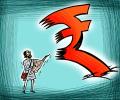
Indian rupee, which earlier this week touched an all-time low, is likely to remain under pressure and may test new levels as a fallout of the US Federal Reserve indicating more interest rate hikes, experts said. The aggressive rate hikes will dampen demand and increase the possibility of a recession in the US. This could accelerate the pace of capital outflows, weaken the rupee and raise the threat of imported inflation.
The total foreign exchange reserves had increased by $1.838 billion to $297.28 billion in the previous reporting week.

In the reporting week, foreign currency assets, which are a major component of the overall reserves, reduced by $ 633 million to $ 398.724 billion.
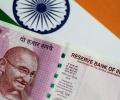
India's current account swung to a deficit for the first time in the current fiscal, with the gap coming at $1.7 billion or 0.2 per cent of the GDP in the December quarter. In the current fiscal, as the pandemic impacted trade, the current account had been in surplus in the previous two quarters, at $15.1 billion and $19 billion, respectively, as per the data on balance of payments released by the RBI on Wednesday. The critical measure of a country's external strength now stands at a surplus of 1.7 per cent of GDP for the first nine months of the fiscal year as against a deficit of 1.2 per cent in the year-ago period. In the December quarter, there was a rise in the merchandise trade deficit to $34.5 billion from $14.8 billion in the preceding quarter, and an increase in net investment income payments.

China on Monday said Sri Lanka has allowed its satellite and missile tracking ship to berth at the Hambantota port on Tuesday, but declined to reveal details of talks with Colombo leading to the bankrupt island's government reversing its earlier stand to defer the high-tech vessel's entry.
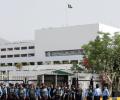
Pakistan's Opposition leader Shehbaz Sharif on Sunday nominated himself for the post of prime minister, while Imran Khan's party threatened to withdraw its lawmakers from Parliament if the former Punjab chief minister was allowed to contest the election for the top post on Monday.

'We welcome (you) back to the purana Pakistan,' top Opposition leader Bilawal Bhutto Zardari said on Sunday, as he took a jibe at ousted Pakistan Prime Minister Imran Khan following the adoption of a no-confidence vote against him.
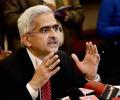
Reserve Bank Governor Shaktikanta Das on Monday said despite the latest headwinds arising from the Jackson Hole summit leading to extreme volatility, our banking system and financial markets are strong enough to withstand such pressures. Taking the markets by surprise, US Fed chair Jerome Powell had told the annual Jackson Hole summit of central bankers and economists last week that he would have to keep raising federal fund rates to tame inflation, which remains the biggest challenge to the world's largest economy. He also warned of the pains that such monetary policy actions would create on growth and jobs.
Contradicting the International Monetary Fund, which does not want India and other countries to use any of its foreign exchange reserves for building infrastructure

'There is a misconception that gold is a dead asset in India.' 'Around 30 per cent of agriculture loans are collateralised by gold, Soumya Kanti Ghosh and Saket Hishikar, economists at the SBI, point out.

The ex-president returned to Sri Lanka on a Singapore Airlines flight.

The government was also faced with problems on its balance of payments. It took steps to conserve declining foreign exchange reserves, and began to regulate the production, supply and distribution of gold. It banned forward trading in the yellow metal in November 1962, and introduced gold bonds as well, reveals the RBI's annual report for the year ending June 1963.
Planning Commission on Thursday said a desicion was expected shortlyon using foreign exchange reserves for infrastructure projects.
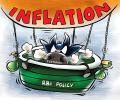
With the next review of the flexible inflation target (FIT) framework coming up soon, the Reserve Bank of India (RBI) on Friday said the current inflation target of 4 per cent with a +/-2 per cent tolerance band is appropriate for the next five years. The country adopted the FIT framework in 2016, and the next review of the inflation target is due before March 31, 2021. "The current numerical framework for defining price stability, i.e., an inflation target of 4 per cent with a +/-2 per cent tolerance band, is appropriate for the next five years," the RBI said in the Report on Currency and Finance (RCF) for the year 2020-21.
India's foreign exchange reserves grew marginally by $253 million to $141.45 billion for the week ended April 8, 2005.
The forex reserves stood at $144.375 billion, a rise of $1.738 billion, during the week under review, according to Reserve Bank of India's weekly statistical supplement released in Mumbai on Saturday.

Shaktikanta Das is a master of the finest balancing act who listens to all but takes his own decisions, discovers Tamal Bandyopadhyay.
