
India's retail inflation, which has stayed below the Reserve Bank of India's (RBI's) 4 per cent target in recent times, is likely to remain benign in the coming months, RBI Deputy Governor Poonam Gupta said in a speech, on Friday, which was uploaded on the central bank's website on Tuesday. Headline inflation dipped to multi-year lows of around 1.5-2.8 per cent in late 2025.

The forthcoming Budget could think of maintaining public capital expenditure at 3 per cent so that domestic resources are available for private investments, points out N R Bhanumurthy.

Experts say the state's economy is grappling with hidden debt, rising welfare costs, and lack of transparency.

'The finance minister missed yet another opportunity to simplify the income tax structure in the Budget.' 'This was an opportune moment to get rid of the old tax system entirely and move fully to the new system,' asserts M Govinda Rao, member of the 14th Finance Commission.

Using the debt-to-GDP ratio as a fiscal anchor aligns with efforts to promote fiscal transparency through proper disclosure of off-budget borrowings.

The Budget should undertake further reductions in import tariffs and seriously consider an announcement of India's intention to join one or both of the two Asian mega-regional free trade agreements, suggests Shankar Acharya, former chief economic adviser to the Government of India.

The road ahead will require navigating complex financial challenges while fostering job creation and sustainable development in the region.

India's economy is likely to grow by 6.5 per cent in the current and the next financial year, an EY report said, attributing lower than anticipated expansion in the September quarter to fall in private consumption expenditure and gross fixed capital formation. Real GDP growth eased to a seven-quarter low of 5.4 per cent in July-September -- the second quarter of the current 2024-25 fiscal year.

'Maharashtra is virtually in a debt trap.'

Union Finance Minister Nirmala Sitharaman, along with her team of bureaucrats, delved into the fine print of the 2024-25 Budget documents in a press conference, detailing the government's road map on bringing down the debt-to-GDP ratio and bold tax measures.

All eyes will be on whether Sitharaman will deliver a populist budget leaving more money in hands of the common man or push the reform agenda by staying on the fiscal glide path to lower the fiscal deficit to 4.5 per cent of GDP by 2025-26.

However, finding the funds to fulfill them will be a herculean task.
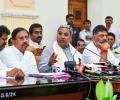
'Karnataka's finances are much healthier than the Union government's, which is indebted to nearly twice the extent of the state.'
The government has already crossed the fiscal deficit at 132 per cent of the estimate as of December end.

Amid a debate on the freebies, the Election Commission on Tuesday proposed amending the model code to ask political parties to provide authentic information to voters on the financial viability of their poll promises.

Diesel price should be freed, open market grain purchases should be ended.
Two important features are Effective Revenue Deficit and Medium Term Expenditure Framework.

'They have started becoming an important player, but not at the same level as they were in the earlier part of the decade.'

Finance Minister Pranab Mukherjee will likely encapsulate this thinking in his Budget speech, to be finalised by March 13.

Moody's Investors Service, while silent on the sovereign rating on the higher-than-expected fiscal deficit numbers, expressed doubts over attaining the higher revenue targets and divestment realisation as assumed in the Budget. The Union Budget 2021-22 has pegged a fiscal deficit of 9.5 per cent for the current financial year as against the consensus 7 per cent, and 6.8 per cent for 2021-22 with a market borrowing of around Rs 12 lakh crore. It also assumes Rs 1.75 lakh crore to be scooped up from divestment.

The government has utilised 'escape clause' under the FRBM Act which provides it leeway for relaxation of fiscal deficit roadmap during time of stress.
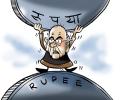
Fiscal deficit has a bearing on sovereign rating of the country as well as the debt market.

The Left parties which had raised the issue were not satisfied with his reply and walked out and they were joined by Samajwadi Party.

The tax base should comprehensively extend over all goods and services up to the final consumer point.
Even as the debate over off-Budget liabilities continues, former finance ministry bureaucrats and leading economists say it's time the government went beyond the targets in the Fiscal Responsibility and Budget Management Act.
The states will be able to raise additional open market loans of about Rs 21,000 crore (Rs 210 billion) in the current year, according to the 2009-10 Budget estimates presented on Monday. According to Budget estimates of 2009-10, the states' share of taxes and duties is expected to increase to Rs 1,64,361 crore (Rs 1,643.61 billion) against Rs 1,60,179 crore (Rs 1,601.79 billion) in 2008-09.
As the duration of the FRBM Act, enacted in 2003, has come to an end, the government would be required to replace it with another law on fiscal consolidation.

There has been a decline in foreign direct inflow from China in the last three years, with FDI coming down to USD 163.77 million in 2019-20, Minister of State for Finance Anurag Singh Thakur informed the Lok Sabha on Monday. Giving details of the total foreign direct investment (FDI) inflow from Chinese companies in India, he said, it was USD 350.22 million in 2017-18, while it declined to USD 229 million in the following year.
Officials in the finance ministry are not happy with credit rating agency Fitch's revision of India's local currency outlook to negative from stable. Officials say Fitch's conclusion that the central government's fiscal deficit will rise to 4.5 per cent of gross domestic product in 2008-09, as against 2.8 per cent in the previous fiscal, is wrong.
The tug of war between the finance ministry and the Planning Commission over more resources for plan projects worsened, with Planning Commission Deputy Chairman Montek Singh Ahluwalia saying he was keen on getting more money for the 11th Plan.

The government on Friday sought Parliament's nod for an additional Rs 54,000-crore spending mainly to meet its obligation towards GST compensation to states and defence-related expenditure. Minister of State for Finance Anurag Thakur presented the second and final batch of supplementary demands for grants in the Lok Sabha.

Sitharaman does away with loans from National Small Savings Fund to Food Corporation of India.
States also demanded that Budget for 2015-16 should make adequate provisions for central sales tax compensation for early roll out of Goods and Services Tax, a Constitutional Amendment Bill for which was tabled in the Lok Sabha last week.
The rise in the fiscal deficit, which is a reflection of the government's borrowing, was mainly on account of subdued tax collection. The revenue deficit also rose to 3.27 per cent, up from the revised estimate of 2.4 per cent of the GDP.

They pointed out that Finance Minister Nirmala Sitharaman relies a lot on divestments, where the government under-performed in FY2019-20, to achieve the 3.8 per cent fiscal deficit target.
 © 2026 Rediff.com - Investor Information - Advertise with us - Disclaimer - Privacy Policy - Sitemap - Feedback - About us - Terms of use - Grievances