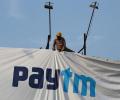
Paytm will focus on its core business of payments and cross-selling financial services as it works to achieve "profitability soon", said Vijay Shekhar Sharma, founder and chief executive officer of the fintech, on Thursday. "The past six months have taught us many lessons, giving us the opportunity to thoroughly examine our business processes, compliance, and the way we operate from the inside out.

Amazon Pay UPI has crossed 100 million customers, with the online platform used mainly for e-commerce transactions, utility bill payments and mobile recharges, the company announced on Monday.
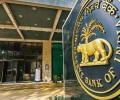
The Reserve Bank of India (RBI) will launch the Unified Lending Interface (ULI) nationwide in due course, aiming to transform India's lending sector, similar to how the Unified Payments Interface (UPI) revolutionised the payments ecosystem, Governor Shaktikanta Das said on Monday.

'Today, let us reaffirm our commitment to strive to realise Gandhiji's dreams. His watchwords, truth and nonviolence, will continue to remain relevant for the whole world. He also taught us that rights and duties are but the two sides of the coin - indeed, the true source of rights is duty. Today we recall his lessons in compassion too - compassion not only for our human neighbours but also for our other neighbours, namely, flora and fauna, rivers and mountains.'
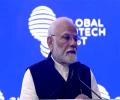
He said the transformation brought about by the fintech sector in India is not just limited to technology, but its social impact is far-reaching. He also stressed that fintech has dented the parallel economy and is bridging the gap between villages and cities on the financial services front. The prime minister also said that in the last 10 years, the fintech space has attracted investments of more than $31 billion and fintech startups have grown by 500 per cent.

More than 50 per cent of SIP accounts come from semi-urban and rural areas.
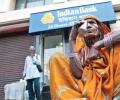
The govt has a lot more to do then just open bank accounts for the poor in the Jan Dhan scheme.

The outlook for India's financial sector appears bright, but it needs to brace for likely vulnerabilities, said Economic Survey 2023-24 tabled in Parliament on Monday. The Indian financial sector is at a "turnpike moment", it said, adding that the dominance of banking support to credit is being reduced, and the role of capital markets is rising. For a country that aspires to be a developed nation by 2047, this is a long-awaited and welcome development, it said.
.jpg)
The first phase would comprise universal access to banking facilities. Under this, basic bank accounts with zero balance, RuPay debit card and financial literacy, will have to be completed in the next one year, officials said.

Out of 3,871 recovery certificates issued by the regulator in various cases, 807 have been certified as difficult to recover.

The average cost of data breaches in India reached $2.18 million in 2023, marking a 28 per cent increase since 2020, according to the Reserve Bank of India's (RBI) Currency and Finance report for 2023-24. The report said that India's average data breach cost was still below the global average. The most common attacks in India are phishing which was at 22 per cent and stolen or compromised credentials was 16 per cent. The automotive industry is highly vulnerable to cyber attacks, whereas the banking and financial services sector, benefiting from stringent regulations, enjoys comparatively stronger protection.

'The dakiyas will be our partners, receiving credit proposals from micro-enterprises at the grassroots level.'

'Have a long way to go even as a small finance bank, both in terms of size, and in terms of fulfilling our aspirations for financial inclusion.'

Following a review of peer-to-peer (P2P) platforms, certain issues -- including high non-performing asset levels, significantly high balances in escrow accounts, and non-compliance with net owned fund and disclosure requirements -- came to the RBI's attention.
India had registered an economic growth of 6.7 per cent in FY'09 after posting over 9 per cent growth in the three preceding year, because of the global economic crisis.

The overall physical presence of life insurance companies in Tier-II and Tier-III cities increased in FY23 compared to a year ago period on account of the higher impetus given to financial inclusion by the government and insurance regulator, as well as recovery from the Covid-19 pandemic, according to the latest data released by the Insurance Regulatory and Development Authority of India (Irdai). It is the first time that there has been growth in the number of offices since the financial year 2019-20.

India will become the third largest economy by 2027-28, with a GDP of over $5 trillion, Finance Minister Nirmala Sitharaman said on Wednesday. Even going by conservative estimates, the size of the Indian economy will be $30 trillion by 2047, she noted. "It is possible that we will be the third largest economy by 2027-28, and our GDP will cross $5 trillion by that time. By 2047, it is a conservative estimate that we will reach at least $30 trillion in terms of economy," Sitharaman said at the Vibrant Gujarat summit.

Paytm, the country's leading fintech player which had to shut its payment bank business following regulatory action, is revisiting its business strategy including partnership with lenders. Also, the company's founder and chief executive officer (CEO) Vijay Shekhar Sharma has decided to oversee the day-to-day operations with all the major verticals reporting directly to him now. "The thing on top of everyone's agenda is getting the core businesses back on track," a person in the know said.

Microsoft co-founder Bill Gates on Tuesday met Reserve Bank of India Governor Shaktikanta Das and discussed various issues including financial inclusion, payment systems, microfinance and digital lending among others. "Mr.@BillGates visited RBI Mumbai today and held wide ranging discussions with Governor @DasShaktikanta #RBI #rbitoday #rbigovernor #shaktikantadas #BillGates," RBI said in a tweet. Gates Foundation pursues a lot of activity in India including promotion of financial inclusion, health sector and climate change.
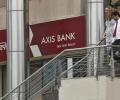
Fintech firm One97 Communications -- owner of the brand Paytm -- has shifted its nodal account to Axis Bank from Paytm Payments Bank. The move will allow continuity of Paytm QR, Soundbox, card machine after the March 15 set by the Reserve Bank of India (RBI), as per a regulatory filing. The RBI has advised customers and merchants of Paytm Payments Bank Ltd (PPBL) to shift their accounts to other banks by March 15, giving 15 more days to the beleaguered entity to close most of its operations, including deposit and credit transactions.
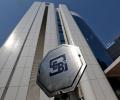
Before framing regulations to curb 'misleading' messages and stock recommendations by finfluencers (a portmanteau of the phrase 'financial influencers'), the market regulator plans to put in place some 'building blocks' to ensure smooth enforcement. Madhabi Puri Buch, chairperson of Securities and Exchange Board of India (Sebi), is of the view that the 'traditional approach may not work' to rein in finfluencers. "There are many interlinked pieces in our regulations - investment advisor regulations, research analyst regulations, the fact that we don't have algorithmic (algo)-related regulations, what brokers are permitted to do, and what is incidental advice.

RBI's exercise will take into account standards of governance, the viability of the payment bank (PB) business model, and changes, if any, if needed.

Finance Minister Nirmala Sitharaman on Wednesday said the National Rural Livelihood Mission has achieved remarkable success by mobilising rural women into 1 lakh SHGs (self help groups).

'We are also conducting ongoing training and grooming at the branch level to pre-empt such cyberattacks.'

At a time when the role of corporate boards is once again under the scanner, independent directors on the Paytm Payments Bank board have indicated that red flags were raised over regulatory issues but they may have been late in doing so. "As independent directors, we asked questions and monitored responses to the Reserve Bank of India (RBI). Many changes were made on compliances. "Obviously, in retrospect, it was not found to be enough," said one of the independent directors on the condition of anonymity.

The top 50 exposures, amounting to Rs 7.8 trillion, of government-registered non-banking financial companies (G-NBFCs) constitute about 40 per cent of corporate credit within the NBFC sector, indicating concentration risk, according to the Reserve Bank of India's report "Trend and Progress of Banking in India 2022-23". Notably, all the 50 are tied to the power sector, a domain fraught with inherent challenges, the report said. The report highlighted recognising the escalating systemic importance of G-NBFCs, the Prompt Corrective Action (PCA) framework had been expanded to include G-NBFCs excluding those falling within the base layer.

Indian fintechs and associated entities are hoping that the Union Budget 2024 will provide a boost and empower firms to extend their reach beyond Tier-II regions, with an emphasis on supporting enterprises led by women. The fintech industry, which has witnessed regulatory reforms over the last year, expects the Budget, scheduled to be presented by Finance Minister Nirmala Sitharaman on February 1, will further encourage financial inclusion, empower micro-small-medium enterprises (MSMEs) with lending solutions, and push for upskilling initiatives for the country's young workforce.

'You cannot have only one product or one market or one customer segment.'

The BRICS nations on Friday underlined the need for using local currencies in international trade and financial transactions besides committing themselves to supporting rule-based open and transparent global trade. A joint statement issued at the end of the meeting of the BRICS Ministers of Foreign Affairs and International Relations, also pressed for a robust Global Financial Safety Net with a quota-based and adequately resourced International Monetary Fund (IMF) at its centre. It further said the process of IMF governance reform under the 16th General Review of Quotas, including a new quota formula as a guide, should be completed by December 15, 2023.
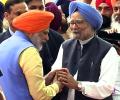
Whether it was the MGNREGS or the NFSA or the Aadhaar-based DBT scheme for cash transfer, the Modi government has built on the basic architecture created by the Singh government. Policy makers in the Modi government, instead of discarding them as products of the previous political regime, worked on them, expanded their scope and reach, and used new tools to improve their performance, explains A K Bhattacharya.

'The focus needs to shift towards the ability to collect payments, particularly in tier-3 to tier-4 areas where acceptance is still lacking.'

'It will dictate the flow of funds into the index. We will maintain caution on mid/smallcaps.'

Has Vijay Shekhar Sharma given up on the bank? For now, he seems to be on a save-OCL mission. The bank will face its logical end, observes Tamal Bandopadhyay.
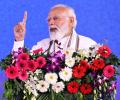
Prime Minister Narendra Modi on Monday stressed the need to make India's banks and currency an important part of the international trade and supply chain. The prime minister also exhorted financial institutions to continuously encourage good financial and corporate governance practices. Inaugurating the iconic week celebrations by the Ministry of Finance and Corporate Affairs as part of the Azadi ka Amrit Mahotsav, Modi said India has developed various financial inclusion platforms and there is a need to create awareness about them for their optimum utilisation.

A gradual approach to privatise public sector banks (PSBs) is more ideal than taking a big-bang approach, a study by Reserve Bank of India (RBI) staff has concluded. It has backed the government's idea to privatise two PSBs initially. Such a gradual approach would ensure that large-scale privatisation does not create a void in fulfilling important social objectives of financial inclusion and monetary transmission, the study has argued.

Growing at a robust rate due to economic reforms in key sectors like digitisation and infrastructure, India has emerged as a star performer and is projected to contribute more than 16 per cent of the global growth, the International Monetary Fund said on Monday. "What we have been observing for quite some time now is that India has been growing at a very robust rate. "It's one of the star performers when it comes to real growth when you look at peer countries.

Prime Minister Narendra Modi on Tuesday said India will become the growth engine for the world in the coming years, and the ease of doing business has improved with "mission-mode" reforms being undertaken by his government. Speaking at the BRICS Business Forum Leaders' Dialogue in Johannesburg, Modi also said India soon will become a $5 trillion economy.
Former RBI governor D Subbarao has suggested that the government should come up with a 10-year road map for privatisation of all Public Sector Banks (PSBs) as it would provide much needed predictability to stakeholders. Subbarao further said that the big bang approach to privatisation of state-owned banks is not desirable but at the same time the issue should not be put on the back burner. "Ideally, we should have a road map, maybe over a 10 year timeframe, to privatise all PSBs. "That will give much needed predictability to all stakeholders," he told PTI.

In an effort to attract investors to the Social Stock Exchange (SSE), the bourses have reached out to the Securities and Exchange Board of India (Sebi) and the government with the industry's demand for additional benefits on contributions made towards social enterprises through the platform. SSE is a regulated platform to facilitate organisations working towards social causes to raise funds and have access to higher capital through the bourses. The platform is aimed at becoming a meeting ground for donors and social enterprises.

Chairing a meeting to review the security situation in LWE-affected states, Shah said the Modi government has adopted a policy of zero tolerance against left wing extremism since 2014.
 © 2026 Rediff.com - Advertise with us - Disclaimer - Privacy Policy - Sitemap - Feedback - About us - Terms of use - Grievances