
To those who ask, "Is all this really worth it? Why can't domestic demand fill the gap?", it is important to remind them that only 13 economies since the Second World War have grown at 7 per cent or more for 25 years -- like India needs to. They all had one thing in common: Strong export growth underpinned by strong global engagement, explains Sajjid Z Chinoy.

Cautioning that risks remain in the 16-nation euro area, Paris-based OECD has called for more financial reforms in many member countries to ensure sustainable growth.

Investor wealth eroded by Rs 4.46 lakh crore in a single day on Friday with the benchmark BSE Sensex tanking more than 1 per cent in line with global stocks rout. The 30-share BSE Sensex plunged 885.60 points or 1.08 per cent to close at 80,981.95 with 25 of its components declining and five ending with gains. During the day, it nosedived 998.64 points or 1.21 per cent to hit an intra-day low of 80,868.91.

The World Bank on Tuesday revised upwards its GDP growth forecast for India to 6.9 per cent for 2022-23, from 6.5 per cent earlier.

The International Monetary Fund (IMF) on Tuesday said it is expecting some slowdown in the Indian economy next fiscal year and projected the growth to 6.1 per cent from 6.8 per cent during the current fiscal ending March 31. The IMF on Tuesday released the January update of its World Economic Outlook, according to which the global growth is projected to fall from an estimated 3.4 per cent in 2022 to 2.9 per cent in 2023, then rise to 3.1 per cent in 2024. "Our growth projections actually for India are unchanged from our October Outlook.

Moody's Investors Service on Wednesday raised India's economic growth estimate for 2023 to 5.5 per cent from 4.8 per cent pegged earlier, on the back of a sharp increase in capital expenditure in the Budget and a resilient economic momentum. It however revised downwards India's growth estimate for 2022 to 6.8 per cent from 7 per cent pegged in November last year. In its February update to Global Macro Outlook 2023-24, Moody's raised the baseline 2023 real growth projections "meaningfully" for several G20 economies, including the US, Canada, the Euro area, India, Russia, Mexico, and Turkiye, accounting for a stronger end to 2022.
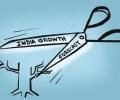
The International Monetary Fund (IMF) on Tuesday lowered India's economic growth projection for the current fiscal to 5.9 per cent from 6.1 per cent earlier. Yet India will continue to be the fastest-growing economy in the world. In its annual World Economic Outlook, IMF also lowered the forecast for 2024-25 fiscal (April 2024 to March 2025) to 6.3 per cent from the 6.8 per cent it had predicted in January this year. The growth rate of 5.9 per cent in the 2023-24 fiscal compares to an estimated 6.8 per cent in the previous year.

The International Monetary Fund (IMF) has said India and China will account for half of the global economic growth in 2023, as the multilateral agency retained its growth forecast for Asia's third-largest economy for 2023-24 (FY24). "India remains a bright spot. Together with China, it will account for half of global growth this year, versus just a tenth for the US and euro area combined," the IMF said in its latest update to the biannual World Economic Outlook. Growth in India is set to decline from 6.8 per cent in 2022 (FY23) to 6.1 per cent in 2023 (FY24) before picking up to 6.8 per cent in 2024 (FY25), the global lender said while citing "resilient domestic demand despite external headwinds".
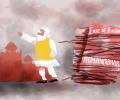
'Limited spillovers' to Asia's third-largest economy, even as world 'perilously close' to recession.

The Indian economy recovered from the Covid-induced downturn during 2022 and is poised for further improvement in the coming quarters though downside risks emanating from geopolitical tensions, strengthening dollar and elevated inflation will continue. The positive trajectory in the growth trend and improved fundamentals will help the nation in neutralising the impact of global headwinds which are expected to have a bearing on the country's exports in the months to come. The challenges before the government and the Reserve Bank in the new year would be to arrest inflation, check declining value of rupee against US dollar and promote private investment and growth, with a view to ensure that the country remains one the fastest growing major economies of the world.

Ahead of the Union Budget for 2023-24, Budget makers have welcomed the global consensus view that India will remain one of the bright spots in calendar year 2023. But there is some alarm over the grim global situation and how that might impact the Centre's projections and assessments for next financial year. The big global headwinds include a deep and sustained recession in the West, including India's biggest trading partners in North America and Europe, continuing volatility in commodity markets, and renewed Covid-19 fears, as lifting of strict curbs by China could potentially lead to a massive spread again.

So, while it is great that India's numbers look relatively good, don't raise a cheer just yet, points out T N Ninan.
The International Monetary Fund (IMF) on Tuesday cut its projection of India's economic growth in 2022 to 6.8 per cent, as it joins other global agencies that have trimmed forecasts. The IMF had in July projected a gross domestic product (GDP) growth of 7.4 per cent for India in the fiscal year that started in April 2022. Even that forecast was lower than 8.2 per cent projected in January this year. India had grown at 8.7 per cent in 2021-22 fiscal (April 2021 to March 2022).

What's different this time is that global financial stress -- which has its genesis in four policy choices made in recent years -- is juxtaposed with a more resilient real economy, observes Sajjid Z Chinoy, chief India economist at J P Morgan.

Perhaps the finance ministry or NITI Aayog could take a detailed look at what governments actually deliver and at what cost; how their services can be improved and expanded where necessary; how much money can be saved through doing things differently; and how many things the government does which it can safely leave to the private sector, argues T N Ninan.

India has been relatively insulated from the severe headwinds in the West. However, with a third of the global economy expected to slip into recession in calendar year 2023, the impact will strongly be felt on India's exports and trade economy, leading economists said in a panel discussion at the Business Standard BFSI Insight Summit in Mumbai on Wednesday. The panel comprised former Reserve Bank of India executive director and former Monetary Policy Committee member Mridul Saggar, State Bank of India Chief Economic Advisor Soumya Kanti Ghosh, Citibank India Chief Economist Samiran Chakraborty, ICRA Chief Economist Aditi Nayar, and IndusInd Bank Chief Economist Gaurav Kapoor. The topic of the panel discussion was No recession in sight: Is India decoupled from developed economies?

The unemployment rate in the 16- nation euro area stood at 10 per cent in July, indicating that the region's labour market continues to remain shaky.

Going by the estimates, 22.899 million men and women in the European Union were unemployed during that month. Out of them, 15.712 million were in the euro area. Between November 2008 and November 2009, the jobless rate for males rose to 9.9 per cent in the euro area.

Signalling that the region's economic recovery is weak, the December quarter figures also come at a time when the euro area is grappling with spiraling debt crisis in Greece. In the third quarter of 2009, euro zone GDP rose 0.4 per cent.

In its latest interim Economic Assessment report released today, OECD said a moderate expansion is under way in most major advanced and emerging economies.

IMF has sharply cut its forecast for world growth this year.
To aid global rebalancing, China needs to re-orient domestic policy to social spending.
Although risks from advanced economies have eased and growth is firming, despite ongoing contraction in the Euro Area, the pick-up in developing countries will be modest because of capacity constraints in several middle income countries.

India's growth is "firming up" while most of the major economies, including China and the US, are seeing stable momentum.

Developing countries need to focus on raising the growth potential of their economies, while strengthening buffers to deal with risks from the euro area and fiscal policy in the US, the Bank said in its latest report Global Economic Prospects, which was released on Tuesday.
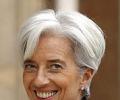
Lagarde said that she had elaborate discussions on the general economic situation.

"Now is the time for countries with room in their budgets to deploy -- or get ready to deploy -- fiscal firepower. In fact, low interest rates may give some policymakers additional money to spend," new IMF chief Kristalina Georgieva said.
The 17-nation euro zone, that share the common currency euro, is reeling under sovereign debt crisis with its epicentre in Greece.

Investors across the globe may find some initial relief in the elections.
Contrary to what was expected earlier this year, the global economy is not out of the woods.
World's richest people have a combined wealth of $25.8 trillion.
Standard & Poor's has placed the sovereign ratings of 15 euro zone nations, including AAA-rated Germany and France, under 'CreditWatch'.
Many in Europe are finding it difficult to survive the harsh economic times.
The unemployment rate in the euro zone has hit the highest since 1995 with the economic crisis forcing many companies to slash jobs.

In India, economic activity slowed substantially in 2019, with the deceleration most pronounced in the manufacturing and agriculture sectors, whereas government-related services sub-sectors received significant support from public spending, the Bank said.

The European Commission has unveiled plans for a radical reform of the European Union's economic governance to tackle the underlying causes of the current debt crisis in the euro area.

Last week's panic in financial markets finally forced European policy-makers into taking decisive action.

Bolstered by strong growth in Germany, the debt-crisis hit euro zone witnessed an economic growth of one per cent in the second quarter of 2010, much stronger than was expected.
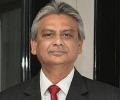
Patra, as executive director of the central bank, was the principal advisor to the Monetary Policy Department since July 2012.

Securities held in custody accounts reached a new high.
 © 2026 Rediff.com - Advertise with us - Disclaimer - Privacy Policy - Sitemap - Feedback - About us - Terms of use - Grievances