
Amidst a sharp run-up in gold and silver prices, investors are advised to rebalance their portfolios by booking partial profits in precious metals and reallocating to domestic equities and debt, according to financial experts.
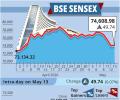
Indian benchmark equity indices, Sensex and Nifty, closed marginally higher, breaking a four-day losing streak, despite elevated crude oil prices and ongoing geopolitical uncertainties. The market saw a temporary pause in panic selling, though cautious sentiment persists.

Net investments into equity mutual fund schemes in India remained elevated at approximately 38,440 crore in April, despite a slight dip from March's high and a 3% month-on-month decline in Systematic Investment Plan (SIP) inflows.

JPMorgan has downgraded Indian equities to 'neutral' from 'overweight', citing elevated valuations, rising earnings risks, and limited exposure to next-generation technology like AI. The brokerage believes other emerging markets offer more attractive risk/reward propositions despite India's strong structural growth story.
Equity-oriented mutual fund schemes in India experienced a 5 per cent decline in net inflows in April, reaching Rs 38,440 crore, while monthly Systematic Investment Plan (SIP) contributions also saw a decrease.

Indian equity markets, including the Sensex and Nifty, experienced a significant downturn for the second consecutive day, driven by escalating geopolitical tensions in West Asia and persistent foreign fund outflows.

Foreign Portfolio Investors (FPIs) have withdrawn Rs 27,048 crore from Indian equities so far in May, bringing the total outflows for 2026 to Rs 2.2 lakh crore, driven by global macroeconomic and geopolitical uncertainties.

Preferential equity listings in India reached an unprecedented 1,307 in FY26, marking a 33% increase from the previous year and reflecting a strategic choice for companies during market volatility.

Indian benchmark indices, Sensex and Nifty, ended lower in choppy trade, with the Sensex declining 114 points, as investors reacted to unabated foreign fund outflows and rising geopolitical uncertainties.

'In India's case, an extended earnings slowdown accompanied by rich valuations have dimmed returns since late 2024.'

Indian equity benchmarks Sensex and Nifty surged nearly 1 per cent, driven by strong earnings reports from FMCG and auto sectors, alongside a rally in Asian markets and signs of de-escalation in geopolitical tensions.

Indian equities are experiencing their sharpest rebound in years, with the BSE 500 index rallying 12.1 per cent so far this month, echoing Covid-era recoveries despite ongoing geopolitical uncertainty and earnings risks.

The Indian rupee gained 2 paise to settle at 93.33 against the US dollar, driven by positive sentiment in domestic equity markets and renewed hopes for US-Iran talks, despite rising WPI and CPI inflation.

Indian stock markets extended their gains for a third consecutive day, with the Sensex climbing 753 points and the Nifty closing above 24,550, driven by a drop in crude oil prices and optimism surrounding potential peace talks between Iran and the US.
Fixed deposits from nationalised banks delivered higher returns than equities, outperforming both inflation and stock market benchmarks.

Trent reported a 20 per cent revenue rebound in Q4FY26, driven by a recovery in like-for-like growth and significant store additions. The company's board has approved raising up to 2,500 crore in equity to fund investments in store network upgrades, new brands, supply chain automation, and Star Bazaar expansion, alongside a 1:2 bonus issue and a 6 dividend.
Indian benchmark stock indices Sensex and Nifty rebounded nearly 1 per cent, snapping a three-day decline, driven by rallies in Reliance Industries and Sun Pharma, alongside positive global market trends and easing geopolitical tensions.
Indian equity benchmark indices Sensex and Nifty rallied in early trade, driven by reports of a second round of talks between the US and Iran, which are fostering hopes for a resolution to the West Asia conflict, coupled with Brent crude oil prices trading below the USD 100 per barrel mark.

Foreign investors have aggressively sold off Indian equities, withdrawing over 48,213 crore in the first 10 days of April, following a record 1.17 lakh crore outflow in March, driven by escalating geopolitical tensions in West Asia, rising crude oil prices, and global inflation concerns.
Foreign Portfolio Investors (FPIs) have withdrawn Rs 19,837 crore from Indian equities in the first two trading sessions of April, extending a significant selling trend from March, driven by geopolitical uncertainty, rising crude oil prices, and a depreciating rupee.

'In my entire career, whenever friends, relatives, or associates have sought my counsel, I have told them consistently: Stay away from equities. Buy gold. Place funds in fixed deposits. Acquire some raw land.' 'That is all one genuinely needs to build meaningful, enduring wealth, without the attendant anxiety of equity market participation.'

Net inflows into equity mutual fund schemes moderated in FY26, falling by 27 per cent to about 3 trillion till February, as choppy markets and global uncertainties prompted investors to shift towards safer options like hybrid funds and gold ETFs.

Indian insurance companies are bracing for reduced profitability in Q4FY26, primarily due to the rationalisation of GST on retail life and health policies, leading to a loss of input tax credit, coupled with volatility in equity markets impacting investment income.

India has emerged as the most impacted market within emerging economies, experiencing $3.7 billion in outflows over the past three weeks, matching the total outflows from the entire emerging market basket, as global equity funds turn negative for the first time since January 2026 due to escalating geopolitical tensions.

Indian equities trading activity saw a moderation in FY26, with cash market turnover declining and derivatives growth remaining subdued due to regulatory tightening and weak market performance. Further impacts are expected from new RBI norms and a hike in Securities Transaction Tax (STT).

Indian benchmark equity indices, Sensex and Nifty, saw a rebound in early trade, driven by a rally in global markets and easing Brent crude oil prices, with hopes of US-Iran peace negotiations also contributing to investor optimism. Track Sensex, Nifty on May 22

Indian equity benchmark indices, Sensex and Nifty, ended marginally lower in a volatile trading session, surrendering early gains due to profit-taking in blue-chip stocks and persistent macroeconomic concerns, despite positive global cues.
Indian benchmark equity indices, Sensex and Nifty, opened higher, tracking positive global trends and easing crude oil prices, fueled by hopes of a swift resolution to the West Asia conflict. Track Nifty 50 and BSE Sensex performance and key global triggers.

The Competition Commission of India (CCI) has approved the acquisition of a stake in AI acceleration cloud provider Neysa Networks by Blackstone-backed private equity funds and other investors, following Neysa's announcement of a USD 1.2 billion capital raise.

Indian benchmark equity indices, Sensex and Nifty, rebounded on Wednesday, recovering intraday losses, primarily driven by strong fag-end buying and a significant rally in blue-chip Reliance Industries.

Indian benchmark equity indices, the BSE Sensex and NSE Nifty, experienced a significant drop in early trade due to elevated oil prices, weak global market trends, and renewed fears of military operations in the Middle East following US President Donald Trump's statements regarding Iran. Track Sensex, Nifty on May 20.

Life Insurance Corporation of India (LIC) announced a significant 23 per cent increase in its net profit for the March quarter, reaching Rs 23,420 crore, alongside a rise in total income and premium collections.
Indian benchmark equity indices, Sensex and Nifty, saw gains in early trade, driven by strong performance in banking shares and positive sentiment from Asian markets, alongside optimism surrounding the ongoing US-China Summit.

Investors can begin investing in mutual funds with as little as Rs 100.

Hybrid mutual fund schemes attracted significant inflows of Rs 1.55 lakh crore in FY26, a 29 per cent increase, as investors increasingly opted for diversified investment strategies to navigate volatile market conditions and geopolitical tensions.

India's gross savings rate is projected to be nearly 47 basis points higher in FY25 than previously estimated, following the Securities and Exchange Board of India's (Sebi) revision of the methodology for calculating household savings routed through the securities market.

Union Health Minister J P Nadda has emphasised the need for sound regulation, ethical oversight, and equity in the application of Artificial Intelligence (AI) to healthcare, speaking at the World Health Assembly in Geneva.

Indian benchmark indices, Sensex and Nifty, closed marginally higher after a volatile trading session, driven by value buying in IT and select blue-chip counters, despite global crude price hikes and a weak rupee.

Indian equity benchmark indices experienced a significant drop in early trade, with the BSE Sensex falling over 525 points and the NSE Nifty down more than 164 points, primarily due to rising crude oil prices and ongoing uncertainty surrounding the US-Iran conflict.
Sensex gains over 400 points while Nifty trades above 23,800 amid strong IT sector buying.
 © 2026 Rediff.com - Advertise with us - Disclaimer - Privacy Policy - Sitemap - Feedback - About us - Terms of use - Grievances