
The Reserve Bank may raise key policy rates by up to 50 basis points in its July 27 monetary policy review to check double-digit inflation, said a member of the Prime Minister's Economic Advisory Council.

Higher economic growth can be sustained only in an atmosphere of reasonable price stability
Earlier the council's outlook was 7-7.5 per cent for the year. Even the revised forecast is yet quite optimistic compared to other agencies.
PM's economic advisors have suggested a hike in petrol and diesel prices to tackle the global crude prices.
Unctad's GDP projection is broadly in line with forecasts by Indian agencies like the Reserve Bank of India and the Prime Minister's Economic Advisory Council, which have projected a growth rate of 7.9 per cent and 7.7 per cent respectively in 2008-09, as against 9 per cent recorded in 2007-08. Finance Minister P Chidambaram expects the Indian economy to expand by more than 8 per cent this year.
Duvvuri Subbarao on Monday joined as secretary, department of economic affairs, Ministry of Finance. He belongs to the 1972 batch of the Indian Administrative Service (Andhra Pradesh cadre).

Prime Minister's Economic Advisory Council Chairman C Rangarajan dashes bullion firms' duty cut hopes.
Chidambaram to meet ministries' financial advisors, PM's economic council.
The govt. has set up a panel to review the investments and savings in the Indian economy. The panel will review financial savings and suggest improvements.
The Prime Minister's Economic Advisory Council on Friday cut its growth forecast for the current fiscal to 7.1 per cent, lower than the previous projection of 7.7 per cent, due to "painful adjustments" to the ongoing global economic turmoil. India's economy had grown 9 per cent in 2007-08.
Even in the coming fiscal, the growth is likely to be in the range of 7 to 7.5 per cent, the PM's panel said, adding that inflation will moderate to four per cent by February-end. The gross domestic product growth was 9 per cent in 2007-08 and inflation has already declined to below six per cent in January from the peak of 12.91 per cent in August 2008.
Various government agencies have predicted that the economy would grow at 7 per cent or above while the Prime Minister's Economic Advisory Council is expected to review the economic growth forecast of 8 per cent. The mid-year review of the economy tabled in Parliament on Tuesday said that the country should be prepared for a growth rate of around 7 per cent in 2008-09.
Petroleum ministry rejects conclusions of two reports ahead of EGoM.
India lags behind many nations in managing exchange rates, including China and Singapore.
The Prime Minister's Economic Advisory Council on Wednesday favoured more income tax sops as also a revision in indirect tax rates on consumer durables in Budget 2008-09 to fire up the economy.
The Prime Minister's Economic Advisory Council warned of serious fiscal risks from growing off-Budget liabilities, which are estimated at 5 per cent of gross domestic product in 2008-09. This would be much more the budgeted central government deficit of 2.5 per cent of GDP for the year.
"For some more time inflation can increase. It could touch 13 per cent, but by December it will start declining and is likely to moderate to 8-9 per cent by March 2009," said outgoing chairman of the PMEAC C Rangarajan while releasing the Economic Outlook for 2008-09.
In 2007-08, the farm sector growth stood at 4.5 per cent, while it was 3.8 per cent and 5.9 per cent in 2006-07 and 2005-06, respectively. The report, which was released on Wednesday by outgoing council Chairman C Rangarajan, said the lower growth projection is in part due to the base effect of very high growth in 2007-08 and the weak South-West monsoon over peninsular, central and western India in July.
The prime minister's economic advisory council has lowered India's GDP growth projection to 7.7 per cent during 2008-09 as against 9 per cent in the last fiscal.
The Prime Minister's Economic Advisory Council will on Wednesday release the outlook for the Indian economy for the current fiscal and is likely to scale down growth projection from earlier 8.5 per cent to 7.5-8 per cent.
Inflation can drop below 8 per cent if confluence of factors like fall in global crude oil followed by a good monsoon work, Prime Minister's Economic Advisory Council chairman C Rangarajan said.
C Rangarajan, chairman of the economic advisory council to the prime minister, has called for revisiting subsidies, dividend distribution tax and tax exemptions.
The paper projects that there will be zero unemployment in 2009 if the economy grows at 9.1 per cent and the labour force continues to grow at 2.93 per cent.
The Prime Minister's Economic Advisory Council Chairman C Rangarajan has said the hike in interest rates will not impact the high economic growth in the face of strong fundamentals.
A group of ministers, constituted to look into pricing and utilization of natural gas produced from new fields like the KG-D6 of Reliance Industries, is likely to hold its first meeting on August 27.
Pointing out that inflation rate is a little beyond comfort zone, the Prime Minister's Economic Advisory Council said the current situation is not favourable for a cut in interest rates. The inflation rate stood at 5.11 per cent for the week ended March 1. For the second week in a row that the rate was over 5%. The RBI aims to limit average rate of inflation for the current fiscal at 5 per cent. When the inflation rate is rising, it is always critical to bring down the rates.
This year's projected increase in per capita (in dollar terms) is nearly double the average 13 per cent growth between 2003-04 and 2006-07.
The panel, headed by former RBI governor C Rangarajan, in its economic outlook for 2007-08 also projected inflation to remain within 4 per cent.
The Prime Minister's Economic Advisory Council has scaled down its growth projection for the Indian economy for 2007-08 to 8.9 per cent from 9 per cent on account of slow expansion in manufacturing and energy generation. Dr C Rangarajan, head of the group of economists released the review of the economy of 2007-08 and said that the economic growth of India would be hovering around 8.5 per cent during 2008-09.

The government has been pressing citizens to pay taxes and be compliant, but they have very little to show regarding improved efficiencies in the companies they themselves own, the fund managers said.
The net FDI for 2006-07 would be around $9 billion, up from $4.7 billion last year, the Prime Minister's Economic Advisory Council said in its update on the country's balance of payments outlook for this fiscal.
"By 2025, world will be a bi-polar society wherein China will be the most influential country and by 2035, India would become the third largest economy, making the world tri-polar," he said.

There are indications or signs of the economy picking up -- collection of GST and consumption of electricity, said former RBI governor, C Rangarajan.
The central government is likely to prescribe a special rate of abatement on the retail prices of drugs for calculation of excise duty.
The Prime Minister's Economic Advisory Council has approved Reliance Industries' 4.33 dollars per mBtu price of gas from KG-D6 fields, saying it was in line with industry practices.
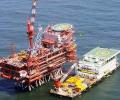
Last month, the government approved the proposal of doubling gas price from RIL's KG basin from $4.2 mmbtu to $8.4 mmbtu from April 1, 2014.
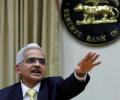
The MPC headed by RBI Governor Shaktikanta Das will announce the resolution of the meeting at around noon on Thursday.
 © 2026 Rediff.com - Advertise with us - Disclaimer - Privacy Policy - Sitemap - Feedback - About us - Terms of use - Grievances