
India is expected to ramp up its purchase of crude oil from the United Arab Emirates (UAE) in the coming months following discussions between the two countries on the sidelines of the ongoing COP28 summit in Dubai, multiple sources in the know said. The UAE has historically been India's third-largest source of crude. It has suffered the largest drop in shipments since Indian refiners began to binge on Russian crude in 2022.

Upstream majors ONGC and Oil India (OIL) results for the January-March quarter (Q4) of FY24 suggest better production in future. But OIL missed its own production targets although it delivered higher volumes and it disappointed the market in terms of Ebitda. ONGC reported standalone Ebitda of Rs 17,400 crore (up 7 per cent year-on-year or Y-o-Y) in Q4FY24, slightly below estimates due to other higher expenses.

The government has brought back the windfall profit tax on domestically produced crude oil after international prices firmed up while the levy on export of diesel has been cut to nil, according to an official order. The levy on crude oil produced by companies such as Oil and Natural Gas Corporation (ONGC) is now Rs 6,400 per tonne with effect from Wednesday, the order dated April 18 said. At the last revision on April 4, windfall tax on domestically produced crude oil was cut to nil as international oil prices dipped below $75 per barrel.

Jaishankar said he was confident that Prime Minister Modi and President Putin will meet for an annual summit next year.

International oil prices continue to be extremely volatile, falling on one day and rising thereafter, a top oil ministry official said explaining the reason behind no reduction in petrol and diesel prices despite softening in input cost, but could not say if the rates will be cut before Maharashtra elections. Global oil benchmark Brent crude futures fell below $70 per barrel last week -- the first time since December 2021 -- but gained thereafter. Brent was trading at $74.58 per barrel on Thursday while West Texas Intermediate advanced to trade at $71.71.

Closely watched by the world for any escalation, the Iran-Israel conflict is already showing early signs of stress for India Inc - longer deliveries, doubling freight rates, extended working capital cycles, and higher costs. For those yet to feel the heat, there is growing apprehension and nervousness over future developments, observed industry executives.

When S Jaishankar became India's external affairs minister in May 2019, he was largely considered a political lightweight despite his undisputed mastery over foreign policy.

The US Fed interest rate decision, domestic inflation data and global trends would be key driving factors in dictating movement in the market this week, as the Lok Sabha elections outcome and the RBI policy decision are behind us, analysts said. The past week was a roller-coaster ride for investors as markets swung sharply in both directions before closing with strong gains.
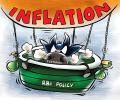
The Reserve Bank of India on Friday retained its projection for retail inflation at 4.5 per cent for the current fiscal assuming a normal monsoon, while emphasising that uncertainties related to food price outlook warrant a close monitoring. Consumer Price Index (CPI)-based retail inflation has been projected at 4.5 per cent with quarter-wise projections at 4.9 per cent in Q1 (April-June), 3.8 per cent in Q2, 4.6 per cent in Q3, and 4.5 per cent in Q4.

Wholesale inflation in the country rose marginally to 0.53 per cent in March compared to 0.20 per cent in the preceding month due to increase in prices of vegetables, potato, onion and crude oil. The Wholesale Price Index (WPI)-based inflation was in the negative zone from April to October and had turned positive in November at 0.26 per cent. The inflation in March 2023 was 1.41 per cent.

Domestic macroeconomic data announcements, global trends and trading activity of foreign investors would guide market sentiments this week, analysts said. After a record rally, markets may face volatile trends this week amid elevated valuations and investors would also keep a track of global oil benchmark Brent crude and rupee-dollar movement for further cues. "Potential volatility in the stock market is anticipated this week. Elevated valuations remain a concern, with investors now focusing on monsoon progress and its impact on the rural economy.

Among the Sensex firms, Tata Motors, Tata Consultancy Services, IndusInd Bank, Power Grid, Bharti Airtel, Sun Pharma, JSW Steel and Tata Steel were the major gainers. On the other hand, Bajaj Finance, State Bank of India, Bajaj Finserv, Axis Bank and NTPC were among the laggards.

The government has cut windfall gains tax on domestically-produced crude oil to nil while continuing the rate at zero on the export of diesel and ATF. The government has slashed the special additional excise duty (SAED) on crude oil produced by companies such as Oil and Natural Gas Corporation (ONGC) to nil from Rs 4,100 per tonne with effect from Tuesday, an official order dated May 15 said. This is the second time that the levy, which was introduced in July last year in the form of a cess to tax supernormal gains of oil producers and fuel exporters, has been cut to nil for domestically-produced oil.

The finance ministry expects a broad-based moderation in inflationary pressures on the back of an anticipated reduction in food prices as a result of the uptick in summer sowing. The retail inflation rate remained stubbornly clung to the 5 per cent mark in seven of the past eight months. "Core inflation is trending downwards, indicating a broad-based moderation in price pressures... Driven by strong domestic growth and benign global commodity prices, core inflation is declining continuously.

Saturday's Quad meeting in Delaware is taking place against the backdrop of China's assertive behaviour in the South China Sea, its sabre-rattling in the Taiwan Strait and increasing footprints in the Pacific and Indian Ocean, asserts Rup Narayan Das.

Experts feel oil prices will remain volatile with an upward bias.

Stocks in the automotive, financial, cement, metal, and hotel sectors are likely to benefit if the Narendra Modi-led Bharatiya Janata Party (BJP) comes back to power for a third time. The key investment themes have been identified after analysing the Sankalp Patra - the party's manifesto for the next five years - released on Sunday.

Production of eight infrastructure sectors expanded at a four-month high of 7.8 per cent in January 2023 on better show by coal, fertiliser, steel and electricity segments, according to official data released on Tuesday.

From its recent lows, the stock of consumer major Marico is up 7 per cent on the back of a better-than-expected June quarter performance and robust outlook. In a pre-quarter update, the management indicated that domestic volume growth should witness an improvement in FY25, while other segments (growth portfolio, international business) too would see traction going ahead. The near-term trigger is strong sales and operating performance for Q1FY25.
Equity markets would take cues from domestic inflation data announcement, global trends and trading activity of foreign investors in a holiday-shortened week ahead, analysts said. Markets would remain closed on Tuesday for 'Diwali Balipratipada'. "As we enter a truncated week with Muhurat trading on Sunday, global cues will play a pivotal role in shaping the market direction.

Movement in the equity market this week will largely be dictated by quarterly earnings of blue-chip firms HDFC Bank and Hindustan Unilever, along with the announcement of WPI inflation data and global trends, analysts said. Trading activity of foreign investors, global oil benchmark Brent crude and rupee-dollar trend would also guide the movement.

Stock markets will be largely driven by global trends and macroeconomic data announcements in a holiday-shortened week which may see volatility amid monthly derivatives expiry, say analysts. Equity markets will remain closed on Monday for Gurunanak Jayanti. Trading activity of foreign investors and the movement of the rupee against the dollar will also be tracked by investors.

Top government officials in New Delhi have started discussions with stakeholders ranging from shipping and container companies to export promotion councils to understand the impact of the Iran-Israel tensions and plan ahead. Inter-ministerial talks are also being lined up amid the crisis situation in West Asia, sources confirmed. While the crude flows are not directly under any threat, elevated oil prices remain a concern, according to officials.

The growth of eight key infrastructure sectors slowed down to a 4-month low of 8.1 per cent in September 2023 against 8.3 per cent a year ago, according to the official data released on Tuesday. The growth rate in the output of refinery products, fertiliser, cement and electricity during the month under review has decelerated, while it was negative in the case of crude oil. The previous low was in May, when the growth rate of these sectors stood at 5.2 per cent.

The Reserve Bank of India (RBI) has identified "climate shocks" as a risk to food inflation rates and overall price rise while stating that the outlook for the country's economic growth remains bright. In its Annual Report for 2023-24, released on Thursday, the central bank said easing supply-chain pressures, broad-based softening in core inflation, and early indications of an above-normal southwest monsoon meant well for the inflation outlook in 2024-25. "The increasing incidence of climate shocks, however, imparts considerable uncertainty to the food inflation and overall inflation outlook," said the RBI while noting headline inflation moderated by 1.3 percentage points on an annual average basis to 5.4 per cent in 2023-24.

From the Sensex basket, Kotak Mahindra Bank, HCL Technologies, ICICI Bank, Infosys, Tata Consultancy Services, Wipro, Tech Mahindra and Larsen & Toubro were the major laggards. Mahindra & Mahindra, Nestle, Tata Motors and IndusInd Bank were among the gainers.

Ukraine and Russia need to engage with each other to find a solution to the ongoing conflict between them, India said on Friday after Prime Minister Narendra Modi held wide-ranging talks with President Volodymyr Zelenskyy in Kyiv under the shadow of the raging war.

Global trends, trading activity of foreign investors and movement of oil benchmark Brent crude would dictate terms in the domestic markets this week, analysts said. Equity markets, which fell nearly 3 per cent last week, may face volatile trends amid the monthly derivatives expiry on Thursday. "This week marks the September month Futures and Options (F&O) expiry, which is expected to bring about volatility in the market," said Santosh Meena, Head of Research, Swastika Investmart Ltd.

Production of eight infrastructure sectors recorded an almost flat growth rate of 6 per cent in February as against 5.9 per cent in the same month last year, according to official data released on Friday. The growth in February is lowest in the last three months. The output of core sectors had increased by 8.9 per cent in January 2023 and 7 per cent in December 2022.

Airline stocks have been soaring following a steep decline in crude oil prices and sustained passenger traffic. Analysts have particularly turned bullish on the stocks of InterGlobe Aviation and SpiceJet. On December 20, shares of InterGlobe Aviation (IndiGo) hit a record high of Rs 3,009 on the BSE, having surged 43.24 per cent year-to-date (YTD).

Global trends, trading activity of foreign investors, outcome of state elections and RBI's interest rate decision are the major factors that will drive the movement in the domestic equity markets this week, analysts said. "Global markets are currently in a fabulous mood. The US 10-year bond yield and the dollar index are also cooling off, which gives strength to the market. These factors will be closely monitored, as they have the potential to influence market sentiment," said Pravesh Gour, senior technical analyst, Swastika Investmart Ltd. On the political front, the results of assembly elections in five states are eagerly anticipated, Gour said.

India's merchandise exports rose by 9.1 per cent to $38.13 billion in May even as the trade deficit widened to a seven-month high of $23.78 billion during the month, according to government data. Healthy growth in sectors, such as engineering, electronics, pharmaceuticals, textiles and plastics helped register growth in exports despite global economic uncertainties.

The Indian economy will grow at around 6.5 per cent in the current fiscal, notwithstanding high crude oil prices and increased uncertainty due climate changes, NITI Aayog member Arvind Virmani said on Thursday. Virmani also asserted that the gross household savings ratio in India has consistently gone up. In an interview with PTI, he said: "My growth projection (of India's GDP growth) is 6.5 per cent plus minus 0.5 per cent... because my experience is that the fluctuations in global GDP more or less has balanced out for us, assuming normal changes."

Quarterly earnings from IT majors Tata Consultancy Services (TCS), Infosys, macroeconomic data announcements, global trends and trading activity of foreign investors would guide the movement in the equity market this week, analysts said. Movement of global oil benchmark Brent crude and the rupee will also influence trading in the markets. "All eyes will be on the beginning of corporate performance for the second quarter of the current fiscal year. TCS is slated to unveil its Q2 results on October 11, with HCL Technologies and Infosys following suit on October 12.

'We expect market consolidation and recommend buying during market dips.'

Geopolitical events, macroeconomic data and quarterly earnings of corporates would guide the stock market in a holiday-shortened week ahead, analysts said. Stock markets will remain closed on Wednesday for Ram Navami. "This week promises to be crucial for the market as fresh worries about a potential conflict between Iran and Israel emerge.

India's merchandise exports in April 2024 marginally rose to $34.99 billion from $34.62 billion in the year-ago month, according to government data released on Wednesday. Imports too increased to $54.09 billion from $49.06 billion in April 2023.

The NSE 50-share Nifty spurted 97.25 points, or 0.92 per cent, to 10,715.50

The growth of eight key infrastructure sectors rose to a 14-month high of 12.1 per cent in August 2023 against 4.2 per cent a year ago, mainly due to expansion in production of coal, crude oil, and natural gas, according to the official data released on Friday. The expansion in August is the highest since June 2022, when it was 13.2 per cent. The production of refinery products, steel, cement and electricity also grew in August, the data showed.

Reliance Industries Ltd, India's most valuable company, on Friday reported a 5 per cent drop in its June quarter net profit as lower fuel cracks and petrochemical margins outdid gains in telecom and retail businesses. The oil-to-retail-to-telecom conglomerate's consolidated net profit was at Rs 15,138 crore, or Rs 22.37 per share, in April-June -- the first quarter of the current 2023-24 fiscal year -- compared to Rs 16,011 crore, or Rs 23.66 a share, earnings a year back, according to a company's statement.
 © 2026 Rediff.com - Advertise with us - Disclaimer - Privacy Policy - Sitemap - Feedback - About us - Terms of use - Grievances