
Key share indices ended over 1 per cent higher on Tuesday led by rate sensitive shares as the sluggish April IIP data re-inforced market expectations that the central bank could cut key policy rates and also lower the cash reserve ratio to boost growth.
Markets extended losses in the last leg of the trade and declined 1% due to selling pressure in financial and mining shares.

Foreign Institutional Investors have pumped in $2.2 billion or Rs 9807 crore in Indian equities in the past eight trading sessions.

Nifty made a gap up opening and moved higher after oil prices eased, relieving concerns of inflation.
Asian markets also ended in the red.
BSE market breadth was negative. Out of 2,954 stocks traded, 1,641 stocks declined while 1,200 stocks advanced.
The Nifty opened in red and remained subdued until the industrial output data for the month of April came in at 6.3%, putting pressure on stocks from capital intensive sectors.

The market breadth was slightly in the negative. Out of the total 2927 total stocks traded on the BSE, 1388 stocks have advanced, while 1402 stocks declined.
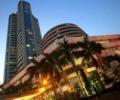
Tata Motors, Maruti Suzuki and Hero MotoCorp among the top Sensex gainers

Market breadth was positive; of 2,896 stocks traded on the BSE today, 1,496 advanced, while 1,275 declined.

The Nifty opened on a firm note and moved between 5,913 and 5,866 as investors awaited TCS and Reliance Industries results.

Nifty advanced 46 points, at 5,833.

Other markets in Asia also ended in higher except Japan which closed flat due to uncertainty over the nuclear plant and economic recovery.
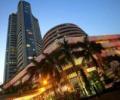

Nifty was very volatile throughout the day swinging between gains and losses.

A preview of the December quarter's company results by three foreign and three Indian broking houses hints at relatively moderate performance. Of the 47 companies that are part of the BSE Sensex & S&P-CNX Nifty, the benchmark indices, the expected net profit growth is 22 per cent.
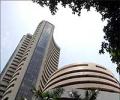
Videocon Industries surged 6.3%, Blue Star rose 6% and Titan Industries rallied 3.5% by close of trade on Friday.

The BSE mid-cap and small-cap indices were down 1% and 1.7% each. Market breadth was negative 2037 stocks which declined for 881 stocks which advanced.

The overall market breadth was negative as 1,989 stocks declined against 882 advancing ones, on the BSE.

The Nifty traded in a narrow band (41 points), the index opened flat at 6,116 and touched a high of 6,120 and a low of 6075.

By trading in index futures, an investor is buying and selling the basket of stocks comprising the index, in their respective weights.
On the last day of Satyam's stint in India's benchmark indices - the Bombay Stock Exchange Sensex and the National Stock Exchange S&P CNX Nifty - its shares turned out to be a punter's delight.

The Nifty traded in a narrow 38 points range, touching an high of 5498 and a low of 5460.

Nifty opened in the red at 5,468 on back of lacklustre cues from Asia and swung between 5408 and 5507.

The managers see Sensex trading at a P/E of 16.

India's premium benchmark equity index, the S&P CNX Nifty, also the fastest growing index on SGX, will be traded for 16 hours on that exchange, compared to the six-and-a-half hours that it traded on the National Stock Exchange in India. The SGX will be traded from 6.30 am to 10.30 pm IST.

The Nifty opened at 5,851 and skidded to a low of 5,736 led by heavy losses in frontline banking and IT shares.


Analysts said that there is some amount of decoupling between India and the rest of world backed by strong growth momentum.

Markets remained muted throughout the day on back of selling pressure in IT and PSU stocks.
Equities registered their sharpest ever and most rapid decline in 2008, reflecting global market conditions and concerns over a slowing domestic economy.
The Nifty Options would add to SGX's suite of Asian equity derivatives, which include SGX S&P CNX Nifty futures, the dominant Indian product for international participants.
The market for Shariah funds is set to grow with Benchmark Mutual Fund launching the first-ever Shariah Benchmark Exchange-traded scheme in India. It's an open-ended listed index scheme.
On the contrary, the fall in the US markets was lower with the S&P 500 and Dow Jones both declining by around 9 per cent and 6 per cent respectively, while emerging markets lost around 18 per cent during the month. Pessimism in the financial markets following the filing for bankruptcy by Lehman Brothers, Merrill Lynch's sell-off, the AIG bailout and perceived uncertainty around the US bailout package added to investor fears.
The 30-share BSE Sensitive index or Sensex slipped below 13,000-mark. At 1450 hrs, Sensex was down 526 points at 12,936. a loss of almost 4 per cent compared to Thutsday's close.
In recent times, 'inflation' has emerged as a buzz word of sorts. Simply put, inflation is a situation wherein too much money chases a limited number of goods. This leads to a fall in the value of money. Inflation is often expressed as a rise in the price level. For example, a product that costs Rs 100 now, would cost Rs 105 a year hence, assuming that prices rise at 5 per cent annually.
Mid cap stocks (and subsequently mid cap funds) have been the worst hit in the recent stock market crash. Investors who added mid cap investments to their portfolios without understanding their true nature are a dismayed lot. Typically, mid caps are presented as an opportunity to make quick money; sadly, investors are rarely made aware of the higher risk involved. While there is no doubt that if identified correctly, mid caps can contribute significantly.
The fund can add value to informed investors who have a view on the infrastructure sector and a flair for high risk investment avenues.
This bloodbath, however, provides investors with yet another opportunity to buy quality stocks at cheap valuations. And many experts buy this argument.
Investors fail to realise the potential of tax-saving investments in contributing towards wealth creation. As a result, it is vital that tax-planning be considered as a part of the investor's overall financial planning and not in isolation.
 © 2026 Rediff.com - Advertise with us - Disclaimer - Privacy Policy - Sitemap - Feedback - About us - Terms of use - Grievances