
C Rangarajan, chairman of the Prime Minister's Economic Advisory Council, on Thursday said he expects the Indian economy to grow by 8.5 per cent in FY'12 on the back of services sector and industry expansion, though he hinted that agriculture might not be a big contributor.

Food inflation rose to 17.47 per cent in the third week of November against 15.58 per cent in the previous week.

The business model of the microfinance sector must change, emphasised C Rangarajan, chairman of the Economic Advisory Council to the Prime Minister, saying that the microfinance movement must have as its ultimate goal the desire to help the poor and enable them to come out of poverty.

The government on June 25 deregulated petrol price and said the same for diesel will be done soon. But with inflation rate continuing to remain at unmanageable levels, the government put-off the decision as any further hike in diesel price would lead to cascading effect.

Interest rates may harden a bit by the end of the current financial year, according to C Rangarajan, chairman of the Prime Minister's Economic Advisory Council.
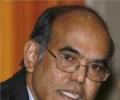
Stating that counter-cyclical measures to combat the impact of the global financial meltdown were important, Subbarao said the government borrowings had gone up 'rapidly and abruptly' hindering transmission of monetary measures to bring about lowering of interest rates.

Regarding the impact of drought on economy, he said, the growth rate could slip to 6-6.5 per cent from 6.7 per cent in the previous fiscal. Stressing that the government should ensure that imported pulses reach the targeted people, Rangarajan said, there is a need to strengthen the public distribution system.
Prime Minister Manmohan Singh sought an end to the cycle of violence in Kashmir while addressing an all-party meet in New Delhi on Tuesday."The key to the problem in Kashmir is a political solution that addresses the alienation and emotional needs of the people," said the PM. The prime minister proposed the setting up of an expert group headed by Dr C Rangarajan with N R Naryanmurthy, Tarun Das and others to formulate a jobs plan for the state.
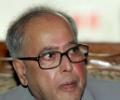
A meeting of a ministerial panel headed by Finance Minister Pranab Mukherjee, to consider raising diesel price by at least Rs 2 a litre, was deferred twice last month and no new date has been notified yet.

The Food Security Act as proposed by the UPA government assures rice/wheat at Rs 3 a kg to BPL families as a matter of legal right.

To rein in prices, the RBI could tweak in policy rates to either suck out money supply or make borrowings costlier.

With major sectors of the economy showing signs of slowdown, the list of those pegging India's economic growth at below eight per cent in the current financial year is expanding.

The RBI governor, D Subbarao had met finance minister Pranab Mukherjee on December 18, fuelling speculation that the monetary policy would be tightened.
With the developed world seeing a fragile recovery from the recession, projected to be a modest 1-2 per cent in the second half of 2009-10, a further financial crisis was not completely ruled out, said C Rangarajan, chairman of the Economic Advisory Council. He said the slow recovery of the developed countries had a negative impact on external demand for both manufactured goods and services from India.

The former Governor of RBI said India would see 'definite signs of recovery' in the second half of 2009-10. On growth forecast, he said this fiscal will see a rate of 6 and 6.5 per cent, but it will be higher next fiscal.

Rangarajan, 77, who will replace Suresh Tendulkar, gave his resignation to Rajya Sabha chairman Hamid Ansari, who has accepted it.

When it comes to running between the wickets -- which is exactly what an FM and a governor do -- Jadeja always defers to Dhoni's larger judgement of the situation and the needs of the team, observes T C A Srinivasa-Raghavan.

The room for political manoeuvre to raise petroleum prices is the highest at this point in time, says Business Standard.
It forecast a growth of 9 per cent for 2011-12.

The Prime Minister's Economic Advisory Council on Friday said the economy will grow by 8.5 per cent, up from a projected 8.2 per cent, and inflation will come down from double digits to 6.5 per cent by the end of 2010-11.

Amid projections that inflation could touch the double-digit mark, the Prime Minister's advisory panel on Thursday said it could fall to 7 per cent by fiscal-end.
The country's new home minister, Palaniappan Chidambaram, today said he prefers a Congressman as his successor in the finance ministry, setting off speculation about the implication of his statement.
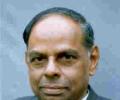
Although the economy did well during the second quarter (July-September) recording a growth of 7.9 per cent, the output of agriculture and allied sector slipped to below 1 per cent.
In an interview with Business Standard's Sapna Dogra Singh and John Samuel Raja D, C Rangarajan says there are some encouraging signs in the economy, but the real recovery will come only in 2010-11.

The gross domestic product grew by 6.1 per cent in the first quarter of 2009-10 and the year may end with 6.5 per cent.
Among possible new members, former chief economic advisor Arvind Virmani's name is doing the rounds.
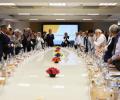
The luncheon at his residence was attended by Planning Commission Deputy Chairman Montek Ahluwalia, Chairman of PM's Economic Advisory Council C Rangarajan, former RBI Governor Bimal Jalan, Foreign Secretary Shiv Shanker Menon and officials of the Prime Minister's Office.

The private demand is still not picking up and the funds under market stabilisation scheme are also maturing.

The Prime Minister's Economic Advisory Council (PMEAC) expects the economy to grow by over 7.2 per cent during the current fiscal and exceed 8 per cent in 2010-11, thanks to increased economic activity.

The Prime Minister's economic panel on Tuesday said it could revise upward the economic growth forecast to 7 per cent from 6.5 per cent for the current fiscal on the back of robust economic growth in the second quarter.
Economist and former Reserve Bank Governor C Rangarajan on Monday said that the economy will recover in the second half of 2009 and there would be distinct improvement in growth in 2010-11.

On an average, PMEAC said economic growth could be around 6.5 per cent.
The committee on financial inclusion, headed by C Rangarajan, the chairman of Prime Minister's Economic Advisory Council, has recommended that the profits transferred to their reserves by such banks should be exempted from tax till the banks achieve the standard capital adequacy ratio (CAR).
The Prime Minister's economic panel on Wednesday said the government needs to draw a programme to rein in the fiscal deficit of over six per cent which is not sustainable.

The Reserve Bank of India has forecast the economy to grow by 6 per cent with an upward bias.
Slower growth in the developed world is expected to impact emerging economies like India by reducing demand for their exports in rich country markets.
Committee of secretaries is working on the formula and it is understood that EAC is also being asked to go through the formula.
PM's economic advisors have suggested a hike in petrol and diesel prices to tackle the global crude prices.
Chidambaram to meet ministries' financial advisors, PM's economic council.
The govt. has set up a panel to review the investments and savings in the Indian economy. The panel will review financial savings and suggest improvements.
