
The India-EU free trade deal could help Indian-made cars enter Europe at lower costs and challenge Chinese dominance.

India and the European Union are set to announce on January 27 the conclusion of negotiations and finalisation of a free trade agreement, which is aimed at boosting economic ties between the two regions amid disruptions in global trade due to US tariffs, an official said.

Automobile exports from India in the first six months of the current fiscal year rose 14 per cent year-on-year, led by gains in shipments of passenger vehicles and two-wheelers. According to Siam data, the overall exports in the April-September period stood at 25,28,248 units, up 14 per cent as compared with 22,11,457 units in the year-ago period. "Key markets like Latin America and Africa, which had slowed down for various reasons, have bounced back.
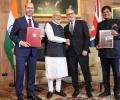
India and the UK on Thursday inked a landmark free trade agreement (FTA) that will cut tariffs on British whisky, cars and an array of items, besides boosting bilateral trade by around $34 billion annually.
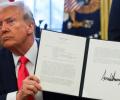
The sweeping tariffs proposed across sectors by US President Donald Trump are scheduled to be imposed starting April 2, with most analysts worried about their impact on companies, and in turn the financial markets. Recently, the US administration signaled that it will impose sectoral tariffs on energy, pharmaceuticals, semiconductors, agriculture, copper, and lumber.

'There is a need for a national task force with a singular objective to increase automotive exports.'

The government on Monday said the country's total vehicle export is likely to increase by up to 15 per cent in the current fiscal, as demand from Europe is expected to rise.

India's gain will be an additional business of $300 million to $400 million per month if 10-11% of Bangladesh's export is diverted to Indian hubs like Tiruppur.

'Bilateral trade has suffered seriously because of the growing unrest.' 'There is a standstill on both sides amid the curfew.'

Automobile exports from India recovered in the first quarter with all vehicle segments, including passenger vehicles and two-wheelers, witnessing growth following an improvement in the pandemic situation across various international markets. As per the latest SIAM data, total vehicle exports during the April-June quarter this fiscal stood at 14,19,430 units as compared with 436,500 units in the same period of 2020-21 which saw massive disruptions due to the COVID lockdowns across the country, hampering sales as well overseas shipments. SIAM director general Rajesh Menon told PTI that while two-wheeler shipments were better than previous three years, passenger vehicles, three-wheelers and commercial vehicles export numbers were yet to catch up with numbers in the first quarter of 2018-19 fiscal.
According to the figures released by the Society of Indian Automobile Manufacturers, total exports from the country stood at 23,39,333 units in last fiscal compared to 18,04,426 units in the year-ago period.

Exports of Made in India vehicles went up by a whopping 56 per cent during the last fiscal as cars, commercial vehicles and two-wheelers continued to charm overseas buyers.
The country's automobile exports went up by a whopping 65.3 per cent in 2002-03 as 'Made-in-India' vehicles, mainly cars and two-wheelers, continued to charm overseas buyers.

Companies such as Tata Motors, Mahindra & Mahindra, TVS Motor Company, Hero Motocorp, Bajaj Auto and Maruti Suzuki, for whom Sri Lanka is a key export destination, are experiencing a significant slowdown in demand following the import duty hikes, which have made their vehicles very expensive in the island nation.
Exports of 'Made-in-India' vehicles have touched Rs 2,928 crore (Rs 29.28 billion) during April-October 2003 after growing by 32.4 per cent in value terms during 2002-03 to Rs 3,396 crore (Rs 33.96 billion).

Nepal's decision to ban the import of non-essential items amid depleting forex reserves may hit Indian exports. The country's central bank - Nepal Rastra Bank - last week instructed commercial banks not to open letters of credit (LCs) for importing non-essential items. This is to prevent further decline of the country's foreign exchange reserves. However, it has not issued any formal communication yet.
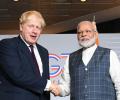
'We don't need to hinge India-UK relations on shared hostility toward China,' observes Ambassador M K Bhadrakumar.
ICRA said on Monday that domestic car sales is likely to grow by eight per cent annually over the next three years to 838,000 units in 2006-07, which will be driven largely by the compact and mid-size segments.

Hyundai has started to build one of two new factories planned for China.

Reflecting the woes of the Indian automobile industry, the country's car exports remained flat at 550,466 units in 2013-14, during which domestic sales fell for the second consecutive year.

Impact of lack of significant investments in the last 4-5 years; inability of private sector to put in fresh capital with availing of loans becoming an issue due to rising NPAs of banks, along with demonetisation were mainly responsible for dampening growth, he said.
So far, India has attracted over $20 billion in the debt segment, thanks to the rate differential.

Make in India right now is just a slogan. The policy content is missing or not clearly articulated. The lion with cogs and wheels must now show some majestic movement forward, says Rahul Khullar.
These automotive companies were afraid of competition and made wrong accusations on grounds of safety.
 © 2026 Rediff.com - Advertise with us - Disclaimer - Privacy Policy - Sitemap - Feedback - About us - Terms of use - Grievances