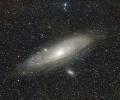
Researchers have detected hints of molecules known to be produced by marine organisms on the exoplanet K2-18 b, providing "the strongest evidence yet" of life outside the Solar System. While the discovery is exciting, more data is needed to confirm whether the molecules are indeed produced by life or through other chemical processes. The exoplanet, over 8.5 times as massive as Earth, lies 120 light-years from Earth and orbits the star 'K2-18'.
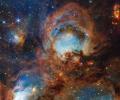
Researchers from the Indian Institute of Astrophysics (IIA) have discovered an unexpectedly high abundance of germanium in the Extreme Helium star A980, challenging existing theories about stellar chemistry and the evolution of rare stars.
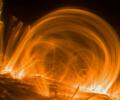
The breakthrough reveals the dazzling world of miniature plasma loops, or tiny loops, which stretch almost as long as the distance between Kashmir and Kanyakumari.The breakthrough reveals the dazzling world of miniature plasma loops, or tiny loops, which stretch almost as long as the distance between Kashmir and Kanyakumari.

Chandrayaan-1 X-ray fluorescence spectrometer detected sodium from its characteristic line in X-rays which opened up the possibility of mapping the amount of sodium on the moon, ISRO said.

Back in 1958, when the 31-year-old Parker suggested that the charged particles streamed continuously from the Sun and fill up the space, the scientific community refused to believe him.

A team of researchers has revealed that the old adage "what goes up must come down" is ringing true for an immense cloud of hydrogen gas that is heading towards our galaxy at nearly 7 lakh miles per hour.
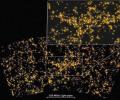
Saraswati spreads across 600 million light years and is four billion light years away from Earth.
This is one of the largest known structures in the neighbourhood of the universe, 4,000 million light-years away from Earth and roughly more than 10 billion years old, IUCAA said.

Brown dwarfs are thought to be the missing link between planets and stars, with masses up to 80 times that of Jupiter.

The National Aeronautics and Space Administration's planet-hunting Kepler spacecraft which is carrying out a new mission has made its first exoplanet discovery -- a 'super-Earth' located 180 light-years from Earth.

The finding may help understand the types of planetary systems that exist beyond our own.

The details of the transition from defined rays in the corona, the Sun's upper atmosphere, to the solar wind have been, until now, a mystery.

The most luminous galaxy in the universe -- a so-called obscured quasar 12.4 billion light-years away -- is so violently turbulent that it may eventually jettison its entire supply of star-forming gas, a new study has found.
