
Researchers at IIT Bombay have discovered that heatwaves in the Indo-Gangetic Plains are primarily caused by local land and weather conditions, rather than hot air originating from elsewhere, emphasising the need for location-specific early warning systems.
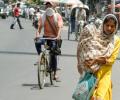
Uttar Pradesh is experiencing an intense heatwave, with Banda recording the highest temperature at 47.6 degrees Celsius. The IMD has issued a 'Red Colour Warning' for severe heatwave conditions. The extreme heat is disrupting daily life and economic activity, prompting government action to prevent heat-related illnesses.
'The intensity and frequency of heatwaves will be much higher than in previous years over Punjab, Haryana, Rajasthan, Gujarat, Madhya Pradesh and Odisha.'

Intense heat swept through east India and parts of the southern peninsular region on Thursday, testing power grids and prompting the Kerala government to order closure of educational institutions till May 6.
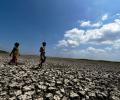
The onset of the southwest monsoon is being keenly watched this year as it may provide an early sign regarding its progress over the Indian subcontinent, particularly when El Nio is expected to rear its head during the latter half of the season.

With temperatures remaining above normal since November, this winter could well be the warmest ever recorded not only in North India, but across the country.

The southwest monsoon might finally start withdrawing from parts of North-West India over the next three days, signaling the end of its four-month journey over the country that started in June, the India Meteorological Department (IMD) said. However, though the retreat might begin from next week, the rains might not descend quickly, as the met department predicted fresh spells of rains in Vidarbha, Chhattisgarh and east MP on September 21-22 and over Odisha, Coastal areas north Andhra Pradesh and Gangetic West Bengal on September 19-21. "Due to anti-cyclonic flows over northwest India at lower tropospheric levels, dry weather is very likely over west Rajasthan, Punjab, Haryana, Chandigarh and Delhi during the next five days. "Hence conditions are becoming favourable for the withdrawal of Southwest Monsoon from parts of northwest India during next three days," the IMD said.

The mercury breached the 46-degree Celsius mark in several places such as Allahabad (46.8 degrees Celsius) and Jhansi (46.2 degrees Celsius) in Uttar Pradesh; Sports Complex (46.4 degrees Celsius) in Delhi; Ganganagar (46.4 degrees Celsius) in Rajasthan; Nowgong (46.2 degrees Celsius) in Madhya Pradesh; and Maharashtra's Chandrapur (46.4 degrees Celsius).

With conditions not favouring its progress, southwest monsoon is expected to hit the Kerala coast by June 4, three days after its normal onset date, the MET department has said.
