
Total pending Customs arrears, including amounts under litigation, court stays and cases where the appeal period has not expired, stood at about Rs 1.36 trillion at the end of December 2024.

The father of a nine-year-old girl who allegedly committed suicide at her school in Jaipur is demanding that the principal and some teachers be charged with abetment of suicide. This follows the CBSE's decision to cancel the school's affiliation due to safety violations.
Goods and Services Tax (GST) collection rose 12.6 per cent Y-o-Y to an all-time high of about Rs 2.37 lakh crore in April, which the government said shows resilience of the Indian economy and the effectiveness of cooperative federalism. The gross GST mop-up was Rs 2.10 lakh crore in April 2024 -- the second highest collection ever since GST was rolled out on July 1, 2017. The net mop-up was Rs 1.92 lakh crore.
Gross GST collection in March grew 9.9 per cent to over Rs 1.96 lakh crore, government data showed on Tuesday.

Gross GST revenue rose 12.3 per cent to Rs 1.96 lakh crore in January on higher domestic economic activity, government data showed on Saturday. This includes 10.4 per cent growth in revenue from sale of goods and services domestically at Rs 1.47 lakh crore and 19.8 per cent rise in tax revenue from imported goods at Rs 48,382 crore.

The 31st meeting of the Goods and Services Tax (GST) Council, held in December 2018, deferred a decision to reduce the GST rate for cement from 28 per cent to 18 per cent. This was despite recognising that cement - along with automobile parts - remained among the few mass-consumption items still taxed at the highest slab, which was originally meant for luxury and sin goods.
Gross GST collections rose by 9.1 per cent to about Rs 1.84 lakh crore in February, boosted by domestic consumption and indicating potential economic revival. As per the official data released on Saturday, on a gross basis, mop up from Central GST stood at Rs 35,204 crore, State GST at Rs 43,704 crore, Integrated GST at Rs 90,870 crore and compensation cess of Rs 13,868 crore.
The gross GST collection rose 7.3 per cent year-on-year to Rs 1.77 lakh crore in December. The Central GST collection stood at Rs 32,836 crore, State GST at Rs 40,499 crore, Integrated IGST at Rs 47,783 crore and Cess at Rs 11,471 crore, according to government data released on Wednesday.
Gross GST collection grew 9 per cent to over Rs 1.87 lakh crore in October on higher revenues from domestic transactions. The Central GST collection stood at Rs 33,821 crore, State GST at Rs 41,864 crore, Integrated IGST at Rs 99,111 crore and cess at Rs 12,550 crore.
Gross GST collections in August grew 10 per cent to about Rs 1.75 lakh crore, reflecting higher domestic consumption. As per the government data released on Sunday, gross GST revenues from domestic transactions grew 9.2 per cent to about Rs 1.25 lakh crore. Revenues from import of goods were up 12.1 per cent to Rs 49,976 crore.
GST collections in July rose 10.3 per cent to over Rs 1.82 lakh crore, mainly driven by domestic transactions in goods and services, according to official data released on Thursday. This is the third-highest-ever monthly collection recorded since the indirect tax regime was rolled out 7 years ago on July 1, 2017. According to the data, total refunds stood at Rs 16,283 crore in July.
In a relief for foreign firms giving loans to Indian subsidiaries, tax authorities have said goods and services tax (GST) will not be imposed on them, subject to some caveats. Additional fees, commissions, or related payments - over and above the amount charged as interest - on these loans will attract GST at 18 per cent, the Central Board of Indirect Taxes and Customs (CBIC) has said.
The Goods and Services Tax (GST) Council, scheduled to meet on June 22, could take a call on ending uncertainty on taxing foreign airlines and shippers as regards certain services, a senior official in the know told Business Standard. He said the Council was expected to decide on exempting the services in question from GST - aircraft lease rentals, maintenance, crew salaries, etc. These services are provided by foreign airlines to their Indian operations.

The fitment committee under the Goods and Services Tax (GST) Council, comprising central and state officials, has begun a rate rationalisation exercise afresh, checking the possibility of dropping some of the rates, particularly the 12 per cent slab, to achieve a revenue-neutral structure, a senior official with direct knowledge of the matter

The Central Board of Indirect Taxes and Customs (CBIC) has stepped up its watch on the import of unbranded gold jewellery amid a spurt in seizures on international borders and from importers. During FY24, the CBIC and Directorate of Revenue Intelligence (DRI) jointly seized about 5 tonnes of gold, 30 per cent more than what they did in FY23. In FY23, 3.5 tonnes of gold was confiscated.
Goods and Services Tax collections jumped 10.4 per cent to over Rs 1.72 lakh crore in January, reflecting buoyant economic activity and setting the stage for the next phase of GST reforms. This is the second-highest monthly collection ever and marks the third month in this financial year with a collection of Rs 1.70 lakh crore or more, a finance ministry statement said on Wednesday.

In a remarkable comeback, foreign portfolio investors (FPIs) have pumped Rs 1.7 lakh crore into the Indian equity markets in 2023, propelled by confidence in the country's robust economic fundamentals amid a challenging global landscape. The year 2023 has witnessed massive investment by FPIs, thanks to the sharp uptick in inflows of Rs 66,134 crore in December. Going forward, FPI flows are expected to be robust.

It's mid-morning and the two-kilometre stretch from Rashbehari Avenue to Gariahat Market is bustling with activity. Dotted with saree shops and hawker stalls that sell everything, from hairpins, hangers and towels to hosiery, mobile phone covers and kurtas, this is one of South Kolkata's busiest shopping areas. And it is beginning to wake up to the Paytm crisis.
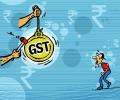
Over 100,000 small and medium-sized businesses are non-compliant with e-invoicing norms under the goods and services tax (GST) regime, a mandatory requirement for businesses with an annual turnover of over Rs 5 crore. E-invoicing provides real-time access to invoices that are prepared by the supplier on the purchase of goods, allowing faster accessibility to input tax credit, thereby limiting the manipulation of fake credit as it has to be generated before the transaction. "The default has been reported mainly in businesses with a turnover between Rs 5 crore and Rs 20 crore," a senior official informed
GST collection rose 11 per cent to over Rs 1.65 lakh crore in July as a result of anti-evasion measures and higher consumer spending. This is the fifth time since the rollout of the Goods and Services Tax (GST) regime that monthly collections have crossed the Rs 1.60 lakh crore mark -- making it the new normal. "Gross GST revenue collected in July is Rs 1,65,105 crore of which CGST is Rs 29,773 crore, SGST is Rs 37,623 crore, IGST is Rs 85,930 crore (including Rs 41,239 crore collected on import of goods) and cess is Rs 11,779 crore (including Rs 840 crore collected on import of goods)," the finance ministry said in a statement.

The government on Friday said GST will not be applicable on residential units if they are rented out to private persons for personal use. The government dismissed media reports which claimed that there is an 18 per cent Goods and Services Tax (GST) on house rent paid by tenants. In a tweet, the government said GST would be levied only when the residential unit is rented out to a business entity.

The GST revenues for August 2023 have shown a growth of 11 per cent year on year due to increased compliance and less evasion, Revenue secretary Sanjay Malhotra said on Friday. The collection from Goods and Services Tax (GST) was Rs 1,43,612 crore in August 2022. "Roughly numbers are in the range of 11 per cent year on year growth as in earlier months," Malhotra told reporters.
GST taxpayers will be required to reverse by November 30 the input tax credit (ITC) claimed in the last fiscal in case their suppliers fail to deposit the due tax by September 30, the finance ministry has said. The taxpayers, however, can reclaim the ITC later following the deposit of taxes by the supplier. The ministry has inserted Rule 37A in Central Goods and Services Tax rules to give effect to the new provision.

Rediff.com Contributing Photographer Pradeep Bandekar glimpsed these stars over the weekend.
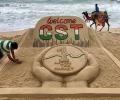
GST collections in March grew 13 per cent to the second highest ever at Rs 1.60 lakh crore, taking the growth rate of revenue mop-up for full 2022-23 fiscal to 22 per cent. March also saw over 91 per cent of the GST registered businesses filing returns and paying taxes - reflecting greater compliance and improving economic activity. Gross GST revenue collected in March 2023 is Rs 1,60,122 crore, of which Central GST is Rs 29,546 crore, State GST is Rs 37,314 crore, Integrated GST is Rs 82,907 crore (including Rs 42,503 crore collected on import of goods) and cess is Rs 10,355 crore, the finance ministry said in a statement.
The collections from Goods and Services Tax (GST) grew by 15 per cent to over Rs 1.49 lakh crore in December 2022, indicating improved manufacturing output and consumption demand, besides better compliance. This is the 10th month in a row that the revenues have remained above the Rs 1.4 lakh crore mark. The collection in November was about Rs 1.46 lakh crore. "The gross GST revenue collected during December 2022 is Rs 1,49,507 crore, of which CGST is Rs 26,711 crore, SGST is Rs 33,357 crore, IGST is Rs 78,434 crore (including Rs 40,263 crore collected on import of goods) and cess is Rs 11,005 crore (including Rs 850 crore collected on import of goods)," the ministry said in a statement.
Six years after the rollout of the biggest indirect tax reform in India, Goods and Services Tax (GST) revenue of Rs 1.5 lakh crore every month has become a new normal and tax officers are focusing on dealing with fraudsters who are adopting newer modus operandi to game the system, causing loss to the exchequer. To apprehend black sheep, who operate as syndicates and create fake entities on the basis of forged documents to claim input tax credit (ITC), tax officers have started using data analytics, artifical intelligence and machine learning aiming to curb evasion, which was over Rs 3 lakh crore since inception of GST. It was over Rs 1 lakh crore in 2022-23. Thinktank Global Trade Research Initiative (GTRI) said the most critical pending GST reform is upgradation of GST Network to prevent fake supplies and fraudulent claims of Input Tax Credit (ITC).

Packed frozen 'paratha' is not 'roti or chapatti' as it requires further cooking before consumption and despite wheat flour being the 'common thread' there are other ingredients used in making parathas, said an order by the Gujarat Appellate Authority for Advance Ruling. Such parathas, whether named Malabar, Mixed vegetable, Onion, Methi, Alu, Laccha, Mooli or Plain, have ingredients like margarine, salt, emulsifying agent, oil, potato, peas, cauliflower, coriander powder, bread improver and water, apart from wheat flour, which make 'quite different' from plain roti or chapatti and hence are not eligible for 5 per cent Goods and Services Tax (GST) rate, the ruling said. The percentage of wheat flour used by Vadilal Industries, which had approached the AAAR, in the eight varieties of paratha manufactured and supplied by it ranges from 36-62 per cent, whereas the ingredient for plain roti or chapatti is wheat flour apart from water.

GST officers can now launch prosecution against offenders in cases where the amount of evasion or misuse of input tax credit is more than Rs 5 crore, the finance ministry has said. However, this monetary threshold will not be applicable in the case of habitual evaders or in cases where arrests have been made at the time of investigation. "One of the important considerations for deciding whether prosecution should be launched is the availability of adequate evidence," the GST investigation wing under the finance ministry said, while issuing instructions for launching prosecution.
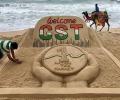
Businesses with monthly turnover of over Rs 50 lakh will have to mandatorily pay at least 1 per cent of their GST liability in cash, the finance ministry said as it moved to curb evasion by fake invoicing. The Central Board of Indirect Taxes and Customs (CBIC) has introduced Rule 86B in Goods and Services Tax (GST) rules which restricts use of input tax credit (ITC) for discharging GST liability to 99 per cent. "... The registered person shall not use the amount available in electronic credit ledger to discharge his liability towards output tax in excess of 99 per cent of tax liability, in cases where the value of taxable supply ... in a month exceeds Rs 50 lakh," the CBIC said.

The government has notified a host of procedural changes in the GST rules, including levy of interest for wrongful utilisation of ITC and turnover threshold for filing annual returns for the 2021-22 fiscal. The changes were vetted by the Goods and Services Tax (GST) Council at its meeting last week. With the amendments notified by the Central Board of Indirect Taxes and Customs (CBIC), businesses have also been allowed to make tax payments on the GSTN portal by using IMPS and UPI payment modes.

A 5 per cent GST rate kicked in on Monday on pre-packed and labelled food items such as cereals, pulses and flour weighing less than 25 kg.

With this, India joins 60 other countries that collect PNR details of international passengers.
The government has extended the deadline for filing GST annual return and audit report for the 2018-19 fiscal year by a month, till October 31.
Businesses that have not filed GSTR-3B returns in the preceding two months will not be able to file details of outward supplies in GSTR-1 from September 1, GSTN has said. While businesses file GSTR-1 of a particular month by the 11th day of the subsequent month, GSTR-3B, through which businesses pay taxes, is filed in a staggered manner between 20th-24th day of the succeeding month. In an advisory to taxpayers, GSTN, which manages the technology backbone for Goods and Services Tax, said that Rule-59(6) of Central GST Rules which provides for restriction in filing of GSTR-1, will come into effect from September 1, 2021.

Provisions in the Central GST Act say reduction in GST rates or the benefit of ITC must be passed on to consumers.

The government has notified mandatory requirement of e-invoicing for B2B transactions for businesses with a turnover over Rs 100 crore with effect from January 1, 2021. Under Goods and Services Tax (GST) law, e-invoicing for business-to-business (B2B) transactions is mandatory for companies with turnover of over Rs 500 crore from October 1. In a notification, the Central Board of Indirect Taxes and Customs (CBIC) said e-invoicing will be extended to businesses with a turnover over Rs 100 crore from January 1.
The controversy over the goods and services tax (GST) rate on food products refuses to die. Now, the Gujarat-based authority of advance rulings (AAR) has ruled that 'parathas' would attract 18 per cent GST. The applicant, Vadilal Industries, sought to know whether various kinds of 'parathas' supplied by them would attract five per cent GST in line with 'khakhra', plain chapati or 'roti'.

The government has reduced the tariff value for import of edible oil, including palm oil, by up to $112 per tonne, a move which experts said can lead to lower domestic prices. The Central Board of Indirect Taxes and Customs (CBIC), through a notification, has cut the tariff import value of crude palm oil by $86 per tonne, and of RBD and crude palmolein by $112 per tonne each. It also reduced the base import price of crude soyabean oil by $37 per tonne. The changes in tariff value of edible oil are effective from Thursday (June 17).

Supplying food to schools under mid-day meal scheme, pre-schools and anganwadis is exempt from GST, the Central Board of Indirect Taxes and Customs (CBIC) has said. Issuing a set of clarification on certain decisions taken by the GST Council in its 43rd meeting on May 28, the CBIC said it had received representations regarding applicability of GST on the issues as to whether serving of food in schools under mid-day meals scheme would be exempt if such supplies are funded by government grants and/or corporate donations. Under the goods and services tax (GST), any catering service, including mid-day meals, provided to an educational institution is exempt from the levy.
 © 2026 Rediff.com - Investor Information - Advertise with us - Disclaimer - Privacy Policy - Sitemap - Feedback - About us - Terms of use - Grievances