
Mercedes-Benz India is aiming to post double-digit growth in sales volume during 2024 as it plans to launch over 12 car models during the year, says its managing director and CEO Santosh Iyer. The German carmaker, which leads the luxury car market in the country, recorded 10 per cent year-on-year (Y-o-Y) growth to 17,408 units in 2023. "For 2023, we always said that the growth would be in double digits.

The S&P BSE Realty Index has emerged as one of the top-performing sectors, yielding a remarkable 45 per cent return over the past six months. The three leading players, listed by market capitalisation, have substantially enriched investor wealth by 43-70 per cent during this period. If the second quarter (Q2) of 2023-24 (FY24) updates from Macrotech Developers (Lodha) and Sobha, along with industry data for the quarter, serve as any indication, the trend of strong bookings for larger players is expected to continue.

Combined profit before tax of 81 firms down 37.5% y-o-y, worst show in at least 3 years.

Dabur India has been the worst performer in the fast-moving consumer goods (FMCG) space this year (CY23), posting a 1 per cent decline even as its peer index, the Nifty FMCG, has delivered returns of over 29 per cent in this period.
Airline stocks have been soaring following a steep decline in crude oil prices and sustained passenger traffic. Analysts have particularly turned bullish on the stocks of InterGlobe Aviation and SpiceJet. On December 20, shares of InterGlobe Aviation (IndiGo) hit a record high of Rs 3,009 on the BSE, having surged 43.24 per cent year-to-date (YTD).

The sector may be overcrowded with a fair number of large players and the entry of the Adani Group through its two key acquisitions, followed by the takeover of majority stake in Sanghi Industries via Ambuja Cements. Since every major player is in expansion mode, there could be a capacity surplus and hence, price wars.

'Health and motor insurance will continue to be our two most important segments'

https://www.rediff.com/business/report/quality-control-orders-what-does-this-mean-for-domestic-industry/20240425.htm

IT company Wipro on Friday posted a 4 per cent rise in consolidated profit at Rs 3,092.5 crore in the fourth quarter ended March 2022. The company had registered a profit of Rs 2,974.1 crore in the same period a year ago. "We have had an outstanding year, finishing with USD 10.4 billion in revenues, and an industry-leading growth of 27 per cent Year-on-Year (Y-o-Y).

Shares of Bajaj Finance surged over 6 per cent on Thursday after the diversified non-banking finance company reported an 18 per cent increase in consolidated net profit to Rs 4,308 crore for the December quarter. The stock rallied 6.33 per cent intraday to touch Rs 8,249.95 - a 52-week high -- on the BSE.

The battle for the top spot in the two-wheeler market is intensifying. The gap between Hero MotoCorp and Honda Motorcycle & Scooter India (HMSI) in retail sales narrowed to just 45,607 units in June. This improvement comes as HMSI has clawed back market share after dipping to a historic low of 18 per cent in May 2023. Now, the retail market shares of the two companies are 28.86 per cent and 25.54 per cent, respectively, compared to 35.54 per cent and 18.05 per cent in May 2023.

Earnings growth trajectory for India's capital goods firms is likely to stay buoyant for the December 2023-ended quarter (Q3 FY24), said analysts. Guidance on margins, ordering activity in an election year and export-related demand would be key monitorables. Brokerages - Motilal Oswal, Nuvama, Kotak Institutional Equities and Prabhudas Lilladher - estimated revenue growth for their capital goods universe to be 11-16 per cent year-on-year (Y-o-Y).
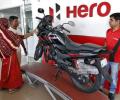
Hero MotoCorp, a major player in the two-wheeler market, has seen a 9 per cent rise in its stock since the beginning of the month. This increase, driven by the largest motorcycle company by volume, is attributed to expectations of a revival in rural sales due to normal monsoons, government measures to boost consumption, recent market share gains, and a large valuation discount compared to peers. In the near term, the company's volume performance and growth trajectory, particularly in rural markets and entry-level segments, are expected to be key drivers.

Credit-to-deposit (CD) ratio of major public sector and private sector banks during the October-December quarter of FY24 inched up as compared to the previous quarter though government-owned lenders reported a lower rate than their private peers. CD ratio is the ratio of the funds that banks lend as compared to the funds raised in the form of deposits. The CD ratio of top public sector banks (PSBs) - State Bank of India, Punjab National Bank, Bank of Baroda and Canara Bank - was lower than their private counterparts.

Shipment of 5G smartphones in the country continues to gain traction and such devices accounted for 22 per cent market share in the third quarter of 2021, according to CMR. As per CMR's India Mobile Handset Market Review Report for Q3 2021, more than 20 5G-capable smartphones were launched over the course of the quarter.

Government announcements for the building of new roads, railways, and other capital expenditure (capex) projects may have hit an all-time low, according to numbers for the December quarter.

The market could not make a clear assessment of Tech Mahindra with the stock swinging wildly in the last two sessions. The results on Thursday were expected to be weak but the stock dropped slightly. However, investors reviewed the three-year turnaround plan and decided the stock had been oversold and the price recovered 7.5 per cent.

The combined market capitalisation of Adani Group companies fell by Rs 54,876 crore, to Rs 10.92 trillion, as investor sentiment turned bearish on Wednesday. Shares of Adani Transmission fell by 7.7 per cent to close at Rs 886 while those of Adani Power lost 7.1 per cent to end the day at Rs 323. The stock of Adani Enterprises, the flagship company of the group, lost 6.2 per cent to finish at Rs 2,530.

Bankers said the outlook of M&As in India in 2024, especially in the second half after the Lok Sabha election, seems relatively better.

A cocktail of heatwave and upcoming cricketing events is expected to usher in the peak season for the country's largest beer maker, United Breweries. The beer maker, which has gained share in some key markets, will be a major beneficiary as April to July is an important period contributing to 40-45 per cent of its annual beer volumes. Going ahead, the T20 Cricket World Cup in June and the ongoing IPL will have a positive impact on volumes and should be able to offset the negative impact of elections on sales, experts believe.

From its lows this month, the stock of Bharti Airtel is up 14 per cent. The gains for the telco have come on the back of expectations that market share consolidation, tariff hike and lower capex should boost margins and profits. While the company is a key player in the Indian market, it also has a leadership position in major markets of Africa.

India's private and state government-owned ports (non-major ports) continued to grow faster than those owned by the Centre (major ports) through the first three quarters of 2023-24 (FY24), cargo handling data shows. At 604 million metric tonnes (mmt), cargo at major ports grew by 5 per cent between April and December, while non-major ports' cargo traffic growth was 11 per cent at 531 mmt. During December 2023, central government-owned ports in India handled cargo volumes of 69.9 mmt, a tepid year-on-year (Y-o-Y) growth of 0.7 per cent.

Union Finance Minister Nirmala Sitharaman will review the performance of regional rural banks (RRBs) after the Budget session of Parliament, according to two people familiar with the matter. The finance minister will review the performance of RRBs after August 13. The review will include discussions on enhancing the digital capabilities of RRBs, said a senior government official.

Lenders in India, comprising banks and finance companies, anticipate robust growth in retail credit during the upcoming festival season, stretching from September to December 2023. This expectation is based on resilient demand, government initiatives, and elections in key states.

The network cost per tower of Reliance Jio is lower than its rival Bharti Airtel even as the gap between them is narrowing due to the latter cutting costs at a faster pace, analysts said. While the energy cost per tower for both telcos is reducing, Airtel has managed to reduce costs at a faster pace, brokerage firm IIFL Securities said in a research note. "Jio used to enjoy 35 per cent lower network cost per tower, including the right of use (RoU) depreciation and lease finance cost, versus Bharti four years back. This gap has now (FY24) narrowed to 7 per cent," it said.
the largest transactions of the year include the merger of Quality Care India and Aster DM Healthcare valued at $5.08 billion, followed by Bharti Enterprises' acquisition of a 24.5 per cent stake in the BT Group at $4.08 billion, and a family settlement transaction in the Godrej family at $3.5 billion.

Coupang, a prominent online retail giant headquartered in the United States (US), is gearing up to establish a cutting-edge technology centre in India, aiming to hire several dozen skilled professionals by the end of the year, Business Standard has learnt. The intended expansion involves the recruitment of software engineers across various domains, underscoring Coupang's commitment to extend its global reach. The Indian team will support the company's global technology team, sources said.

Cement companies posted mixed figures for the first quarter of the 2023-24 financial year (Q1FY24). Volume growth was robust at 17 per cent year-on-year (Y-o-Y) - on an aggregate basis - for 15 cement companies, with revenue growth at 15 per cent. Aggregate earnings before interest, taxes, depreciation, and amortisation (Ebitda) were up 8.8 per cent Y-o-Y and 1.2 per cent quarter-on-quarter (Q-o-Q).

... catch up with Blinkit, Swiggy Instamart and Zepto...

UPL, the country's largest agrochemical company, had a weak July-September quarter (Q2), reporting a sharp fall in revenues across geographies. Overall, the revenues were down 19 per cent on the back of lower agrochemical prices and inventory destocking. While the overall volumes were down 7 per cent, prices fell by 15 per cent. Volume decline in the European market was on the back of high channel inventory and product bans while in India the fall by 27 per cent was on account of muted demand for segments such as cotton and pulses.

The fresh meat and seafood delivery startup Licious plans to set up 500 stores nationwide within the next five years as part of an omnichannel strategy. The aim is to attract new users in the offline channel and encourage them to transact online as well. The move would also help the company in its efforts to achieve profitability and go for an initial public offering (IPO) in the next 24 months, according to the sources.

While the four largest listed paint companies have seen marginal negative returns, the S&P BSE Fast Moving Consumer Goods (FMCG) and the National Stock Exchange Nifty FMCG indices have delivered a solid 16 per cent return during the same period. Initially, volume growth and reduced costs bolstered the sector's sentiment, but brokerages have grown cautious due to increased competitive pressures.

'The top five IT giants are not hiring, but most of the freshers want to start their careers with the top five IT firms.' 'In today's scenario this is a challenge.'

Upstream majors ONGC and Oil India (OIL) results for the January-March quarter (Q4) of FY24 suggest better production in future. But OIL missed its own production targets although it delivered higher volumes and it disappointed the market in terms of Ebitda. ONGC reported standalone Ebitda of Rs 17,400 crore (up 7 per cent year-on-year or Y-o-Y) in Q4FY24, slightly below estimates due to other higher expenses.

The June quarter numbers of the country's largest listed healthcare services provider, Apollo Hospitals Enterprise (Apollo), were in line with Street estimates on the operational front. Net profit estimates, however, missed expectations due to higher interest and tax outgo. The revenue performance of the core hospital segment was robust, registering a 13 per cent increase over the year-ago quarter.
HDFC Bank's January-March quarter result, which came in-line with expectations, failed to enthuse investors. The reason? The management's decision to abstain from providing any specific growth guidance, and analysts' expectations of an arduous road to recovery. Analysts believe the path to normalisation of several growth metrics is unlikely to be a straightforward one, and the road to balance sheet realignment may be long.
Investors are increasingly turning optimistic about shares of new-age companies. From broad-based 'sell' calls, analysts are giving thumbs up to Zomato, Paytm, and FSN e-Commerce Ventures-owned Nykaa as these companies have shifted focus to sustainable profits. The shares of Zomato hit a fresh 52-week high of Rs 126 apiece on the BSE on November 7, having rallied 15.4 per cent in one week.

The stock of Crompton Greaves Consumer Electricals has shed about 12 per cent since the start of the month due to a muted near-term outlook. Demand slowdown across segments and pre-buying in cooling products in the June quarter are expected to weigh on revenues going ahead. In addition to pre-buying in the preceding quarter, demand conditions are soft on account of lower consumer spending due to inflationary conditions, weakness in rural demand and the fact that Q2 remains a soft quarter after a strong summer.

Smartphones have been a key success story of the government's production-linked incentive scheme, helping India become the second-largest mobile phone manufacturing country, after China.

'It will take some more time because the affordability of these cars have changed drastically.'
