
Competition in the fast-growing quick commerce sector is heating up as Swiggy Instamart faces a tough challenge in narrowing the gap with Blinkit, which currently dominates the market. In the second quarter (Q2) of 2024-25 (FY25), Instamart's gross order value (GOV) rose by 42.1 per cent quarter-on-quarter (Q-o-Q) and 75.5 per cent year-on-year (Y-o-Y), reaching Rs 3,382 crore.

Consumer goods firms and auto companies are witnessing an upturn in rural demand, which had been lagging for most of FY24. Expectations of a bumper rabi crop harvest have helped turn the tide. The Reserve Bank of India's (RBI's) Monetary Policy Committee kept the repo rate unchanged last week, noting that as rural demand catches up, consumption is expected to support economic growth in 2024-25.

The combined net profit of "early bird" companies, those that have declared their quarterly results, rose for the third consecutive quarter in July-September 2023 (Q2FY24). But the figures suggest a continued slowdown in revenue growth and stagnation in earnings over recent quarters. This slowdown is severe for companies in the manufacturing and non-financial service sectors.

Management commentary on demand environment, and forward guidance will be in focus when Indian IT services players declare their September quarter results for financial year 2024-25 (Q2FY25). The industry is exepected to have continued on the path of recovery in Q2, similar to the preceding quarter, rather than sprint towards growth. The top four firms likely grew between 0 per cent and 4 per cent year-on-year (Y-o-Y), according to consensus estimates.

Bharat Forge, the Pune-based automotive component maker, has been one of the top-performing companies in its segment. The company's stock price is up 39.3 per cent since the beginning of the 2023 calendar year, surpassing other leading automotive component makers such as Bosch and Samvardhana Motherson International. The stock also outperformed the benchmark BSE Sensex, which is up 17.3 per cent year to date so far.

Bajaj Auto reported steady results in Q1FY25, with revenue surging 16 per cent year-on-year (Y-o-Y), operating profit registering a growth of 24 per cent Y-o-Y, and margins swelling 20.2 per cent. The profitability was aided by 50 basis points (bps) on the accrual of PLI benefits. The domestic prospects for two-wheelers are healthy, though the response to the newly launched CNG motorcycle is a key monitorable.

The auto major is not just looking at domestic sales, but also planning to ramp up exports to key markets from here, like the Middle East, North Africa and Australia.

Automobile retail sales in India declined 9 per cent year-on-year in September amid a massive buildup of passenger vehicle inventory due to sluggish demand, dealer's body FADA said on Monday, urging original equipment manufacturers to take corrective steps. The overall registrations declined to 17,23,330 units last month from 18,99,192 units in September 2023, as most of the categories including passenger vehicles and two-wheelers witnessed a year-on-year (Y-O-Y) drop.

Maruti Suzuki India (MSIL) plans to open new Arena Satellite showrooms as the country's largest carmaker aims to tap small towns and new markets, said a senior company executive, amid signs of recovery in rural demand and an approaching festival season. Senior executive officer for marketing and sales MSIL, Partho Banerjee, told Business Standard the company was aiming to penetrate deeper into markets and reach closer to its customers. "We have already had a concept of mobile showrooms in the Arena channel.

The Indian pharmaceutical industry is likely to benefit from a major wave of patent expiries in the US, as small-molecule drugs worth $63.7 billion are expected to go off-patent between 2025-29, a 65 per cent rise over the previous five years, according to a report by Antique stock broking limited.

Life Insurance Corporation of India (LIC) declared disappointing results in Q1FY24. While it reported a net profit of Rs 9,540 crore in Q1FY24, this was attributable to the transfer of Rs 7,490 crore from non-participating (non-par) products to shareholders' accounts due to the accretion on available solvency margin. In operational terms, annualised premium equivalent (APE) declined and value of new business (VNB) margin was flat. But the medium-term prospects may be better.

Credit card spending reached Rs 2 trillion in October, a 14.5 per cent rise from September, largely driven by festival season purchases. However, the volume of outstanding credit cards increased only marginally during the same period. The spike in spending comes at a time when nearly all major credit card issuers are calibrating their growth in the segment due to visible signs of stress.

Propelled by strong demand and lower costs, the country's largest airline, InterGlobe Aviation (IndiGo), reported solid operational performance in the 2024-25 (FY25) October-December quarter (Q3). While demand was driven by the festival season, year-end increase, and higher consumer spending, lower fuel and rental costs helped deliver a beat at the operating profit level.

India's four listed Real Estate Investment Trusts (Reits) collectively distributed 13 per cent more funds to their shareholders in fourth quarter of financial year 2024-25 (Q4FY25) at Rs 1,553 crore on year, reflecting the growing strength of the sector fuelled by strong leasing activity, especially from Global Capability Centres (GCCs).

Balance-level delinquencies in the credit card segment saw a 17 basis points (bps) year-on-year (Y-o-Y) rise in the quarter ending June 2024 (Q1FY25). In all other credit segments, including personal loans, delinquencies declined even as retail credit growth moderated, consequent to banks tightening the supply of credit to the unsecured segments, a report by TransUnion CIBIL said on Monday. Data shows that balance-level delinquencies, measured in terms of 90 days or more past due, in the credit card segment stood at 1.8 per cent in Q1FY25- highest among all other credit segments.

The life insurance industry reported a 25.28 per cent decline in new business premium income in November 2023 to Rs 26,494.83 crore from Rs 34,588.8 crore recorded a year ago. The fall in group premium and change in taxation norms for policies with a higher ticket size dragged the premiums of the state-run Life Insurance Corporation of India (LIC) and private insurers, respectively. According to the data released by the Life Insurance Council, the premium of private insurers slipped 9.33 per cent Y-o-Y to Rs 10,360.29 crore from Rs 11,426.73 crore as a result of a change in product mix due to the measures taken to counter the impact of tax imposed on the premiums of Rs 5 lakh.

Genset manufacturer Cummins India has seen its share price rise by 45 per cent in the past three months. The management has reaffirmed that growth would be in double digits over the coming two fiscal years. Growth is expected to be driven by a pickup in domestic infrastructure spending.

Kotak Mahindra Bank's loan and deposit growth are likely to be affected after the Reserve Bank of India (RBI) asked the private-sector lender not to take on board new customers through the bank's online and mobile banking channels and not to issue any new credit cards, according to analysts. The bank's share price fell 10.85 per cent on Thursday to close the day at Rs 1,643 on the BSE. The RBI's action came after market hours on Wednesday.

Union Finance Minister Nirmala Sitharaman's call for making lending rates affordable may not resonate anytime soon as banks still struggle with margin compression, and await clues from the Reserve Bank of India (RBI) on liquidity and rate action. Hinting that any lending rate cut was some time away, State Bank of India (SBI) managing director Vinay M Tonse said there was still some aggression in the market regarding deposit pricing.
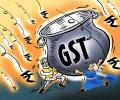
Gross GST collection in March grew 9.9 per cent to over Rs 1.96 lakh crore, government data showed on Tuesday.

Stocks of Indian steel companies are reeling from pricing pressure that is partly blamed on cheap imports. The stocks have declined up to 9 per cent on the NSE in one month, likely allowing investors an opportunity to use the correction to enter the pack as pricing pressure eases. "In steel or any other commodity, if prices or spreads are nearing their bottom, it can be an opportune time to invest in those stocks.

In the e2W category, which accounts for more than 60 per cent of total EV sales, volumes fell 15 per cent to 118,944 units in November, compared to 139,787 units in the previous month

ICICI Prudential Life Insurance Company (IPru) is struggling to generate growth in the value of new business (VNB). This is due to a combination of weak growth through the parent bank's channels, a shifting product mix in favour of unit-linked life insurance policies (ULIPS), and higher payouts to third-party channels. Leverage from current investments, a further reduction in contributions from ICICI Bank, and a pick-up in non-participating policies from the end of the year is key for this metric in the near to medium term.

Crude and gas supply concerns have eased amid reports that Israel and Hamas have struck a peace deal. The International Energy Agency estimates oil demand may drop slightly in calendar 24 but Opec probably has enough pricing power to maintain $80/ barrel Brent prices. Russia's share of India's crude imports remained strong at about 35 per cent in September 2023.
The information technology (IT) services industry may be headed for another year of sluggish growth. Based on the results of the top five IT services companies for the first quarter of 2025-26 (Q1FY26), analysts say the possibility of hitting high single-digit revenue growth in FY26 looks unlikely.

Corporate earnings got a big boost from the fall in commodity and energy prices in July-September 2023 (Q2FY24) despite a slowdown in revenue growth during the quarter. The combined net profits of 3,123 firms that have declared their results so far were up 38 per cent year-on-year (Y-o-Y) to Rs 3.07 trillion in Q2FY24, up from Rs 2.24 trillion a year ago. Earnings were, however, down 3.5 per cent on a sequential basis from Rs 3.18 trillion in April-June (Q1) FY24.

Households may be feeling the pinch of higher inflation but corporate India is enjoying record high margins and profits. The combined quarterly net profit of listed companies scaled a new high in the April-June 2023 quarter owing to a sharp rise in operating and net profit. The expansion in margins more than compensated for the slowdown in revenue growth, which slipped into single digits in Q1FY24 after a gap of nine quarters.

'Retail investors, who had not seen such a massive correction in the SMID universe since COVID-19, are witnessing something like this for the first time. Panic profit booking may continue.'

Automobile (auto) retail sales in India grew by an impressive 14 per cent in July compared to the same period last year, driven by a surge in the rural economy, good product availability, and product launches. While passenger vehicles (PVs) saw a 10 per cent increase during this period, inventory levels have surged to a historic high of 67-72 days in PVs, equating to Rs 73,000 crore worth of stock, according to the Federation of Automobile Dealers Associations (Fada). This poses a risk to dealer sustainability. Inventory levels in July 2023 were only 50-55 days, equating to a stock worth Rs 49,833 crore. In June 2024, inventory was between 62 and 67 days, with a stock value of Rs 60,000 crore.

The past 18 months have seen a resurgence in the real estate industry, with developers regaining the ground lost to the Covid-19 pandemic. But it is once again adding inventory at a pace faster than sales. The industry's inventory rose by 28 per cent year-on-year (Y-o-Y) in H1FY24, com-pared to a 25.5 per cent year-on-year increase in net sales during the same period.

Toyota Kirloskar Motor (TKM) has reported a consolidated net profit of Rs 4,787 crore for 2023-24 (FY24) - more than three times the earnings recorded the previous year. This growth can be attributed to robust demand for its vehicles, particularly hybrid models and cross-badged cars from the Toyota-Suzuki alliance.

Bajaj Finance, IndusInd Bank, State Bank of India, Maruti, Tata Motors, ITC, Tata Steel and Reliance Industries were also among the gainers. Nestle, NTPC, Kotak Mahindra Bank, Power Grid and Titan were among the laggards.

Research and development (R&D) spending by BSE 100 companies has grown steadily, rising from 0.89 per cent of revenue in FY20 to 1.32 per cent in FY24, averaging around 1 per cent over the period in-between, according to data compiled from Bloomberg and company annual reports. Also, these companies more than doubled their R&D spending in absolute terms over these five years: From Rs 25,041 crore to Rs 63,072 crore. While this reflects a prioritisation of innovation, corporate R&D investment remains relatively conservative.

Shares of Bajaj Finance sprinted 4.7 per cent to Rs 7,732 per share on the BSE in Thursday's (January 4) intra-day trade as the non-bank finance company's (NBFC's) December quarter business update reflected minimal impact of the Reserve Bank of India's ban on two of its lending products. The shares, eventually, ended 4.4 per cent higher at Rs 7,710 per share as against 0.69 per cent gain in the benchmark S&P BSE Sensex. The NBFC's asset under management (AUM) topped the Rs 3-trillion-mark at the end of December 2023, swelling by roughly Rs 20,700 crore (35 per cent year-on-year) to hit Rs 3.11 trillion-mark.

From premium electric motorcycles to mass-market scooters, manufacturers are rapidly expanding their portfolios to capture a larger share of the booming market.

Samsung is losing the race in India's premium smartphone market as rival Apple continues to increase its dominance in the segment, driven by robust iPhone sales and festival season discounts. Shortly after Apple CEO Tim Cook announced an all-time revenue record in India yet again for the September quarter, the company recorded its best-ever quarter of shipments at four million units in the third quarter of calendar year 2024 (Q3CY24), led by the iPhone 15 and iPhone 13, according to a report by the International Data Corporation (IDC).

The Indian cement industry is hopeful of greener pastures after a long period of stress led by pricing pressures and other factors. The second half of FY25 is expected to bring respite due to price hikes, cost benefits and higher volumes, said analysts. The optimistic momentum also makes cement stocks attractive, analysts added, advising to buy dips following a period of bearish sentiment in these stocks.

'This year overall hiring has seen a slight improvement as compared to the dip seen during the last financial year.'

With more than 1.2 million Indians stuck in green card backlogs, investor-driven EB-5 programme sees rising interest as a secure route for migration to the US.
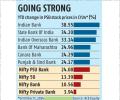
Stock Market News today, PSU banks: The year 2024 was a roller-coaster ride for Indian stock markets, marked by volatility driven by the Lok Sabha elections, Union Budget 2024, a slowdown in corporate earnings, and sticky inflation. Geopolitical tensions - particularly between Israel and Iran in West Asia - along with various stimulus announcements by China and yen carry trade rocked the equity markets throughout the year.
