
Around six weeks ago, Sun Pharmaceutical Industries, India's largest drugmaker, suffered a setback, which led to a selloff in the share. The US District Court of New Jersey granted Incyte's request for a preliminary injunction against Sun Pharma's launch of Leqselvi, a drug that treats alopecia.

Developers are entering one of the busiest construction cycles, with the top four firms planning launches worth Rs 1.13 trillion over the near to medium term, even as execution faces pressure from approval delays, labour shortages, rising costs, and contractor capacity limits across the industry.
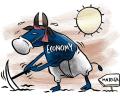
For the second month running, the demand for work under the flagship MGNREGA scheme has been lower than in 2020, which was an extraordinary year for the scheme. Latest data shows that around 35.1 million households have sought work under MGNREGA this June, or 21.48 per cent lower than the number that had sought work in the same month of 2020. This May, some 27.6 million households had sought work under the scheme, or 26.01 per cent lower than the same month last year.

The early-bird results for the April-June quarter of 2024 (Q1FY25) hint at a slowdown in corporate revenues and profits in FY25. Corporate profits might face headwinds from a continued revenue growth slowdown and a reversal in margin gains from lower commodity and energy prices in FY24. The combined net profit (adjusted for exceptional gains and losses) of the 210 companies that have declared their Q1FY25 results so far is down 4.2 per cent from the year-ago period - their worst showing in seven quarters.

Voltas saw strong growth in both UCP (Unitary Cooling product) and EMPS (electro mechanical projects) segments.

HCLTech reported flat net income of Rs 4,235 crore in the second quarter of 2025-26 (Q2FY26) compared to last year, even as its revenue was up 10.7 per cent to Rs 31,492 crore helped by financial services and technology business verticals.

Steel maker JSW Steel's Q3 results, announced on January 24, 2025, after market hours, failed to meet Street expectations. The company reported a consolidated net profit attributable to the owners of Rs 717 crore in Q3FY25, reflecting a 70.3 per cent decline Y-o-Y, compared to Rs 2,415 crore in Q3FY24.

The new business premium (NBP) of life insurance companies dropped 21.7 per cent year-on-year (Y-o-Y) to Rs 30,218.71 crore in December 2024 on the back of a steep fall in business. According to data published by the Life Insurance Council, LIC's premium dropped 41.15 per cent Y-o-Y to Rs 13,523.87 crore while private insurers reported 7 per cent growth in NBP to Rs 16,694.85 crore as the industry absorbs the impact of the revised surrender value norms.

After several years of consolidation and price weakness, the cement industry may be moving towards a more stable phase. Pan-Indian, average cement prices have risen through the past three months consecutively.

The stock of mall developer and commercial real estate major, The Phoenix Mills (Phoenix), is up 26 per cent since its business update in the third week of January. The gains came on strong December quarter performance and the consumption boost in the Budget which is expected to help the company sustain its growth trends.

While FY25 attrition rates remained below pre-Covid levels, most companies experienced a 1 to 3 percentage point increase compared to FY24.

Thermax reported 13 per cent Y-o-Y revenue growth with operating profit margin decline in Q1FY25. It took a hit of Rs 70 crore on specific projects. The company enjoys a strong order pipeline across sectors like power, steel, refining and petrochemicals.

Eternal (formerly known as Zomato) reported a net profit of Rs 39 crore for the fourth quarter of FY25, down 77.7 per cent year-on-year from Rs 175 crore in the same period a year ago. On a sequential basis, profit was also down 33.8 per cent from Rs 59 crore in the preceding quarter (Q3FY25).

India's top information- technology (IT) services companies, all cash-rich, have been tightfisted about ploughing back their earnings in new projects or acquisitions and the bulk of the profits have been distributed to shareholders through dividend and share buybacks. In the past 10 years (that is, excluding the current one), the firms have reinvested in growth and expansion only around 13.5 per cent of the cash flow generated from their operations.

Infrastructure bonds, which were relied upon the most in 2024-25 (FY25) by commercial banks to raise funds through the domestic debt capital market amid lagging deposit growth, seem to have lost their sheen in FY26. So far in FY26, no bank has tapped the domestic debt capital market to raise funds via infra bonds, and the expectation is that the amount raised through this route will be significantly lower than that last year, unless credit demand picks up.

India's largest cable and wire manufacturer Polycab India ended financial year 2024-25 (FY25) on a high, delivering another strong quarter of double-digit growth and market share gains. This coupled with margin expansion, operating breakeven for its fast-moving electrical goods (FMEG) business, and steady exports outlook for FY26 is expected to support the stock, which is up 18 per cent over the past month. The stock is currently trading at Rs 5,765 a share.

ABB reported a weak quarter. Revenue was at Rs 2,910 crore, up only 5 per cent year-on-year (Y-o-Y), with operating profit at Rs 540 crore, up 23 per cent and net profit at Rs 440 crore.

Marico reported consolidated revenue growth of 20 per cent year-on-year (Y-o-Y) during the January-March quarter (Q4) of FY25. Domestic revenue surged 23 per cent Y-o-Y, while volume growth was 7 per cent. International growth stood at 11 per cent (16 per cent in constant currency growth).

Industrial base metals major Hindalco delivered a strong consolidated performance during the January-March quarter (Q4) of FY24. Consolidated revenue was reported at Rs 56,000 crore, up 6 per cent quarter-on-quarter or Q-o-Q (flat year-on-year or Y-o-Y), with better realisation and higher India volumes.
LTIMindtree's (LTIM's) December quarter revenue, at $1.139 billion, was up 1.8 per cent quarter-on-quarter (Q-o-Q) (5.6 per cent year-on-year or Y-o-Y) in constant currency (CC) terms, marginally ahead of expectations.
India's real estate investment trust (Reit) sector is set for robust expansion, with at least one new Reit expected to enter the market each year over the next three-five years. This growth trajectory builds on rising occupancies, surging leasing activity, and increasing investor interest.

'We remain cautious in this environment, and the uncertainty continues.'

The VBL board approved the purchase of SBC Tanzania for Rs 1,304 crore and SBC Beverages Ghana for Rs 127 crore. These own manufacturing/distribution rights for NARTD (PepsiCo branded) beverages in Tanzania and Ghana. The acquisitions will help VBL gain ground in East and West Africa.

'Indian private universities can provide world-class education at one fourth the cost, home comforts, and direct links to Indian and global industries.'

Electrical Consumer Durable (ECD) companies like Havells India have seen strong Q4FY24 sales and continuing seasonal demand across fans, air coolers, and room air conditioners (RAC) in addition to business-to-business sales of cables, switchgear, and professional lighting, among others. Havells India's Q4FY24 revenue rose 12 per cent year-on-year (Y-o-Y) to Rs 5,400 crore, in-line with consensus. Strong summer demand led to robust volume growth in fans and RAC and volume growth in cable and wires (C&W) due to infrastructure spending and real estate activity.
Fast-moving consumer goods (FMCG) companies are expected to witness pressure on volumes in the October-December quarter. However, price hikes will help push up revenues, said brokerages.For India's largest engineering firm, Larsen and Toubro (L&T), the analysts expect a 20 per cent growth in consolidated revenue, and an 8.1 per cent core business Ebitda margin, up 40 bps from a year ago.

Eight of the top 10 employers showed a double-digit growth in fixed capital. Only one out of 10 showed a double-digit addition in employment.

Logistics major Delhivery has had promising Q2FY25 results. The Q2FY25 consolidated revenue was Rs 2,190 crore (up 0.8 per cent quarter-on-quarter or Q-o-Q and 12.8 per cent year-on-year or Y-o-Y). Express parcel revenue was Rs 1,300 crore, (up 1.7 per cent Q-o-Q/7.3 per cent Y-o-Y) alongside better yield (+5 per cent Y-o-Y) in the segment.

Hyundai aims to raise exports to 30% of output by FY30 as domestic sales slow; six EVs among 26 product launches planned as part of long-term growth strategy.

Net profit of 19 listed banks is likely to decline by 4 per cent year-on-year (Y-o-Y) for the quarter ended March (Q4FY25) mainly due to pressure on net interest margins (NIM) as a result of rate cut by the Reserve Bank of India (RBI), according to analysts' estimates. Additionally, loan growth is expected to further slowdown amid low demand in certain secured products, stress in the unsecured segment, and a high cost to deposit (CD) ratio across the system.

Footwear companies were among the weakest performers in the consumer discretionary sector during the October-December quarter (Q3) of 2024-25. The combined revenue growth of the top four listed firms was just 2.9 per cent year-on-year (Y-o-Y) - the lowest among major discretionary categories.

India's power sector CO2 emissions fell in H1 2025 for the first time in nearly 50 years (outside the pandemic), thanks to record renewable growth and lower coal use from cooler, wetter weather.

Marico's January-March quarter (Q4) results were slightly better than consensus. Revenue was up by 1.7 per cent year-on-year (Y-o-Y) to Rs 2,280 crore. Ebitda grew by 12.5 per cent Y-o-Y to Rs 440 crore. Adjusted PAT was up 10.3 per cent Y-o-Y to Rs 320 crore.

Mahindra & Mahindra on Tuesday posted a 28 per cent year-on-year increase in its consolidated profit after tax to Rs 3,673 crore for the second quarter ended September 30, 2025, driven by robust performance of the farm sector, while also seeing the impact of the GST transition on the auto sector. The company reported a profit after tax (PAT) of Rs 2,867 crore for the July-September period of the last fiscal.

However, the Polycab share price is up by nearly 80 per cent while Havells' has risen by 39 per cent. The Sensex has gained 26 per cent in this period. The Q1FY25 results were in line for both companies.

Britannia Industries reported revenue growth of 4 per cent year-on-year (Y-o-Y) in Q1FY25 and volume growth of 8 per cent implying price trends were adverse. Other operating income jumped 195 per cent, due to the incentive received for the Ranjangaon plant. The non-biscuit portfolio (rusk, cake, bread) remained key to growth and contributed 25 per cent of the total revenue.

Information-technology (IT) services major Cognizant has kept its full-year guidance on revenue growth unchanged at 3.5-6 per cent in constant currency even as the industry is becoming cautious about macro conditions because of tariff wars.

Godrej Consumer Products (GCPL) reported 6 per cent year-on-year (Y-o-Y) consolidated net revenue growth in Q4FY24 to Rs 3,385 crore and this was impacted adversely by currency movement. The constant currency (CC) growth would have been 30 per cent Y-o-Y in Q4FY24. India business clocked 12 per cent Y-o-Y revenue growth (5 per cent of it organic) with volume growth of 15 per cent Y-o-Y (7 per cent organic).

During the September quarter (Q2FY25), Hindustan Zinc's (HZL's) revenue was reported at Rs 8,300 crore (up 22 per cent year-on-year or Y-o-Y, and 2 per cent quarter-on-quarter or Q-o-Q), marginally above consensus. Operating profit stood at Rs 4,100 crore (up 31 per cent Y-o-Y and 5 per cent Q-o-Q), also a small beat. The operating profit margin was 50 per cent, up from 48.5 per cent in Q1FY25.

Mahindra & Mahindra (M&M) reported very strong results for the January-March quarter of the last financial year (Q4FY24), beating consensus comfortably. The margins of the automobile business improved 170 basis points (bps) year-on-year (Y-o-Y) to 8.8 per cent, while FES (Farm Equipment Sector) margins improved to 15.8 per cent (up 60 bps Y-o-Y), despite a decline in volumes due to cost optimisation and lower raw material costs.
