
India's wholesale price-based inflation surged to 11.39 per cent in September, up from 9.92 per cent in August, primarily driven by increasing prices of food, manufactured items, and fuel and power.

India's wholesale price-based inflation (WPI) increased to 9.92 per cent in August, up from 9.78 per cent in July, primarily due to rising prices across food, manufactured items, and fuel and power sectors.

Indian benchmark stock indices, Sensex and Nifty, closed lower due to profit-taking, a spike in wholesale price-based inflation, and firm crude oil prices, despite some support from easing intraday crude oil prices and rupee appreciation.

The National Payments Corporation of India (NPCI) is set to consider linking the ATM interchange fee to the Wholesale Price Index (WPI), alongside a potential hike from the current 19 to 21-22, which could impact customer charges for transactions beyond the free limit.

India's wholesale price index (WPI) inflation marginally eased to 9.78 per cent in July 2026, down from 9.87 per cent in June, primarily due to a cooling in the prices of fuel, power, and food items, marking the first month-on-month drop under the new 2022-23 base year.

Analysts predict that crude oil prices, geopolitical tensions in West Asia, and upcoming inflation data will be the primary drivers of the Indian stock market this week, alongside foreign investor activity and domestic quarterly earnings.

India's statistics ministry has defended its newly released economic growth estimates, stating that revisions to last year's GDP and the divergence between different price measures reflect updated data and estimation techniques rather than an attempt to artificially boost headline growth.

India's wholesale price inflation (WPI) increased to 9.87 per cent in June, up from 9.68 per cent in May, primarily due to significant price increases in non-food and food products, with food inflation alone rising to 5.49 per cent.

Analysts predict that the US-Iran geopolitical conflict, upcoming quarterly earnings announcements, and fluctuations in crude oil prices will be the primary drivers of investor sentiment in the Indian equity markets.

Wholesale price inflation (WPI) came in at (-) 0.32 per cent in November, driven by an uptick in prices of food articles like pulses and vegetables on a month-on-month basis, government data showed on Monday.

India's wholesale price index (WPI) inflation surged to 9.68 per cent in May, up from 8.26 per cent in April, primarily due to significant increases in the prices of fuel and power, manufactured goods, and food items.

Most members of the Reserve Bank of India's Monetary Policy Committee (MPC) expressed concerns about inflation becoming generalised and highlighted uncertainties surrounding both inflation and growth prospects due to the West Asia conflict, according to the recently released minutes.

India's wholesale price inflation surged to 8.30 per cent in April, up from 3.88 per cent in March, primarily driven by a significant increase in the prices of fuel, power, and crude petroleum, according to data from the commerce and industry ministry.

India's toll collection growth is projected to moderate to 5-7 per cent year-on-year in FY27, a 150-200 basis points reduction, primarily due to the economic impact of the West Asia conflict and a slowdown in commercial traffic, according to Crisil Ratings.

India's finance ministry anticipates inflation will remain relatively contained in the coming months, supported by a correction in crude oil prices and softening input costs following the cessation of the West Asia conflict, despite earlier spikes in wholesale and retail inflation.

Bank of Baroda economists project India's GDP to grow 6.5-6.8 per cent in FY27 but warn that the fiscal deficit could overshoot the budgeted 4.3 per cent target, potentially reaching 4.7-4.8 per cent of GDP due to subsidy overruns, excise duty cuts, and oil marketing company losses.

Analysts predict that inflation data, the US Federal Reserve's interest rate decision, and crude oil price trends will be the primary factors influencing the movement of Indian stock markets. Geopolitical developments, particularly the US-Iran deal, and foreign investor activity will also play a crucial role.

'The real shock is going to be from a deficient monsoon.'
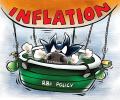
The Reserve Bank of India has increased its retail inflation projection for 2026-27 to 5.1 per cent, up from an earlier estimate of 4.6 per cent. This revision is primarily attributed to mounting input costs, driven by the pass-through of higher global energy prices to domestic petrol and diesel rates, which have seen significant increases since May.

India's wholesale price inflation (WPI) increased for the fourth consecutive month in February, reaching 2.13 per cent, primarily due to rising prices of food and manufactured goods, according to government data.

The Indian rupee gained 2 paise to settle at 93.33 against the US dollar, driven by positive sentiment in domestic equity markets and renewed hopes for US-Iran talks, despite rising WPI and CPI inflation.

India's wholesale price inflation surged to 3.88 per cent in March, marking the fifth consecutive monthly increase, primarily driven by a sharp rise in crude petroleum, natural gas, and manufactured items amidst the West Asia crisis.

Indian companies recorded their highest profit margins in 21 quarters during Q4FY26, reaching 11.3 per cent, primarily due to significant savings from lower employee costs and reduced interest payments, which offset rising raw material prices.

Petrol and diesel prices in India have been increased for the second time in a week, following a long freeze on revisions. The increase comes as global crude prices surge and state-run oil firms look to recoup losses.

Petrol and diesel prices in India have been increased by Rs 3 per litre each, marking the first rate hike in over four years. This decision follows a period of stable prices during recent state elections, despite rising global crude oil prices and significant losses for fuel retailers.

Petrol and diesel prices have been increased by Rs 3 per litre each, marking the first hike in over four years, as state-run fuel retailers pass on some of the impact from surging global crude prices, which have been exacerbated by the Iran war.

Wholesale price inflation extended upward momentum for the third straight month, at 1.81 per cent in January, driven by an uptick in prices of food, non-food articles, and manufactured items on a month-on-month basis, government data showed on Monday.
Wholesale price inflation extended upward momentum for the second straight month, recording at 0.83 per cent in December 2025, driven by an uptick in prices of food, non-food articles, and manufactured items on a month-on-month basis, government data showed on Wednesday. Wholesale Price Index (WPI)-based inflation returned to positive in December, after witnessing a deflationary trend in the previous two months.

Macroeconomic data, global geopolitical developments and rising concerns over AI-related disruptions are likely to dictate sentiment in the stock market next week, even as investors may remain cautious amid ongoing volatility, according to analysts.

India's net oil import bill could rise by $56 billion to $64 billion annually assuming global crude averages $110 to $115 per barrel in FY27.

If the conflict continues for a prolonged period, State-run oil companies may have to review retail fuel prices accordingly.

Analysts predict that the ongoing conflict in West Asia, crude oil price fluctuations, and the US Federal Reserve's interest rate decision will significantly influence the Indian equity market this week.

In an event-heavy week ahead, stock markets are expected to track Q3 corporate earnings from several blue-chip firms, including TCS and Infosys, while inflation data and global trends would also dictate investors' sentiment, analysts said.

Wholesale price inflation (WPI) fell to (-) 1 .21 per cent in October, driven by a decline in prices of food articles like pulses and vegetables, as well as lower fuel and manufactured items' prices, government data showed on Friday.
WPI inflation data, trading activity of foreign investors and global cues would dictate trends in the stock market this week, analysts said.
Wholesale price based inflation declined to a 3-month low of 1.89 per cent in November on cheaper food items, and experts predicted a 0.25 per cent interest rate cut by the RBI in the policy review in February. The Wholesale Price Index (WPI) based inflation was 2.36 per cent in October 2024. It was 0.39 per cent in November, last year. In August, 2024, it was 1.25 per cent.

India's new national accounts will leverage new data sources and surveys to enhance the measurement of the country's informal economy, and introduce double deflation methods across sectors, replacing the current system that relies on a single deflation mechanism in Gross Domestic Product (GDP) calculations.

Alliances fight wars effectively only when they share an endgame. If Israel acted without US knowledge, then the military alliance is operating without real coordination at the level of strategic targeting. Neither picture is reassuring in a war that is no longer regional in its consequences. Prem Panicker continues his must read daily blog on the Gulf War.

Wholesale price inflation (WPI) softened to 0.13 per cent in September on easing in prices of food articles and manufactured items, government data showed on Tuesday. WPI-based inflation was 0.52 per cent in August and 1.91 per cent in September last year.

Wholesale price inflation (WPI) returned to the positive zone after two months at 0.52 per cent in August, as prices of food articles and manufactured items inched up, government data showed on Monday. WPI-based inflation was (-) 0.58 and (-) 0.19 per cent in July and June, respectively.
