
Foreign investors continued their relentless selling in the Indian equity markets in August, offloading shares worth Rs 21,201 crore due to the unwinding of the yen carry trade, recession fears in the US and ongoing geopolitical conflicts. This came after an inflow of Rs 32,365 crore in July and Rs 26,565 crore in June, data with the depositories showed.

The exodus of foreign investments from Indian equity markets continued unabated, with FPIs pulling out nearly Rs 20,000 crore in the last five trading sessions on higher valuations of domestic stocks and shifting their allocation to China. As a result, foreign portfolio investors (FPIs) have turned net sellers in the equity market, with total outflows reaching Rs 13,401 crore for 2024 so far. Going ahead, the FPI selling trend is likely to continue in the near term till data indicate the piossibility of a trend reversal.

ICICI Prudential Life Insurance Company (IPru) is struggling to generate growth in the value of new business (VNB). This is due to a combination of weak growth through the parent bank's channels, a shifting product mix in favour of unit-linked life insurance policies (ULIPS), and higher payouts to third-party channels. Leverage from current investments, a further reduction in contributions from ICICI Bank, and a pick-up in non-participating policies from the end of the year is key for this metric in the near to medium term.

'Future market gains will likely depend primarily on earnings growth.'

'If it doesn't, it will continue with measures to infuse liquidity, signalling a new cycle,' predicts Tamal Bandyopadhyay.

Analysts seem to be generally pessimistic about Bharat Heavy Electricals (BHEL). Out of 15 brokerages with recommendations since May this year, two have 'buy' while five have 'sell' and eight have 'underweight'/'reduce'/'underperform'/'hold' recommendations. The average target price of the public sector undertaking (PSU) is Rs 61. However, the stock has been consistently hitting new highs, which indicates that there is some kind of valuation mismatch.

Foreign investors turned net sellers in October, offloading shares worth Rs 27,142 crore in just the first three days of October due to intensifying conflict between Israel and Iran, a sharp rise in crude oil prices, and improved performance of Chinese markets. The outflow came after FPI investment reached a nine-month high of Rs 57,724 crore in September. Since June, Foreign Portfolio Investors (FPIs) have consistently bought equities after withdrawing Rs 34,252 crore in April-May.
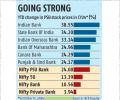
Stock Market News today, PSU banks: The year 2024 was a roller-coaster ride for Indian stock markets, marked by volatility driven by the Lok Sabha elections, Union Budget 2024, a slowdown in corporate earnings, and sticky inflation. Geopolitical tensions - particularly between Israel and Iran in West Asia - along with various stimulus announcements by China and yen carry trade rocked the equity markets throughout the year.

Coal India (CIL) produced 89 million tonnes (MT) in March-24, up 6 per cent year on year (Y-o-Y) and offtake was 69 MT, up 7 per cent Y-o-Y. FY24 production was 774 MT, up 10 per cent Y-o-Y. Offtake was 754 MT, up 9 per cent Y-o-Y. CIL targets production of 838 MT in FY25, up 8 per cent Y-o-Y over FY24.

Axis Bank's results for the fourth quarter of the 2022-23 financial year (Q4FY23) were skewed due to large one-off charges related to its acquisition of Citi's retail business. Axis reported a loss of Rs 5,730 crore on account of exceptional items of Rs 12,350 crore (net of tax) towards Citi's acquisition, policy harmonisation etc. Excluding this one-off, the adjusted net profit or profit after tax (PAT) would be Rs 6,630 crore, up 61 per cent year-on-year (YoY).

Invest in these funds through the SIP route with at least a seven-year horizon.

Automobile, apparel and electronics are among sectors that see a sales boost during the festival season, a time when investors expect gains in related stocks. This year could be different: Analysts have factored in all positives and do not expect such stocks to deliver lucrative returns. "Indian households spend across sectors like automobiles, consumer durables, and consumer staples during the festival season.

Siemens's share price has lost ground in the past few sessions following weak management commentary. The management indicated challenges to the growth outlook due to stagnant private capex and concerns over semiconductor shortages for digital industries. Government infra-spending may regain momentum from January 2025.

'The IPL provides a different ladder in terms of recognition.' 'If you do well, you will obviously get noticed and it enhances your selection into white-ball formats.'
Foreign investors have adopted a cautious stance and infused Rs 7,320 crore in the Indian equities in August owing to high valuation of stocks and the unwinding of the Yen carry trade after Bank of Japan raised interest rates. This investment was way lower than Rs 32,365 crore in July and Rs 26,565 crore in June, according to data with the depositories. While September is likely to see continued interest from FPIs, the flows would be shaped by a combination of domestic political stability, economic indicators, global interest rate movements, market valuations, sectoral preferences, and the attractiveness of the debt market, Vipul Bhowar, Director Listed Investments, Waterfield Advisors, said.

India's most valued company, Reliance Industries Ltd (RIL), reported a robust performance in the third quarter of the current financial year (Q3FY25), surpassing analyst expectations. This coupled with positive commentary by brokerages led to the stock of the oil-to-telecom conglomerate surging as much as 4.44 per cent to hit an intraday high of Rs 1,325.1. It settled at Rs 1,301.3 apiece, up 2.57 per cent.

Retail investors have become a force to reckon with in the last 10 years with their ownership of Indian equities rising 800 basis points, or 8 per cent, to 23.4 per cent during this period, suggests a recent note from Morgan Stanley. This number, Morgan Stanley said, is set to rise in the next few years as Indian households are still underinvested in equities. India's demographics, policy framework, investor education and modest positive real rates, it said, will fuel the 'equity cult' in India.

Value mutual funds have witnessed robust investor interest, garnering Rs 22,757 crore in inflows in 2024, nearly double the amount seen in 2023, fueled by impressive returns generated by the segment. This surge reflects a shift in investor focus towards fundamentally strong yet undervalued stocks.

Fast-moving consumer goods (FMCG) companies are expected to witness pressure on volumes in the October-December quarter. However, price hikes will help push up revenues, said brokerages.For India's largest engineering firm, Larsen and Toubro (L&T), the analysts expect a 20 per cent growth in consolidated revenue, and an 8.1 per cent core business Ebitda margin, up 40 bps from a year ago.

Propelled by strong demand and lower costs, the country's largest airline, InterGlobe Aviation (IndiGo), reported solid operational performance in the 2024-25 (FY25) October-December quarter (Q3). While demand was driven by the festival season, year-end increase, and higher consumer spending, lower fuel and rental costs helped deliver a beat at the operating profit level.

India is among the three least-favoured Asian stock markets, according to BofA Securities whose survey found that 10 per cent of fund managers are underweight on Indian equities from a 12-month perspective.

'Reduce your equity allocation, put that allocation into gold and fixed income.'

'I believe that the overall demand for commercial vehicles will improve, even though there is a slowdown in the GDP.'

Power Grid Corporation of India's (PWGR's) Q3FY25 revenue declined 3 per cent year-on-year (Y-o-Y) to Rs 11,200 crore, with operating profit falling 7 per cent Y-o-Y to Rs 9,500 crore and margin contracting to 85 per cent from 91 per cent Y-o-Y. Other income surged 89 per cent Y-o-Y to Rs 500 crore, but regulatory income dropped 62 per cent Y-o-Y to Rs 42.5 crore.
From the 30-share blue-chip pack, Zomato cracked nearly 7 per cent. Power Grid, Adani Ports, Tata Steel, NTPC, Tata Motors, Tech Mahindra, Mahindra & Mahindra, Asian Paints, Sun Pharma and UltraTech Cement were the other major laggards. In contrast, Axis Bank, Hindustan Unilever, Tata Consultancy Services and IndusInd Bank were the gainers.

After a brutal selloff since October, foreign portfolio investor (FPI) flows for the year-to-date (YTD) in 2024 have turned negative. In early September, YTD FPI investments peaked at a record Rs 22,000 crore ($2.6 billion). This wave of selling has also pulled down benchmark indices, with the Nifty's YTD returns declining to 11 per cent from their high of 21 per cent in September.

'As we navigate uncertain waters, a conservative approach to largecap investing could provide a strategic advantage.'

Foreign portfolio investors (FPIs) have invested Rs 25,300 crore through the anchor book for IPOs in 2024, surpassing the Rs 20,351 crore invested by domestic mutual funds (MFs). FPIs accounted for 46.6 per cent of shares sold in the anchor category, the highest share since 2021, according to PRIME Database.

The ratio of market capitalisation to gross domestic product (GDP) in India remains elevated despite the recent correction in the equities markets. It was 147.5 per cent on December 3, 56 per cent higher than the 10-year average of 94 per cent. The current ratio is slightly lower than the all-time high ratio of 154 per cent at the end of September this year.

From the 30 Sensex pack, Hindustan Unilever fell by nearly 6 per cent after the FMCG major reported a 2.33 per cent decline in consolidated net profit at Rs 2,595 crore for the second quarter ended in September 2024 impacted by moderation in demand from the urban market.


Equity markets this week will take cues from global trends, trading activity of foreign investors and quarterly earnings, with TCS kick-starting the results calendar on Thursday, analysts said.

Info Edge (India) topped expectations in its October-December quarter (Q3) results, posting strong revenue and profit growth. Its shares have rallied as much as 6.14 per cent in two days. The technology holding company's revenue rose 15.2 per cent year-on-year (Y-o-Y) to Rs 722.3 crore, driven by robust performance across its key verticals, particularly its recruitment business.

FMCG major Hindustan Unilever Ltd on Wednesday reported a 19.18 per cent rise in consolidated net profit at Rs 2,989 crore in the December quarter.

'IPOs have performed exceptionally well, with a notable increase in average ticket size from Rs 800 crore in the last financial year to around Rs 1,300 crore in this financial year.'

Udaan, India's largest business-to-business (B2B) e-commerce company, has received approval from the National Company Law Tribunal (NCLT) for its internal corporate restructuring plan, according to sources. By consolidating into a single entity, the restructuring will enhance Udaan's agility and pave the way for various financing options, including the ability to pursue an initial public offering (IPO) in India by 2026, according to people familiar with the matter.

Fintech firm BharatPe is targeting an initial public offering (IPO) in the next 18-24 months with the company expecting profitability at an earnings before interest, taxes, depreciation and ammotisation (Ebitda) level for FY25, chief executive officer (CEO) Nalin Negi said.

As regards mid-caps and small-caps, analysts suggest investors buy only those stocks of those companies where there is earnings visibility for at least a few quarters and where the valuations have become reasonable.

Hyundai Motor India (HMIL) raised Rs 8,315 crore from anchor investors on Monday, setting the stage for the country's biggest-ever maiden share sale. The Indian arm of the South Korean carmaker Hyundai Motor Company (HMC) allotted 42.4 million shares to 225 funds at Rs 1,960 apiece, the higher end of its price band. Among the investors receiving allotments were the Singapore government's sovereign wealth fund (GIC), New World Fund, and Fidelity.

Investors attribute the revival to the country's strong public markets, which are boosting confidence in initial public offering (IPO)-bound startups offering viable exit opportunities.
 © 2026 Rediff.com - Advertise with us - Disclaimer - Privacy Policy - Sitemap - Feedback - About us - Terms of use - Grievances