
The S&P BSE Midcap and the S&P BSE Smallcap indices have managed to stay afloat in a volatile January that saw the frontline indices hit their respective 52-week high levels and then slip. While the S&P BSE Sensex has lost over 2 per cent thus far in January, the S&P BSE Midcap and the S&P BSE Smallcap indices have gained nearly 2.5 per cent and 4 per cent, respectively during this period.

'The whole narrative will change from TV is dying to TV-plus-digital is the future.'

The US Federal Reserve's interest rate decision, global cues, macroeconomic data announcements and the ongoing quarterly earnings are the major triggers that will dictate trends in stock markets this week, analysts said. Besides, the trading activity of foreign investors and the movement of global oil benchmark Brent crude will also be tracked. "All eyes are on the outcome of the US Federal Reserve meeting scheduled for November 1, particularly due to the multi-year high levels of the US bond yields.
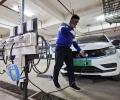
New Delhi's timing couldn't have been worse, both for India's fledgling electric vehicle (EV) sector and prospective electric bike buyers. It was hard to miss the perfect storm brewing for India's EV industry since early 2022. On one hand, you had several accidents involving battery fires that unnerved consumers; on the other, uncertainty had crept in over subsidies.
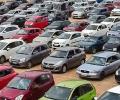
Auto industry volumes have grown by 2.5 per cent overall, led by domestic sales of three-wheelers, two-wheelers and passenger vehicles (PVs) in the first quarter of this financial year. Analysts predict an 18 per cent growth in revenues for automotive original equipment manufacturers (OEMs) and profit growth of 69 per cent year-on-year (YoY). However, on a sequential basis, a decline in revenues as well as earnings before interest, taxes, depreciation, and amortisation (Ebitda) margins is expected.

Which entrepreneur would willingly part with her or his hard-earned money for grasping, self-serving politicians? asks Debashis Basu.

Copparam Shreyas Hareesh, a 13-year-old prodigy from Bengaluru, succumbed to injuries that he had suffered following a crash in the third round of the MRF MMSC FMSCI Indian National Motorcycle Racing Championship.
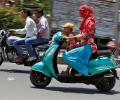
Two-wheeler exports from India have decreased by 20 per cent year-on-year (Y-o-Y) to 1.69 million units in the first half (H1) of 2023-24 (FY24) due to a challenging geopolitical situation and foreign exchange (forex) crises in key markets such as South Asia, industry body Society of Indian Automobile Manufacturers (Siam) said on Monday. On the other hand, passenger vehicle (PV) exports in H1FY24 increased by 5 per cent to 336,754 units because the key markets are much more diversified worldwide, Vinod Aggarwal, president, Siam, told reporters during a press conference. The Russia-Ukraine war, which started in February 2022, has brought significant instability to global fuel prices.

Could the MPCE survey results be used as a basis of reconstructing the Consumer Price Index with new weights, asks Madan Sabnavis.

Holger Rune rallied from a set down and saved a match point to defeat former champion Taylor Fritz 2-6 7-6(2) 6-3 on Wednesday and reach the Indian Wells quarter-finals where he will meet fourth seed Daniil Medvedev.

Reflecting subdued global economic growth, India's outward foreign direct investment (FDI) fell by 33.3 per cent sequentially to $1.21 billion in August, compared to over $1.82 billion in July.

Consumer durables firms and fashion retailers expect double-digit growth in value terms in the ongoing festival season as consumers have stepped up purchases during this period. They expect to see value sales growth upwards of 15 per cent, which is especially coming in from cities. However, volume growth may lag behind value growth.

British supermarkets and pubs are set to enjoy a boost to trade this weekend as families and friends gather for breakfasts and barbecues to watch England's Lionesses play Spain in the Women's World Cup soccer final in Australia.

There's a hint of new competition riding into a sector that has attracted attention for being in a duopoly-like situation. Rapido, a commute app known for its budget-friendly bike-taxi services, on Tuesday announced its entry into the cab market, which is currently dominated by marquee brands Uber and Ola. Rapido's cab foray will be enabled by a software as a service (SaaS)-based platform.

Domestic mutual funds (MFs) have underpinned demand for most public floats this year, dominated by small- and mid-sized initial public offerings (IPOs). Of the 24 IPOs that have hit the market so far this financial year (2023-24, or FY24), MFs have played the role of 'anchor investors' in 20. They have subscribed to over 40 per cent, or Rs 2,850 crore, worth of shares of the Rs 6,900 crore on offer in the anchor category, according to data provided by PRIME Database, a firm that tracks primary market data.

This is a good opportunity for long-term investors to pick quality small and midcap stocks at reasonable valuations.

The two-wheeler segment is, however, still far from its H1FY19 peak of 9.7 million units

Tata Sons chairman Natarajan Chandrasekaran was paid Rs. 113 crore as remuneration for 2022-23 (FY23), including Rs. 100 crore as commission on profit. Chandrasekaran, 60, often referred to as Chandra, received a remuneration of Rs. 109 crore in 2021-22 (FY22). With this, Chandra has emerged as one of the highest-paid chief executive officers (CEO) in Corporate India for FY23.
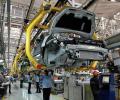
The K-shaped economic recovery in India from the pandemic slowdown shows in corporate results as well. The automobile sector, which represents big-ticket consumption, continues to do well and has increased its share in corporate revenues and profits while fast-moving consumer goods (FMCG) companies that sell low-ticket consumer goods are struggling with poor sales and earnings growth. The share of the automobile sector, including makers of auto ancillaries, in corporate net sales rose to a 10-quarter high of 10.05 per cent during July-September 2023 (Q2FY24) from 8.94 per cent a year earlier and 9.75 per cent in Q1FY24.

That win gave us something no other victory ever would: It gave a young nation hope. It gave us the will to dream, notes Abhishek Mande Bhot.

'Two in three creators in India who earn money from YouTube agree that YouTube is their primary source of revenue.'
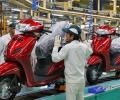
Honda Motorcycle and Scooter India (HMSI), the country's second-largest two-wheeler manufacturer, is planning to launch its first electric vehicle (EV) here by March next year, said CEO & MD Atsushi Ogata on Monday. The company would also enter the low-end motorcycle market in March by launching a 100cc engine bike at a price that will "positively shock" customers, he said while speaking with reporters, after launching the Activa with Honda Smart Key. HMSI's first EV, an electric scooter, will have a fixed battery and the second model will have two swappable batteries, Ogata explained.
Automobile manufacturers are likely to report strong numbers for the September quarter of Financial Year 2023-24 (Q2 FY24), riding on growth across segments and offset by a marginal drop in overall two-wheeler (2W) volumes. Higher average selling price (ASP) year-on-year (YoY), which was necessitated by price hikes taken by original equipment manufacturers (OEMs), and an improved product mix will also aid revenues and margins. Moreover, commodity prices are down on a YoY basis, leading to higher margins in earnings before interest, taxes, depreciation and amortisation (Ebitda).

Mahela Jayawardena pays a heartfelt tribute to newly inducted ICC Hall of Famer Aravinda de Silva.

With Housing Development Finance Corporation's (HDFC's) merger with HDFC Bank becoming effective on July 1, the merged entity is set to become the top weight in the benchmarks S&P BSE Sensex and the National Stock Exchange Nifty indices, dislodging the country's most valuable company, Reliance Industries (RIL), from its perch. HDFC will stop trading after July 13. At present, RIL has a weighting of close to 12 per cent in the Sensex and 10.3 per cent in the broad-based Nifty. Meanwhile, HDFC Bank and HDFC have weights of 9.9 per cent and 6.8 per cent in the Sensex and 8.8 per cent and 6 per cent in the Nifty, respectively.
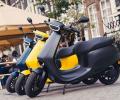
Electric two-wheelers have zipped past the half-a-million registration mark and achieved a market penetration of 4 per cent at the fag end of Calendar 2022, according to data released by VAHAN. According to VAHAN data for the year (until December 27), 560,000 two-wheelers were registered in the country, up a staggering fourfold over 2021, when only 136,000 were registered, and when electric vehicle penetration was a mere 1.05 per cent. The total number of two-wheelers (internal combustion engine, or ICE, and electric) registered so far in 2022 stands at 14.5 million, up only 12.7 per cent over the previous calendar year.

The previous May peak was observed in 2018 when the domestic PV wholesales stood at 301,238 units.

At Prestige Polygon Towers in Chennai's Teynampet, hectic preparations are on for a mega global investors' meet under the aegis of Guidance Tamil Nadu (the state investment promotion agency) scheduled for January 2024. Asked about the key focus areas of the meet, the agency's managing director and chief executive officer, V Vishnu, said the state was betting big on electric mobility. This is no surprise, given that the state has signed electric vehicle (EV)-related memorandums of understanding (MoUs) with several companies in the recent past that may bring in investments worth around Rs 33,000 crore with the potential to create over 43,000 job opportunities.

Congress MLA Mamman Khan has been arrested in connection with the July 31 Nuh violence case, police said on Friday.

The semiconductor chip supply for the electric two-wheeler industry has normalised but the prices are up by nearly 50 per cent compared to pre-pandemic period, said Eric Vas, president, Urbanite, the electric vehicle (EV) business of Bajaj Auto. "It (the supply) has improved greatly. It has pretty much normalised. The problem is the cost. "The costs remain very high. Hopefully, the costs will start correcting themselves over this fiscal year," he said in an interview with Business Standard.

The limited availability of flexible (flex)-fuel vehicles in the Indian market and the slow rollout of ethanol-blended petrol by oil-marketing companies (OMCs) remain major obstacles to achieving widespread use of biofuels in the transportation sector in India. Recently, two Union ministers have emphasised India's biofuel potential, arguing that it has the capacity and potential to lead a transition towards widespread biofuel adoption. Road Transport Minister Nitin Gadkari signalled that this transition is well underway and urged car manufacturers to quickly adapt and introduce new biofuel-run vehicles, lest the government resort to taxing diesel vehicles.

The company said the new model would be available for sale in sugarcane-producing Maharashtra, Uttar Pradesh and Karnataka, to begin with.
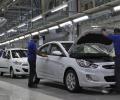
Automotive retail sales saw a 14 per cent rise in March on a year-on-year (YoY) basis, according to data released by the Federation of Automobile Dealers Associations (FADA). For the whole of financial year 2022-23 (FY23), sales grew 21 per cent YoY. For both March and the financial year, all categories, except for tractors, and including two-wheelers, three-wheelers, passenger vehicles (PVs), and commercial vehicles (CVs), posted double-digit growth. However, the total retail sales of 22.1 million for the financial year were still 12 per cent lower than the pre-Covid (FY20) level of 25 million, owing to an 18 per cent dip in the two-wheeler segment.

The country saw a massive year-on-year surge in the demand for electric vehicles, with retail sales of electric two-wheelers rising by 58 per cent, passenger vehicles by 130 per cent, three-wheelers by 82 per cent, and commercial vehicles by 171 per cent in March 2023, according to the data shared by the Federation of Automobile Dealers Associations (Fada). According to a report by JMK Research, the EV segment as a whole grew by 157 per cent during FY23, to 1,180,597 units, from 458,746 units a year ago. Overall, EV sales in March 2023 rose by 82 per cent from the March 2022 figure, the JMK report added.

'For me, Nitin Chandrakant Desai will always be associated with masti-mazaak.'
The two-wheeler sector has been underperforming its peers on the volumes front for over five quarters now. Even in the March quarter, Bajaj Auto and Hero MotoCorp posted a 17-24 per cent YoY decline in volumes, the sharpest in the listed auto universe. The ongoing impact of frequent price hikes, all-time high fuel prices, and muted rural sentiment has led to the lacklustre showing by two-wheeler makers. What has aggravated the situation for two-wheeler companies, which get almost all their sales from the internal combustion engine or ICE-based units, is the traction for electric two-wheelers (EV).

The Indian startup ecosystem has lauded the inclusion of startups in the New Delhi Leaders' Declaration for the first time ever in the history of G20. Industry stakeholders say that the move will lead to easier access to capital, reduce regulatory hurdles, and may revive funding activity. The Declaration, through the Startup20 initiative, recognised startups as "natural engines of growth" and key to socio-economic transformation by driving innovation and creating employment.

Captain Mahendra Singh Dhoni unboxed the new-look jersey featuring camouflage design on the shoulders, four stars atop the franchise's logo to depict their four IPL titles.
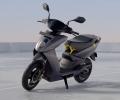
If you thought electric scooters have caught the fancy of only people in the metros, think again. According to data from electric two-wheeler maker, Ather Energy, 54 per cent of its sales of scooters, starting from Rs 1.2 lakh, come from Tier 2 and Tier 3 cities. Based on sales per lakh population, the top five cities for the company are Calicut, followed by Kochi, Kolaphur, Trivandrum and Pune.

The National Stock Exchange (NSE) Nifty Next 50 Index could undergo large-scale changes if the proposed tweaks to its computation methodology get implemented. In a discussion paper floated recently, NSE Indices, which owns and manages a portfolio of over 350 indices under the Nifty brand, proposed that only stocks that are traded in the futures and options (F&O) segment can be part of the index. Currently, as many as 11 non-F&O stocks are part of the Nifty Next 50 Index, which, as the name suggests, represents the next rung of large and liquid securities after the Nifty50.
