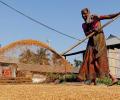
Stating that the food subsidy bill is becoming "unmanageably large", the Economic Survey 2021 on Friday suggested the government to increase the selling price of foodgrains provided through ration shops to over 80 crore beneficiaries. Foodgrains via ration shops are supplied at highly subsidised rates of Rs 3 per kg for rice, Rs 2 per kg for wheat and Rs 1 per kg for coarse grains through Public Distribution System (PDS) as per the National Food Security Act (NFSA). "While it is difficult to reduce the economic cost of food management in view of rising commitment towards food security, there is a need to consider the revision of central issue price (CIP) to reduce the bulging food subsidy bill," the survey said.

As part of steps to control inflation and augment availability of essential commodities, the government is considering re-allocating wheat in place of rice for the Targeted Public Distribution System (TPDS) and other welfare schemes.
What is ailing India's Public Distribution System (PDS)? "Corruption" is the one and only answer to that question.

The government had pegged food subsidy at Rs 90,000 crore (Rs 900 billion) in the 2013-14 Union Budget.
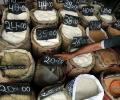
Food subsidy bill rises 20% in April-January
.jpg)
Sakshi Balani presents an FAQ on the Food Security Bill that was passed by Lok Sabha on Tuesday.
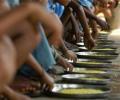
Nowhere on the planet, nowhere in mankind's history has such an idea taken the concrete shape in form of a law. The National Food Security Bill, which will come via ordinance and not after the debate in Parliament, is an incredible economic tool to tackle the hunger of poor Indians. Also, it has already been condemned widely as a political gimmick.

The stock and foreign exchange markets have had a negative reaction to the government's biggest social security programme, the National Food Security Bill. Food minister K V Thomas questions the rationale behind such a response
