
As many as 31 mainboard IPOs raised a cumulative Rs 26,272 crore in this period, according to Prime Database. During the April-September 2007 bull run, 48 IPOs totalling Rs 21,243 crore were launched. The number of deals in H1FY24 was 2.2 times that of the same period of the last fiscal year, but the amount raised was 26 per cent lower.

'Valuations of midcaps and smallcaps have reached very high levels, and hence to that extent leave little margin of safety.'

Ulhas Joshi, Head -- Sales, Rank MF, a mutual fund investment platform, answers your queries.

The biggest bounce is in the realty sector, where the industry index jumped 80%. There's been a turnaround also in automobiles and ancillaries (up 45%). The pharma and health care indices have a welcome return of roughly 35%.

From the Sensex basket, Tech Mahindra, Tata Steel, JSW Steel, HCL Technologies, Tata Consultancy Services, Larsen & Toubro and Kotak Mahindra Bank were the biggest laggards. Mahindra & Mahindra, Power Grid, Bajaj Finance, IndusInd Bank and Maruti were the major gainers.

The market capitalisation of BSE-listed companies soared to an all-time high of Rs 406.52 lakh crore on Monday thanks to a rally in equities where the BSE Sensex climbed over 1 per cent. The 30-share BSE Sensex rallied 941.12 points or 1.28 per cent to finish at 74,671.28. During the day, it zoomed 990.99 points or 1.34 per cent to 74,721.15.

Investors' wealth eroded by Rs 6 lakh crore in a single day on Wednesday as the BSE benchmark Sensex tumbled over 790 points. The 30-share BSE Sensex fell by 790.34 points or 1.08 per cent to settle at 72,304.88. During the day, it slumped 872.93 points or 1.19 per cent to 72,222.29.
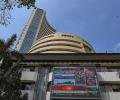
According to data from BSE, the 4,357 companies available for trade had a combined mcap of around Rs 416 trillion on Tuesday against India's GDP at current prices of Rs 296.6 trillion in FY24.

'Investors should focus on largecap funds, flexicap funds, business cycle funds, or hybrid-category funds.'
The universe of stocks trading at a 12-month forward price-to-earnings (P/E) multiple of 50x or more has swelled by 2.5x to 104, indicating the growing froth in the market. In March 2023, the number of stocks with a P/E of 50x and 100x stood at 41 and 3, respectively, which has now grown to 104 and 9, according to an analysis by Kotak Institutional Equities (KIE).

The post-Covid pandemic boom in corporate revenues appeared to have faded away in 2023-24. Yet, companies have reported a sharp recovery in their profits in FY24, driven by high margins. Their combined net sales, including gross interest income for lenders, rose by a modest 4.8 per cent year-on-year (Y-o-Y) in FY24.

'Sectors like e-commerce, small finance, housing finance, and healthcare are in great favour, and people are paying a PEG ratio of up to 5, which is dangerous.' 'Wealth destruction is inevitable.'

The number of companies had touched a low of 792 in July 2020 amid heightened uncertainty because of COVID-19.

Economic growth, which we are taking for granted, slows for a completely different set of local or global factors and the Modi premium vanishes, observes Debashis Basu.

'Sell in May, go away' is a popular market adage. But 'Don't sell any new shares in May' is the best kept secret of Dalal Street that's set to break. Sample this: the last four General Election election cycles starting 2004 have not seen a single initial public offering (IPO) launch during the month of May.
Shares of Avenue Supermarts (DMart) have rallied 15 per cent in the past month, even as the benchmark National Stock Exchange Nifty has remained flat. The stock has garnered favourable commentary from both fundamental and technical analysts after three years of poor performance. "DMart has reached its first 52-week high since October 2021, taking off from solid base formations.

Among the Sensex firms, Tata Steel, Tata Motors, Asian Paints, Wipro, State Bank of India and Larsen & Toubro were the major gainers. ICICI Bank, NTPC, Axis Bank and Mahindra & Mahindra were among the laggards.

Mutual funds' equity buying remained elevated for the fifth consecutive month in December, taking the net equity purchase past Rs 1.7 trillion in 2023. The aggressive buying in December indicates that flows into equity funds are likely to have remained unaffected by the sharp run-up in the market last month. Mutual funds (MFs) bought equities worth Rs 23,000 crore last month (until December 28) compared to Rs 18,000 crore in November, shows data from the Securities and Exchange Board of India (Sebi).

Investors' wealth soared by Rs 10.58 lakh crore in three days of the market rally, where the BSE benchmark jumped over 2 per cent, and hit an all-time high on Monday. Extending its winning momentum to the third day running, the 30-share BSE Sensex jumped 363.20 points or 0.49 per cent to settle at 74,014.55. During the day, it zoomed 603.27 points or 0.81 per cent to hit its record high of 74,254.62.

'A mid-year review makes the end-of-year financial review manageable and less stressful.'

'If you are investing in a Ulip for returns, go for a type I Ulip.' 'If you are investing for insurance cover as well, type II is better.'

After a short-term blip, mutual funds (MFs) are back to adding new systematic investment plan (SIP) investors at a record high pace, which was seen during the financial year 2021-22 (FY22). During the first six months (H1) of this financial year (FY24), MFs have added a net 77 million SIP accounts compared to 56 million during the same period of FY23. The net additions this year are a tad higher than the 76.5 million additions in H1 of FY22.

Selling in index heavyweights, including Infosys, TCS, ICICI Bank and Reliance Industries, dragged the benchmark indices into the negative for the second straight session, analysts said. Among the Sensex shares, Asian Paints fell the most by 3.9 per cent as analysts expressed concerns over rising competition in the domestic paints market following the entry of Aditya Birla group company Grasim Industries into the paints segment. IT shares Infosys, TCS, HCL Tech, Wipro and Tech Mahindra continued to slide amid inflation concerns in the US market.

In the Sensex pack, HCLTech rose the maximum by 3.12 per cent, followed by ITC which gained 2.73 per cent and M&M went up 2.61 per cent. TCS climbed 2.44 per cent. Tech Mahindra, Wipro, L&T and Maruti were among the other major gainers.

Investors' wealth grew by Rs 3.24 lakh crore on Thursday as the BSE Sensex jumped nearly 1 per cent after a two-day slide. The 30-share BSE Sensex jumped 490.97 points or 0.69 per cent to settle at 71,847.57. During the day, it rallied 598.19 points or 0.83 per cent to 71,954.79.
HDFC Bank's latest shareholding data showed that the room for foreign investment has fallen just 5 basis points short of the threshold set by Morgan Stanley Capital International (MSCI) to fully include the stock in its indices. Currently, the index provider has applied an adjustment factor of 0.5 since the foreign room is less than 25 per cent. Removal of the adjustment factor will result in inflows of a massive $4.8 billion (Rs 40,000 crore) into HDFC Bank, according to Brian Freitas, a New Zealand-based analyst with Periscope Analytics.

Brokerages believe that the Bharatiya Janata Party's (BJP's) stronger-than-expected showing in state elections reduces political risks for the domestic markets going into 2024. However, after the short-term excitement, the focus will soon shift to earnings, global liquidity conditions, and the interest rate trajectory. "BJP's win in the three state elections is much better than what exit polls suggested and reinforces the consensus expectations of a Modi win in the 2024 national elections with a greater likelihood of 300+ seats for the BJP.

'From a risk-return perspective, large-cap funds may generate lower-than-historical average returns in 2024, whereas mid-, and small-cap funds hardly have any upside left.'

These stocks offer the best combination of maximum 'buy' recommendations from brokerages and share price upside over the next 12 months.

The number of dematerialised (demat) accounts - required to hold shares and other securities in electronics format - crossed the 150-million mark for the first time in March. In March, 3.12 million new demat accounts were added despite a spike in market volatility, taking the total count to 151.4 million. The milestone has come 19 months after the total number of demat accounts hit the 100-million mark, a sign that more domestic households are taking to direct equity investing.

HDFC Bank, Reliance Industries and ICICI Bank remained among the top mutual fund (MF) buys for the second consecutive month in September. MFs deployed a net of Rs 15,000 crore into these stocks during the two-month period (August-September), revealed Nuvama Alternative & Quantitative Research reports.

From the Sensex basket, Tata Consultancy Services, Nestle, Bajaj Finserv, Wipro, Maruti Suzuki India, Reliance Industries, Larsen & Toubro and NTPC were the major laggards. Tata Steel, Bajaj Finance, JSW Steel and Bharti Airtel were among the gainers.

'It is advisable to stay away from the markets for now and buy only on a dip.'

rediffGURU Ramalingam Kalirajan answers your personal finance queries.

Dalal Street investors became richer by Rs 9.68 lakh crore in five days of market rally, where the Sensex breached the historic 73,000-mark for the first time ever to reach a new record peak, taking the market capitalisation of BSE-listed companies to an all-time high of Rs 376 lakh crore. The 30-share BSE Sensex jumped 759.49 points or 1.05 per cent to settle at a new closing high of 73,327.94 on Monday. During the day, it zoomed 833.71 points or 1.14 per cent to reach its all-time peak of 73,402.16.

Stocks of smallcap and midcap companies, which had caught the fancy of retail investors, also feature in the portfolio of leading politicians in addition to bluechip stocks.

'Historically, the markets tend to perform well during election years as governments aim to increase spending and call attention to growth.'

Notwithstanding the ongoing decline in equity markets week after week, August has proven to be the most successful since December for initial public offerings (IPOs). In August of this year, six companies have collectively raised approximately Rs 4,269 crore through IPOs.

Among Sensex shares, Bajaj Finserve, ICICI Bank, Bharti Airtel, Bajaj Finance, Sun Pharma, Maruti Suzuki, ITC, and Nestle were the lead gainers. On the other hand, L&T Wipro, IndusInd Bank and TCS and Tata Motors were the lead losers.

At a time when exchange-traded funds (ETFs) were unloading Jio Financial Services from their portfolios, some active fund managers were placing large bets on the demerged financial services arm of Reliance Industries Ltd (RIL), a report by Nuvama Alternative & Quantitative Research shows. Motilal Oswal Mutual Fund and Quant Mutual Fund were the top MF buyers of the stock in August. They bought around 60 million shares each, together investing around Rs 2,800 crore.
