
According to the financial services major, FY13 Sensex EPS has been downgraded from Rs 1,510 to Rs 1,175, and FY14 Sensex EPS is likely to be downgraded to below Rs 1,300.

The benchmark BSE Sensex's trailing 12-month price-to-earnings (P/E) multiple has declined to 20.2x, its lowest since May 2020, driven by a record $42 billion FPI selloff since September 2024 and concerns over corporate earnings and economic growth.

Indian stock markets experienced a significant rally following the announcement of a US-Iran ceasefire, coupled with a drop in crude oil prices. The Sensex and Nifty both closed nearly 4 per cent higher, mirroring gains in global markets.

Infosys shares experienced a significant drop, hitting a 52-week low, after the company announced its Q4FY26 results and provided a modest revenue growth guidance of 1.5-3.5 per cent in constant currency for FY27, falling below market expectations and raising concerns about AI-led deflation and margin pressures.

TVS Motor Company is strategically positioned for sustained outperformance in the domestic two-wheeler industry, propelled by increasing market share in scooters, premium motorcycles, electric vehicles (EVs), and robust export growth, according to analysts.

Companies in the fast-moving consumer goods (FMCG) sector are losing favour with equity investors, with their price-to-earnings (P/E) ratio declining to its lowest level in six years, now trading at 38.8 times trailing earnings.

Dabur India's shares rose 3.7 per cent after reporting in-line Q4FY26 results, driven by a healthy 10 per cent growth in its India business, despite some analysts remaining cautious about future execution.

Mahindra & Mahindra (M&M) is largely bullish among analysts following its Q4FY26 results, driven by strong SUV demand, a robust product pipeline, and improving growth visibility across segments, despite near-term margin pressures from rising commodity costs and potential weakness in the tractor cycle.

Analystsare showing optimism in Sensex EPS growth after double digit growth in the second quarter of current year.

Brokerages were divided on Bajaj Finance after its 2025-26 (FY26) third-quarter (October-December/ Q3) results, with a few raising targets on valuation comfort, while others flagged concerns over the credit cost trajectory.

After two years of strong gains, smallcap stocks fell sharply in 2025, but the correction may be setting up opportunities for long-term investors.

The shares of Titan Company hit its all-time high on the BSE and was the top gainer in the Sensex on Wednesday after the company released its business update for the third quarter of 2025-26 (Q3FY26). The stock closed at 4,272, up 3.94 per cent as compared to the Sensex, which was a tad down.

Analysts have sharply reduced cigarette maker ITC's earning estimates for the next two years, fearing a significant dent in the company's profitability and margins. This is owing to a steep hike in excise duty on tobacco by the government.

According to the foreign brokerage major, after two quarters of 'near-zero' growth aggregate headline profit for Sensex companies, it is expected to show a weak recovery.

'It's better to stay away from large IT stocks until there is clarity on tariffs.'

After a year of modest returns, equity investors may anticipate gains of 10-15 per cent in Samvat 2082, which began on October 21. Although valuations have moderated from their peaks a year earlier, they remain above long-term averages, potentially limiting sharp upsides.

As the Indian equity markets scale a new high, the gap between stock prices and the underlying corporate earnings has widened to its highest level in more than 30 years. At its current level, the benchmark BSE Sensex has run up nearly 31 per cent more than the growth in its underlying earnings per share (EPS) in the past 20 years. Most of the divergence between share prices and underlying earnings growth occurred in the past 10 years.

The index is more expensive than it was at 2014-end or when it hit a life-time high in January.
Buying stocks during a dip, says Amar Nandu, research analyst, Samco Securities, can lead to higher compounding returns when the uptrend begins.

'Like all long-term bull markets, the Indian stock market will continue to climb the proverbial wall of worry.'

The brokerage believes the economic growth cycle is not fully priced in. It has revised upwards the earnings per share (EPS) estimate for Sensex.

Shares of Tata Consultancy Services (TCS), the country's largest IT services provider, continue to remain under pressure, hitting a new eight-month low of Rs 3,624.90 intraday on Tuesday before closing at Rs 3,631, down 1.19 per cent. In the past two trading sessions, the stock price has declined 4 per cent on fears of a slowing US economy.

Foreign portfolio investors (FPIs) have net sold domestic shares worth over $10 billion so far this month amid a shift to China, which not only offers attractive valuations compared to India but has also announced several measures to support the economy and the stock market in recent weeks. If the trend doesn't reverse, this will be the first time that overseas funds will yank out more than $10 billion from Indian equity markets in a month.

Fall in crude prices has eased interest rate worries and that expectation of good Q2 is already factored in the prices.

Sensex is now as expensive as in early 2008

Equity valuations are once again on the rise, after they cooled down in the second half of 2021 and the first half of 2022. The BSE Sensex trailing price-to-earnings (P/E) multiple has risen to a 17-month high of nearly 25x, from 23.7x at the end of December 2022 and 21.6x at the end of June 2022. Similarly, the index closed on Friday with a trailing price-to-book (P/B) value ratio of 3.6x, up from 3.4x at the end of December 2022; it is the highest since December 2021.

Alternative Investment Funds (AIFs) with a lock-in period performed better than the ones that allow investors to withdraw capital at any time. Close-ended schemes had a median return of 5.62 per cent in December, according to data from industry tracker PMSBazaar. The median returns for open-ended schemes were 3.91 per cent

These 10 stocks represent the best mix of value and growth, offering relatively low price-to-earnings and price-to-book ratios, a high return on equity, and sufficiently high potential from current levels.

Domestic institutional investors pumped Rs 2.3 trillion into equities during H1 CY24. Of this, mutual funds contributed 80%.

India Inc's earnings seem to have gathered momentum with a surge in the BSE Sensex over the past two quarters.

Motilal Oswal of Motilal Oswal Financial Services tells Puneet Wadhwa why he thinks the current market levels will sustain.

The Sensex is on course to ending calendar year (CY) 2019 at a price-earnings (P/E) multiple of 29x, the highest in 25 years. Current valuations are, however, lower than those seen in the early 1990s. The Sensex has risen close to 14 per cent in the last 12 months, while the index underlying EPS dropped 6.7 per cent during the period.

'Over the next 12 months, it will be difficult to make 15 to 20 per cent return in the markets as the valuations appear stretched.'
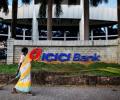
An in-line ICICI Bank result for the quarter ended March 31, 2024, has led to analysts raising target price and earnings per share (EPS) forecast on the stock. ICICI Bank, they said, appeared least vulnerable to regulatory action on its digital offerings or for risk monitoring lapses.
The Sensex is likely to scale 24,000 mark by December-end on receding chances of a fractured verdict in the upcoming Lok Sabha elections, lower inflation and improving global risk appetite, German brokerage Deutsche Securities said on Tuesday.

Experts say the BSE Sensex could rise to around 32,000 in a year.

However, the Polycab share price is up by nearly 80 per cent while Havells' has risen by 39 per cent. The Sensex has gained 26 per cent in this period. The Q1FY25 results were in line for both companies.


Ambuja Cements' announcement that it would acquire Hyderabad-based Penna Cement Industries could be the Adani Group company's first step for wider inorganic expansion, according to analysts.

Indian companies typically have higher return on equity.
