
India's services sector experienced its strongest growth in three months in September, with the HSBC India Services PMI Business Activity Index rising to 55.2, driven by a sharp increase in new orders and strengthening domestic demand.

Indian benchmark indices Sensex and Nifty closed higher for the second consecutive day, primarily driven by robust buying in IT stocks following strong quarterly results and positive global trends. Tech Mahindra notably surged over 8% after reporting a significant jump in net profit.

Indian benchmark indices Sensex and Nifty rebounded in early trade after two days of losses, driven by easing crude oil prices and strong buying in blue-chip IT stocks, despite continued global uncertainties. Track Sensex, Nifty on September 30.

India's nine key infrastructure sectors recorded a three-month low growth of 4.8 per cent in August, primarily due to reduced production in coal, natural gas, crude oil, and fertiliser, according to government data.

Indian equity benchmarks Sensex and Nifty rallied up to 1 per cent in early trade, driven by strong performance in IT stocks, Reliance Industries, and favourable global market sentiment, rebounding from previous losses.

Zoho Corporation has paused annual pay hikes and reduced marketing expenditure, citing a four-fold increase in server prices for AI infrastructure and an uncertain software sector outlook, according to founder Sridhar Vembu.

India's real estate sector recorded an unprecedented $9.5 billion in capital inflows during Q3 2026, primarily driven by foreign investors' strong interest in data centres, according to a CBRE Group report.

The International Monetary Fund (IMF) has increased India's growth forecast to 7 per cent for 2026-27, up from 6.4 per cent, attributing this robust outlook to resilient domestic demand and strong services activity, positioning India as one of the fastest-growing major economies.

India's cement industry is on the brink of an oversupply situation as aggressive capacity expansion by major players is set to outpace demand growth over the next two financial years, potentially leading to pricing pressures and moderated utilisation rates.

French aerospace and defence major Thales views India as a highly dynamic market for avionics, with significant growth potential as Indian airlines expand their fleets. The company, which has a substantial presence and MRO facilities in India, is also exploring opportunities to replicate India-developed solutions globally and sees increased use of AI in development.

Civil Aviation Minister K Rammohan Naidu announced significant opportunities for Micro, Small, and Medium Enterprises (MSMEs) within India's rapidly expanding aviation sector. With Indian airlines ordering over 1,600 aircraft and the aerospace market projected to double by 2035, there's a massive scope for Indian suppliers to integrate into global aerospace supply chains, moving beyond assembly to design and manufacturing.

India's private sector capital expenditure is projected to reach approximately 3.2 trillion in the financial year 2026-27, up from 2.6 trillion in FY26, according to a Reserve Bank of India bulletin report, indicating sustained confidence despite global uncertainties.

"Pressure on the current account is a temporary problem. Sooner rather than later, our external sector will improve," said RBI Governor Sanjay Malhotra.

The Indian corporate sector demonstrated strong credit quality in the first half of FY27, driven by robust balance sheets and healthy liquidity, despite facing risks from elevated crude prices, inflation, and global interest rates.

Domestic telecom gear maker HFCL reported its highest-ever quarterly consolidated net profit of Rs 394.22 crore for the second quarter ended September 30, 2026, a multi-fold increase from Rs 72 crore a year ago, primarily due to strong demand for optical fibre cables from AI data centres.

The Reserve Bank of India's 25-basis point increase in the repo rate to 5.5 per cent is expected to exert pressure on housing affordability and buyer sentiment, particularly affecting interest rate-sensitive segments and potentially moderating sales during the crucial festival season.

Indian IT stocks have experienced their most significant weekly surge in 18 years, with the Nifty IT index climbing 11.72 per cent, as a global sell-off in AI-linked equities redirected investor attention towards India's IT services sector. This shift aligns with a JP Morgan report identifying India as a 'natural AI hedge' due to its large, liquid market and strong domestic institutional investor base.

Indian equity benchmark indices extended losses for a second consecutive session, with the Sensex dropping 143 points, driven by a sell-off in power, banking, and financial stocks, coupled with elevated crude oil prices and persistent FII selling.

Indian banks are projected to achieve healthy profit growth in the second quarter of financial year 2027 (Q2FY27), driven by lower credit costs, robust advance growth, and fee income. However, net interest margins (NIMs) are expected to face pressure due to significant mobilisation of foreign currency non-resident (bank) FCNR(B) deposits.

A panel supported by Congress MLC Satej Patil has won the election for the Kolhapur District Cooperative Milk Producers' Union (Gokul Dairy), defeating the Mahayuti-backed group led by NCP minister Hasan Mushrif. This victory marks a setback for the ruling Mahayuti alliance in western Maharashtra and gives the Patil-backed panel control of the influential cooperative's board.
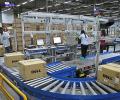
India's manufacturing sector activity surged to a seven-month high in September, driven by a significant acceleration in new orders and output, leading to solid expansion in factory hiring and a four-month peak in business optimism.

Tata Sons Chairman N Chandrasekaran views the group's investment in semiconductors not as a short-term financial play, but as a critical long-term commitment to India's growth and self-reliance in a sector vital for domestic consumption and global supply chains.

Indian information technology (IT) stocks, led by Infosys, experienced a significant selloff, dragging the Nifty to a two-month low, primarily due to escalating West Asian tensions pushing crude oil prices higher, and concerns over upcoming large IPOs diverting funds from secondary markets. The sector is also grappling with the long-term implications of AI disruption.

Domestic passenger vehicle dispatches in India increased by 21.8 per cent year-on-year to 4,54,574 units in September, while two-wheeler sales rose 13.5 per cent to 24.63 lakh units, according to SIAM data.

Domestic rating agency Icra on Monday upped its banking sector outlook to 'positive' on healthy asset growth, improving asset quality and stronger capital buffers. The agency expects asset quality to improve to a decadal best of 4 per cent from a gross non-performing assets (NPAs) perspective by the end of FY24. The banking system's credit growth will slow down to 11-11.6 per cent in FY24, after a very healthy growth of 15.2-16.1 per cent expected in FY23, the rating agency said.

Wipro reported a marginal 1.40 per cent decline in consolidated net profit to Rs 3,200.6 crore for the July-September quarter of FY27, despite a 9.1 per cent increase in revenue from operations to Rs 24,752.7 crore.

L&T Technology Services (LTTS) CEO Amit Chadha announced that artificial intelligence is a net positive for the company, with six key focus areas expected to contribute 80% of revenue in five years. These areas, including digital manufacturing and AI infrastructure, are projected to deliver higher growth and margins, offsetting pricing pressures in traditional IT services. LTTS also inaugurated an NVIDIA-powered AI manufacturing lab in Bengaluru.

India's services sector experienced its weakest growth in four-and-a-half years in July, as new business orders, both domestic and export, eased due to intense competition and declining demand. Despite a modest rebound in job creation and improved profit margins, overall business confidence slipped, reflecting a broader slowdown in the economy.

A dozen companies, including major players like Jio Platforms and Zetwerk Manufacturing Business, are poised to launch Initial Public Offerings (IPOs) in October, continuing India's strong fundraising momentum in the primary market. These offerings span diverse sectors, reflecting sustained investor interest in businesses with robust growth prospects.

Indian equities, particularly the Nifty 50, have significantly underperformed their Asian and global counterparts over the past year, with the index down 10.6 per cent. This lag is attributed to factors like rising global oil prices, rupee depreciation, and a lack of participation in the global chipmaker rally that boosted markets like South Korea and Taiwan.

HDFC Bank reported a 5.55 per cent increase in consolidated net profit to Rs 20,700 crore for the September quarter, with incoming MD and CEO Anup Bagchi indicating a focus on strengthening the balance sheet and addressing retail vertical concerns post-merger.

The Indian government has approved the sale of a 60.72 per cent stake in IDBI Bank Ltd to Canadian billionaire Prem Watsa's Fairfax Financial Holdings Ltd for approximately 52,878 crore, a move that reflects improving India-Canada ties and marks a significant turning point for the bank.
The Indian stock market experienced a significant downturn, with the Sensex crashing over 1,000 points and the Nifty hitting a fresh 52-week low, driven by sustained selling from foreign institutional investors, the RBI's monetary policy tightening, and elevated Brent crude prices.

Indian benchmark equity indices, Sensex and Nifty, rebounded after a two-day losing streak, driven by strong buying in blue-chip IT stocks and positive global market cues, with the Sensex climbing 330.92 points.
Indian benchmark equity indices, Sensex and Nifty, closed higher on Monday, driven by softer-than-expected US jobs data which reduced expectations of aggressive monetary tightening by the US Federal Reserve, boosting risk appetite across emerging markets.

Union Finance Minister Nirmala Sitharaman expressed strong confidence in India achieving over 10 per cent economic growth, advocating for increased technology adoption and innovation. She urged overcoming scepticism and highlighted technology's transformative role in agriculture and public sector reforms, while also launching a new fund and book at an IIT Madras event.

A new HCLTech study reveals that 84% of global wealth management firms recognise the need to redesign their operating models for AI, yet less than 10% are prepared for the transition. The report identifies "blind spots" in ambition, execution, and strategy, hindering effective AI implementation and measurable business outcomes.

A year after GST rates were rationalised, retail growth in automobiles has sustained beyond the initial festival surge, led by two-wheelers and passenger vehicles (PVs), with the Fada data showing rural markets emerging as a key driver of the post-GST demand recovery.

Indian benchmark indices, Sensex and Nifty, closed nearly flat on Thursday, influenced by the US Federal Reserve's interest rate hike and indications of further monetary tightening. Despite some intraday gains, caution prevailed, with foreign institutional investors continuing to offload equities. Meanwhile, the National Stock Exchange of India's (NSE) mega initial public offering opened for subscription, garnering 39 per cent subscription on its first day.
India's Goods and Services Tax (GST) receipts, after accounting for refunds, surged by 18.1 per cent annually to approximately 1.77 trillion in September, marking its fastest growth in six months. This increase was primarily driven by a significant rise in tax revenue from imports, which grew 26 per cent annually.
