
A World Inequality Lab paper reveals significant land inequality in rural India, with the top 10% of households owning 44% of the land, while 46% are landless. The study highlights the impact of historical institutions, social stratification, and agro-ecological conditions on land distribution.

The Indian government has appointed Finance Secretary Tuhin Kanta Pandey as the new chairman of the Securities and Exchange Board of India (SEBI). Pandey, a 1987-batch IAS officer, will replace Madhabi Puri Buch, whose three-year tenure ends on February 28. Pandey's appointment comes at a time when the markets are experiencing bear pressure due to withdrawals by foreign institutional investors (FIIs). Pandey has extensive experience in the finance ministry, having served as the longest-serving secretary in the Department of Investment and Public Asset Management (DIPAM) and the Department of Public Enterprises (DPE). He also played a key role in the framing of the 2025-26 Budget and the drafting of the new Income Tax Bill. Pandey's appointment is for an initial period of three years.

Seasoned bureaucrat and a stickler for rules Finance Secretary Tuhin Kanta Pandey will be at the helm of capital market regulator, Securities and Exchange Board of India (SEBI), for three years. The 1987-batch Odisha-cadre Indian Administrative Service (IAS) officer, Pandey, would replace Madhabi Puri Buch, whose three-year term ends on Friday.


'Those betting against PSUs will likely be punished in this upswing.'

Domestic institutional investors (DIIs) have infused a record Rs 4.6 trillion into Indian equities over the course of Samvat 2080, marking the highest net annual investment in any Samvat to date. This robust domestic inflow has effectively counterbalanced the comparatively subdued investments from foreign portfolio investors (FPIs), who contributed a net Rs 90,956 crore within the same timeframe. Against this backdrop, the Nifty 50 and BSE Sensex indices are on track to achieve their best performance in three Samvat years, despite recent market corrections.
The Union government on Wednesday constituted a Board for Reconstruction of Public Sector Enterprises.\n\n\n\n

The government is not in a "crazy rush" to sell everything and it will continue to have a presence in four strategic sectors, including telecom, Finance Minister Nirmala Sitharaman said on Saturday. In strategic sectors, a bare minimum presence of the existing public sector commercial enterprises at the holding company level will be retained under government control. The remaining enterprises in a strategic sector will be considered for privatisation or merger with another PSE or for closure.

Rediff.com Contributing Photographer Pradeep Bandekar captures glimpses of the stars over the weekend.

The last year has seen public sector undertakings (PSUs) outperforming the Nifty50, albeit by a small degree. But PSU valuations are still, on average, less than half of private sector peers at price-to-equity or PE 8.7x for the Nifty PSU Index versus 20.9x for the Nifty50. There are several reasons for lower valuation.
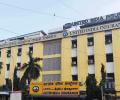
The NITI Aayog has recommended privatisation of state-owned insurer United India Insurance Company as the government aims to move ahead with its new public sector enterprise (PSE) policy for Atmanirbhar Bharat. The policy think tank has suggested that the public sector insurer be considered for privatisation in the banking, insurance and financial services sector, which has been classified as 'strategic' in the PSE policy, said an official. The policy proposes the "bare minimum" presence of government-owned companies in strategic sectors, and privatisation, merger or closure of remaining public sector undertakings (PSUs).

Government-owned companies are more generous in rewarding their shareholders with dividends.

Changing tracks helps. But, not taking the beaten path isn't always helpful. This is the story of two of India's biggest privatisations - Air India and Bharat Petroleum (BPCL). Nearly two decades after the last privatisation, a landmark divestment concluded this year when the loss-making national carrier Air India was sold to the Tatas.
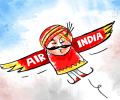
Air India sale will give a boost to India's privatisation drive, the Economic Survey said on Monday, as it suggested redefining the public sector role in business enterprises to encourage private participation in all sectors. The government earlier this month handed over ownership rights in national carrier Air India to Tata Group for Rs 18,000 crore. The amount includes the takeover of the debt burden of Rs 15,300 crore and another Rs 2,700 crore in cash.

Re-rating of Bharat Petroleum Corporation, Container Corporation, Shipping Corporation, SAIL, and Hindustan Copper, for which the government has already shown intent to divest its stake, possible now, say analysts.
With the new owner shelling out Rs 18,000 crore for the buyout of 'Maharaja' this would be the highest ever amount garnered through privatisation or even the cumulative sum garnered through strategic sale in 1999-00 to 2003-04. The government had garnered roughly over Rs 5,000 crore during that five-year period by privatising 10 CPSEs.
After a hiatus of nearly two decades, the government's programme to privatise state-owned firms restarted with the handing over of debt-laden national carrier Air India to the Tata Group. With the new owner shelling out Rs 18,000 crore for the buyout of the 'Maharaja', this would be the highest-ever amount garnered through privatisation, and is even more than the cumulative sum mopped up through strategic sales from 1999-00 to 2003-04. The government had in October last year inked the share purchase agreement with the Tata Group for sale of national carrier Air India for Rs 18,000 crore. Tatas would pay Rs 2,700 crore cash and take over Rs 15,300 crore of the airline's debt.
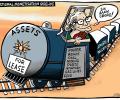
But use of that word -- privatisation -- is not encouraged. This seems to be a classic case of reforms through subtle signals, observes A K Bhattacharya.
The share of public sector undertakings (PSUs) in the total market capitalisation of listed companies--at an all-time low of 10 per cent currently --- may get a leg-up from the government's divestment push. Recently the government announced the successful sale of national carrier Air India to Tata Sons, India's first privatisation of a PSU since 2002-03. The transaction is expected to be completed by December.

The walk through enclosure is designed for personnel decontamination, one person at a time. It is a portable system equipped with sanitiser and soap dispenser, officials said.
The Left Front government in West Bengal will close down two public sector enterprises (PSEs), offload shares in nine PSE to hive them off as joint ventures, retain 13 enterprises and decide on three more using a line of credit from UK's Department for International Development (DFID) worth 23 million pounds.

To counter the pandemic, air transport was suspended from March 25 till May 24 which rendered zero traffic at AAI airports. Even after resumption of flights, traffic is yet to pick up at airports due to quarantine measures implemented by states and an overall fear of flying.
In an effort to leverage sick public sector enterprises, the Cabinet on Thursday approved cash incentives for their chief executives or functional directors.

A better system of operating central and state PSEs, and indeed all commercial activities of the government, would require eliminating the current system that oversees them.
Shanghai tops returns charts among emerging markets.
Public Sector Enterprises contributed over Rs 95,000 crore (Rs 950 billion) to the government exchequer during the financial year 2004-05
Hyundai Motors India entered into an alliance with State Bank of India on Wednesday to provide special finance scheme for central public sector enterprise employees.
The Cabinet Committee on Economic Affairs on Thursday gave an in-principle approval for listing of unlisted profitable public sector companies with a net worth of more than Rs 200 crore (Rs 2 billion).

Prime Minister Narendra Modi on Wednesday said the government has no business to be in business and his administration is committed to privatising all PSUs barring the bare minimum in four strategic sectors. "It is government's duty to support enterprises and businesses. But it is not essential that it should own and run enterprises," he said. Modi also said the Centre's policy is to either monetise or modernise public sector enterprises, with the intent that the government has "no business to be in business".

The government on Monday announced a one-time Rs 10,000 interest-free festival advance to all its officers and employees as part of plans to increase consumer spending to spur demand in the economy.

EY said out of the nearly Rs 21 lakh crore package, Rs 8.01 lakh crore is on account of liquidity enhancing measures taken by the RBI since February.
Tech Mahindra and United Spirits will replace them in the 50-share index of the National Stock Exchange with effect from March 28.
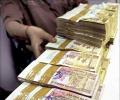
India's public debt decreased marginally to Rs 46,25,037 crore (Rs 46.25 trillion) at end-March 2014 from Rs 46,29,689 crore (Rs 46.29 trillion) at end December 2013.
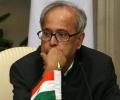
The President noted that the green shoots of recovery were already visible, with the economy growing at 5.7 per cent during the first quarter of current fiscal.

The rally followed the govt's plan to bolster state-owned lenders.
 © 2026 Rediff.com - Advertise with us - Disclaimer - Privacy Policy - Sitemap - Feedback - About us - Terms of use - Grievances