US-based chip maker Intel has signed an agreement with Tata Group to manufacture and assemble semiconductors in India for the local market, the Indian conglomerate said on Monday.

The Indian government has approved two major manufacturing initiatives worth nearly Rs 1.9 lakh crore (USD 22 billion) to expand the country's semiconductor ecosystem and scale up mobile phone production, aiming to strengthen its position as a global electronics manufacturing hub.
Prime Minister Narendra Modi is set to inaugurate a semiconductor plant in Sanand, Gujarat, and launch multiple development projects worth over Rs 20,000 crore, marking a significant boost to India's semiconductor industry and infrastructure.

Tata Steel more than doubled its Indian capacity through acquisitions and expansion, strengthening cash generation as it pursued a costly restructuring of its European operations.

Semiconductor makers need thousands of engineers and technicians, and though India has one of the largest pool of engineers in the world, they do not have experience in the semiconductor manufacturing space.

Modi inaugurated the Semicon India 2025 in Delhi, in the presence of Chief Minister Rekha Gupta, and Union Minister of Commerce and Industry Jitin Prasada.

'The world now realises that semiconductors are not just important for national security, but also for economic prosperity.'

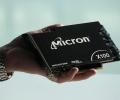
The government is close to approving a proposal by Micron Technology to set up an assembly, testing, marking and packaging (ATMP) facility in the country involving an investment of about $1 billion. The world's fifth largest semiconductor company, based in Idaho, USA, will use the facility to process some of its own wafers, manufactured across the globe.

India is all set to make its presence felt in the $47 billion global outsourced semiconductor testing and packaging market, an arena where Malaysia and Vietnam have been way ahead so far. The Cabinet last Thursday cleared two projects, the Tata's assembly testing and packaging plant (ATMP) and the Murugappa-owned CG Power with Renesas from Japan as its tech partner. These, together with Micron's assembly and testing plant which is already being constructed in Sanad in Gujarat, will collectively invest Rs 47,300 crore to set up the factories.
India and Vietnam are vying with each other to woo semiconductor companies to their country. With the tension between the US and China escalating, and Taiwan getting vulnerable both countries are trying to present themselves as alternative destinations for global players. Vietnam, which started the effort as early as 2010, has got a leg-up after US President Joe Biden's visit last month.

The government has cleared US-based chip maker Micron's project to set up a semiconductor test and packaging unit worth USD 2.7 billion in the country, according to sources. The approved project is expected to create 5,000 jobs. "The project was cleared about a week back," a source said, confirming details of the project.

The Uttar Pradesh government and iPhone maker Foxconn have started discussions to set up an electronics manufacturing unit in the state, sources aware of the development said. The investment pitch was made by Invest UP to Foxconn at the time of the final land allocation for the HCL-Foxconn chip joint venture Vama Sundari.
The exclusive club that dominates the global semiconductor fab scenario is about to get a new member. Taiwan, South Korea, and China control nearly 70 per cent of the global capacity. SEMI, the global industry body for semiconductor and electronics design and manufacturing, projects all fabs collectively will churn out 30 million wafers a month this year.

OSAT majors have concerns about India's ability to provide a stable, predictable, and lasting policy environment for years to come, which is key for making a decision in a capital-intensive business.

Their favourite alternatives: Malaysia, Vietnam and the Philippines. Note, India is missing from that list. And this is despite an attractive financial incentive scheme for OSAT players. The reason, said a senior executive of a US chip company who had a meeting in Taiwan just a few weeks ago, is that "they want more predictability in government policy because they plan to put in big money."
The Indian government is keen to woo major semiconductor players, but a global race to attract them to countries where there is already an ecosystem is making it difficult for India to attract the biggies in the business. On Wednesday the government decided to throw open the doors to more players to participate in its semiconductor scheme. It is now looking at not only 28 nanometre (nm) chips and below, but higher nodes like 40 nm.

'Those trying to use these funds for quick gains should avoid them due to risk of being late to the party.'

Clearly, Foxconn Chairman Young Liu and his team are looking to raise their game in India.

The first leg of Micron's semiconductor play in Sanand is crucial for the company to sprint towards India's goal of joining the chip race.
Mumbai-based Indian Semiconductor Manufacturing Company (ISMC) and Singapore-headquartered IGSS Ventures have one strategy in common: They have told the government in their application for semiconductor fabrication plants that they will export the bulk of the chips they make in India in the initial five or 10 years. The third applicant, Vedanta-Foxconn, which is also building a fab plant, has said it will concentrate on the needs of consumer electronics and mobile device markets, and earmark 80 per cent of output for domestic consumption, but has not specified its customers. Finding a viable domestic market could well be the biggest challenge for India's renewed tryst with semiconductors. Fab plants do not sell directly to end users but to intermediary chip design companies - such as Qualcomm or MediaTek.
Is self-reliance the right approach in a mega-buck game, or better to be part of a network? asks T N Ninan.

Rather than focussing on manufacturing, Indian companies need to concentrate on conceiving, designing and branding products.

'It is in electronics that the gap between where we are and where we need to be is most obvious and most persistent.' 'It is not only a national security issue, but also a commercial issue,' argues Rajeev Srinivasan.
India is today one of the top locations for semiconductor design and embedded software, but it remains hidden under a generic and misleading name, IT/ITES services.
