Making life easier for people, the Reserve Bank on Thursday allowed holders of pre-paid payment cards, to deposits school and college fees and pay taxes in addition to buying rail and air tickets within the prescribed limit of Rs 10,000.
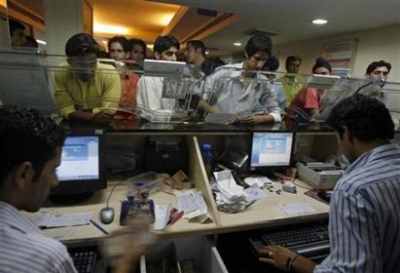
Criterion for corporates will effectively rule out entry for business houses.

The new regulations by the Reserve Bank of India (RBI) on microfinance have prompted MFIs to go for a makeover, in order to cope with the new limitations imposed on them.

During the meeting with Finance Minister Nirmala Sitharaman, it was also suggested that employees' provident fund should increase its exposure in the stock market, which in turn would improve liquidity.

Gold loan companies offer loans to financially-excluded customers and MSMEs by enabling them to monetise their gold without the need for documentary proof of income
A staunch defender of demonetisation, it would be interesting to see how he handles the government's increasing demand for more cash from the RBI, and letting some weak banks get out of prompt corrective action.

The Reserve Bank, in Annual Monetary Policy Statement, has also asked banks to set up internal exposure limits for those non-banking financial companies who have gold loans portfolio of more than 50 per cent of the total financial assets.

Banks have been demanding a single centralised registration system, like at present, as they feel multiple registrations would create procedural and compliance problems.

For smaller MFIs, resuming operations is more difficult because they haven't got any fresh bank credit sanctioned from their lenders.

'The situation is quite terrifying as you have no job creation and there will be loss of jobs.'

Sector-wise, the study revealed that the core industries have witnessed virtually negative growth in headcount, with crude oil just about maintaining the employment level.

'The shadow banks are currently facing a liquidity and solvency crisis.' 'The danger is that it could potentially engulf the entire financial system because shadow banks have borrowed huge amount of money from banks, mutual funds, pension funds, and insurance companies.'

The BJP hailed teh package, saying it reflected the government's commitment towards creating jobs and stimulating the economy.

There could be multiple measures announced in quick succession, not only by the finance minister but also other ministers regarding their respective sectors, and by the Reserve Bank of India. The total size of these announcements could rival that of other G-20 nations as a percentage of GDP.

'And the top 10 per cent will grow because they have to serve the market.'

A discount on the product may make a credit card loan seem cheaper than a consumer durable loan. But missing a payment in case of the former will mean exorbitant charges.
'A strong foreign exchange reserve is the best safety net against global spillovers.'

Yes Bank was the top loser in the Sensex pack, crashing 8.36 per cent, followed by NTPC, M&M, Vedanta, Sun Pharma and TCS, which lost up to 4.81 per cent lower.

Banks, through the Indian Banks' Association, have urged RBI and credit information companies to maintain a database of wilful defaulters.

Wipro, Steel Authority of India, HDFC Bank, Mahanagar Telephone Nigam, Bharat Heavy Electricals and Reliance Commnications among companies reporting a decline in headcount in FY17.

"RBI will given additional licences" for setting up banks in the country, he said presenting the budget for 2010-11 in the Lok Sabha.

Frequent balance transfer in search of a lower rate can be tricky for borrowers, if property prices fall

The most common complaint of financial consumers is cumbersome processes, complicated products, usurious charges, and mis-selling of products, which finally don't deliver what is promised or as expect, notes Debashis Basu.

'India's march towards being a $5 trillion economy continues, notwithstanding momentary setbacks.' 'India is at an inflexion point and most economists believe this growth super-cycle will extend for over four decades.'
Financing against gold being a secured form of lending and higher margins are key reasons.

The Reserve Bank on Monday cautioned people against money schemes offering assured high returns and asked them not to have deposits with unauthorised non-banking finance companies (NBFCs), which falsely claim to have approval from the central bank to conduct business.

The finance ministry's plan to offer basic banking licences may find few takers because of doubts over the commercial viability of the proposed business model.
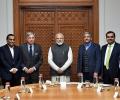
Further stimulus measures are expected in the upcoming Budget where the focus is likely to be on reforms, including some structural measures such as reducing red tape and boosting foreign direct investment. The meeting with industrialists is in the series of discussions that Modi has had during the last couple of weeks to seek suggestions to revive growth.

Half a dozen stocks from the large-cap universe and over two dozen from the mid-cap universe have been replaced.

Welcoming the latest round of stimulus announced by Finance Minister Nirmala Sitharaman on Thursday, experts said the measures will support the economic recovery boosting demand, job creation and by providing funds to the MSME and stressed sectors. The fiscal impact of the stimulus is likely to be around 0.25-0.6 per cent of GDP in the current fiscal, they said.
PM's economic advisory council chairman C Rangarajan has asked microfinance institutions (MFIs) to overhaul their "flawed" business model for sustainability.

'Several businesses like entertainment, hospitality, travel etc would never be the same again.'

Owing to the risk perception attached with the segment by banks, the residential realty segment has been increasingly relying on non-banking financial companies and housing finance companies to raise debt financing, reports Abhijit Lele.

Every political party loves to use the bait of loan waiver to woo the electorate. If their hearts bleed for the poor, they can always use the party funds to pay off the lenders, suggests Tamal Bandyopadhyay.

Even if Mudra steps in to play its main role of refinancing at some stage, the responsibility for the bad loans remains with the banks.

'The economy is expected to bounce back and things are expected to recover faster than what we previously thought.'

A bunch of CEOs in their mid-30s and early 40s are trying to rectify the scenario where shady lending applications trap hapless borrowers with astronomically high interest rates and even bodily harm if the money was repaid. Anup Roy reports.

The infra-major going belly up cracked open some major flaws in the system - the most evident being weak corporate governance and how layers of corporate structures could be formed adding to the opaqueness of the group.
It's not widely advertised, but a few banks and non-banking finance companies (NBFCs) provide loans against used cars.

In HDFC Life, the company has to pare 1.43 per cent, and in HDFC Ergo, it has to pare only 0.58 per cent.
