
While the latest trigger for him stepping down could be the uncertainty around his renewal as a director at the AGM, which is otherwise a routine matter, Chandra may have been contemplating quitting for some time now because of the overall turbulence with the principal shareholder on the leadership issue.

Bajaj Finance, India's largest private-sector NBFC, reported a 29 per cent year-on-year increase in standalone net profit to 5,346 crore for Q1FY27, propelled by robust growth in net interest income and assets under management, which surpassed 4 trillion.

Non-banking financial companies (NBFCs) reported encouraging results for Q4FY26 with improved asset quality and earnings, but analysts maintain a cautious near-term outlook due to geopolitical tensions, monsoon risks, and specific portfolio concerns.

Bharti Airtel is strategically shifting its focus towards data centres, cloud services, and financial services as key drivers for its next phase of growth, leveraging significant past investments in digital infrastructure, as outlined by Chairman Sunil Mittal in the company's Annual Report for 2025-26.

CRISIL Ratings predicts that the share of bank loans in NBFCs' overall borrowings will increase to 44-45 per cent by FY27, driven by elevated bond yields and softening bank lending rates.

Commercial banks in India recorded their highest credit growth in two years, accelerating to 18.6 per cent year-on-year by June 27, while also mobilising nearly 7 trillion in deposits, marking the third-highest fortnightly deposit growth in 29 years.

Tata Capital is set to launch India's largest ever initial public offering (IPO) by a non-banking financial company (NBFC), valuing the Tata group firm at Rs 1.38 trillion. This will make the company India's fifth-most-valued NBFC after Bajaj Finance (Rs 6.12 trillion), Bajaj Finserv (Rs 3.2 trillion), Jio Financial Services (Rs 1.87 trillion), and IRFC (Rs 1.59 trillion).

Fintech giant Paytm reports a consolidated profit of Rs 183 crore in Q4 FY26, marking a significant turnaround driven by its core payments business, growth in loans, and consumer-side profitability. The company is also prioritising investments in AI and has ruled out applying for an NBFC licence.

The top agenda of the meeting includes a review of Tata Trusts representation on the Tata Sons board.

'We are staying away from making forward-looking statements on when we will reach 1 trillion, etc. But growth will be rapid; it's only a matter of time.'

If Tata Sons is listed, the special veto rights of Tata Trusts, under Article 121A, may have to go away.

A crucial Tata Trusts board meeting was unexpectedly postponed, highlighting internal conflicts over veto power, Tata Sons listing, and trustee eligibility, raising concerns about the stability of the $180 billion conglomerate.

A board meeting of Tata Sons, the holding company of the Tata conglomerate, concluded in Mumbai, with discussions likely revolving around mounting losses in unlisted businesses and the future of Chairman N Chandrasekaran amid rising internal frictions.
Bernstein brokerage firm maintains 'Outperform' rating for Paytm, stating the PPBL licence cancellation will not impact Paytm's business and may open new regulatory opportunities.

Students and families must stress test repayment capacity based on Indian salary standards.

Several non-banking financial companies (NBFCs) are observing an increase in early-stage delinquencies within their micro, small and medium enterprises (MSME) loan portfolios, primarily driven by supply chain disruptions and escalating raw material costs exacerbated by the ongoing conflict in West Asia.

The Reserve Bank of India's 2024 norms for the voluntary conversion of Small Finance Banks (SFBs) into universal banks, particularly the subjective 'diversified loan portfolio' criterion, are proving to be a significant hurdle, with Ujjivan SFB and Jana SFB having their applications returned.

Despite recent share price dips, Bharti Airtel is strategically positioned for growth, driven by investments in data centres via Nxtra, a potential tariff hike, and strong performance in Africa, alongside efforts to deleverage and expand its subscriber base in underpenetrated rural markets.

The Reserve Bank of India (RBI) on Friday allowed multiple entities in a bank group to undertake the same business as long as they cater to different client segments, while mandating board approval to ensure that any overlap in business has proper rationale and justification.

India's first maritime lender, state-owned Sagarmala Finance Corporation Ltd (SMFCL) hit the ground running with a Rs 4,300 crore disbursement announcement last Tuesday, within months of being registered as a non-banking financial company (NBFC) in June 2025.

Tata Sons, now debt-free, has asked the RBI to drop its 'upper-layer NBFC' tag and allow it to stay private.

Leading non-banking financial company (NBFC) Shriram Finance on Friday said Japan-based MUFG Bank would invest Rs 39,618 crore, or $4.4 billion, to acquire a 20 per cent stake on a fully diluted basis through a preferential issue of equity shares.

Food and grocery delivery major Zomato has pulled the plug on its plan to enter the lending business. Zomato Financial Services, a wholly-owned subsidiary of Zomato, has withdrawn its application for a non-banking financial company (NBFC) licence with the Reserve Bank of India (RBI), stating that the company does not have plans to pursue lending in the future. "There is no material impact on the revenue/operations of the company and this disclosure is being made voluntarily," the Gurgaon-based company said in a regulatory filing on Tuesday.

Canadian firm Manulife and Mahindra & Mahindra (M&M), an Indian automaker with interests in financial services, have signed an agreement to form a 50:50 life insurance joint venture (JV) with a total capital commitment of up to Rs 3,600 crore each totalling Rs 7,200 crore.

'There is a challenge in repositioning yourself, maybe reinventing yourself.'
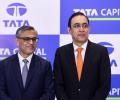
Tata Capital Ltd, set to launch its IPO next week, has identified green financing and digital innovation as its core growth pillars, backed by the merger of its IFC-backed subsidiary Tata Cleantech Capital in 2024. By FY25, the cleantech and infrastructure finance book reached Rs 18,000 crore, growing at a 31.8 per cent CAGR over the last two years, the NBFC said on Friday.
Clarity on Tata Sons' position on listing, as of 2025, would help define the future of the group better, irrespective of the RBI stand. As of now, the ball is in the RBI's court, and everyone is watching the space, points out Nivedita Mookerji.

The initial public offering of non-banking financial company Tata Capital Ltd got fully subscribed on the final day of bidding on Wednesday. The company's Rs 15,512 crore share sale received bids for 45,84,78,044 shares against 33,34,36,996 shares on offer, translating into 1.38 times subscription, according to NSE data till 13:36 hours.

Payouts to key management personnel in non-banking financial companies (NBFCs) are under the banking regulator's scrutiny. Top industry officials said this is a follow-through on the Reserve Bank of India's (RBI's) circular of April 29, 2022, which asked NBFCs in the "middle" and "upper" layer of its four-tiered scale-based regulatory (SBR) framework to put in place a board-approved compensation policy.
Non-banking financial companies (NBFCs) such as Bajaj Finance, Shriram Finance, Muthoot Finance, and IIFL Finance have regained their growth momentum after losing market share to banks in the post-Covid period. The growth surge is being led by diversified lenders and gold-loan companies while development-finance institutions such as Power Finance Corporation (PFC), REC, and Housing & Urban Development Corporation (Hudco) continue to grow at a slower pace.

Ask rediffGURU and PF expert Nitin Narkhede your mutual fund and personal finance-related questions.

Non-banking financial company (NBFC) Tata Capital is set to launch its much-anticipated $2 billion (Rs 17,200 crore) initial public offering (IPO) in the week beginning September 22, market sources familiar with the matter said on Sunday. The issue is expected to value the company around $11 billion, they added. Tata Capital is likely to make its stock market debut by September 30.
Asset quality within the non-banking financial sector (NBFCs) deteriorated with the share of stressed assets rising to 5.9 per cent in March 2025 from 3.9 per cent in September 2024, according to the Reserve Bank of India's Financial Stability Report (FSR). Slippage ratios among upper layer NBFCs have been rising, along with an upward trend in loan write-offs.

Billionbrains Garage Ventures, the parent company of stock broking firm Groww, on Thursday fixed a price band of Rs 95-100 per share for its upcoming Initial Public Offering (IPO), targeting a valuation of over Rs 61,700 crore (about $7 billion). The company's Rs 6,632 crore IPO would open for public subscription on November 4 and conclude on November 7, according to a public announcement.

When evaluating bonds, returns shouldn't be the sole factor. Pay close attention to the bond's credit rating. It should ideally be AA or higher.

Indian corporates collectively raised over Rs 17,500 crore from the domestic debt capital market through bond issuances on Tuesday. The issuances were led by Bharti Telecom's Rs 10,500 crore fundraise in two tranches, the largest by an Indian company in the domestic market so far in FY26.

Flipkart has received a lending licence from the Reserve Bank of India (RBI), the Walmart-backed ecommerce company confirmed on Thursday. The nod came in March this year, according to sources.

SP Group chairman Shapoorji Pallonji Mistry on Friday reiterated calls for public listing of Tata Sons to bring transparency, amid infighting among trustees of Tata Trusts which controls a 66 per cent stake in the holding company of the salt-to-software conglomerate. Shapoorji Pallonji family is the single largest minority shareholder with about 18.37 per cent in Tata Sons.

The government is developing ports across the country as centres for green hydrogen production and export, Sarbananda Sonowal, minister of ports, shipping and waterways (MoPSW) said on Tuesday. "Across the country, over 12 million tonnes of green hydrogen-based e-fuel capacity has been announced.

Banks and NBFCs are launching festival offers, including lower loan rates, cashback, EMI schemes and GST-linked benefits to tap rising demand ahead of Diwali
