
The Andhra ordinance and SKS IPO have abruptly changed the industry's prospects

The year 2010 was a tumultuous one for micro-finance institutions (MFIs) in India.
The KAS Foundation is touching the lives of 700,000 people.

The Micro Finance Institutions (Development and Regulation) Bill, 2012, is currently being scrutinised by a Parliamentary Standing Committee.
The plan has received positive feelers from Canara Bank, which, along with others, will together hold 49 per cent. The MFI will be set up with a capital of Rs 100 crore (Rs 1 billion).

The Confederation of Indian Industry (CII) has urged the Indian government to gradually restore the Rs 10-per-litre cut in special additional excise duty on petrol and diesel over six to nine months. This move aims to relieve pressure on government finances as crude oil prices stabilise, without significantly impacting consumer sentiment.

Brokerages were divided on Bajaj Finance after its 2025-26 (FY26) third-quarter (October-December/ Q3) results, with a few raising targets on valuation comfort, while others flagged concerns over the credit cost trajectory.

A government mandate requiring central public sector enterprises to use the Trade Receivables Discounting System (TReDS) for settling small business invoices is expected to significantly increase volumes on these platforms.

Even if there is an early agreement on a cessation of hostilities in West Asia, the price shock will not go away easily, points out A K Bhattacharya.

The Confederation of Indian Industry (CII) has proposed a 20-point policy agenda to the finance ministry, including a conflict-linked emergency credit line guarantee scheme and tax rationalisation on energy inputs, to support MSMEs, exporters, and energy-intensive industries affected by the ongoing West Asia war.

The Reserve Bank of India's 2024 norms for the voluntary conversion of Small Finance Banks (SFBs) into universal banks, particularly the subjective 'diversified loan portfolio' criterion, are proving to be a significant hurdle, with Ujjivan SFB and Jana SFB having their applications returned.
The government has released the draft Micro Financial Sector (Development and Regulation) Bill, 2011, which seeks to make it mandatory for all microfinance institutions to be registered with the Reserve Bank of India, making it the sector regulator.

India's urban areas are projected to contribute 70 per cent of gross domestic product in 2025-26, up from 45 per cent in the 1990s, according to a report by Dun & Bradstreet.
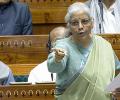
Finance Minister Nirmala Sitharaman launched a strong attack on Rahul Gandhi and the Congress party, accusing them of compromising India's interests on the world stage and selling out farmers and the poor during their time in power.

Bajaj Finance's shares fell more than 7 per cent on Tuesday after it trimmed growth guidance for FY26, from 24-25 per cent projected earlier to 22-23 per cent.

'Credit growth in India remains in double digits, even though corporate borrowing is subdued.' 'Corporate credit is weak because companies are cash-rich and cautious amid global uncertainty.'

'Bank has a robust capital adequacy base. Along with balance sheet preparation, the bank is focusing on strengthening risk management for the new regime.'

The Budget emerges as a measured, credible and forward-looking policy document that reinforces India's commitment to remaining a stable, reform-oriented economy amid an increasingly fragmented global landscape, says A Balasubramanian.

'The trade deficit in some sectors is huge and that is an area of opportunity to localise.'

The Union Budget for 2026-27, presented by Finance Minister (FM) Nirmala Sitharaman on Sunday, which was a first, had an excellent domestic macro backdrop. According to the first advance estimates, gross domestic product (GDP) in constant prices is projected to grow 7.4 per cent in the current financial year, against 6.5 per cent in 2024-25.

Finance Minister Nirmala Sitharaman's biggest challenge will be to find a new growth driver, particularly against the backdrop of a global economy ravaged by heightened uncertainty and fragmentation, financial markets on a precipice, and global commodity prices on a continued uptrend.

This is the first Budget in my memory of Budgets over the last half a century which has embraced upfront, enthusiastically and emphatically, technology, modernity and fiscal sobriety, notes Shreekant Sambrani.

The idea of back-loading the target of fiscal consolidation is perhaps guided by the government's desire to be prepared for any adverse developments in the coming year, points out A K Bhattacharya.

Customs regimes can lead to labyrinthine legal disputes. Budget 2026 must recognise that an excessively defensive Customs posture can itself become a trade barrier, point out Mukesh Butani and Shankey Agrawal.

Gurugram, already established as the corporate hub of Delhi-NCR, is increasingly attracting developers from outside the region, drawn by robust end-user demand, premium pricing, and emerging development opportunities.

Total pending Customs arrears, including amounts under litigation, court stays and cases where the appeal period has not expired, stood at about Rs 1.36 trillion at the end of December 2024.

Leading non-banking financial company (NBFC) Shriram Finance on Friday said Japan-based MUFG Bank would invest Rs 39,618 crore, or $4.4 billion, to acquire a 20 per cent stake on a fully diluted basis through a preferential issue of equity shares.

Restoring weighted tax deductions and adopting a petty patents regime can foster firm-level innovative activity critical for competitiveness, points out Nagesh Kumar.
Any initiative backed by a political institution and intention, would not achieve the desired result of serving the common man. The pre-condition of success is its management by a private entity with ownership shared between the promoters and the common people.

'The tools of warfare are changing. The MoD must deepen its engagement with technology thinkers that can present compelling visions of where warfare may be heading.'
'This micro-finance sector has seen a tremendous upsurge in the recent time. There is a huge potential in this domain'.

This was perhaps a missed opportunity for India to spotlight a core domestic challenge: The scale of workforce preparation required for a young, populous, rapidly growing country seeking to reach net zero, points out Radha Roy Biswas.

'The campaign by the Mahagathbandan has failed to capture the imagination of the electorate given the fatigue factor with the Nitish government.'

India needs to increase the investment rate to 34-35 per cent from 31-32 per cent currently to achieve a growth rate of 7 per cent and above, said S Mahendra Dev, chairman, economic advisory council (EAC) to the Prime Minister, on Wednesday.

India is on track to exceed the $4 trillion milestone in 2025-26 (FY26), surpassing the $3.9 trillion gross domestic product (GDP) mark recorded at the end of March 2025, Chief Economic Adviser (CEA) V Anantha Nageswaran said on Tuesday.
 © 2026 Rediff.com - Advertise with us - Disclaimer - Privacy Policy - Sitemap - Feedback - About us - Terms of use - Grievances