
The Goods and Services Tax (GST) Council has announced that Input Tax Credit (ITC) will now be available on health and life insurance policies provided by employers to their employees, a move expected to significantly reduce costs for businesses, especially MSMEs.


Major life insurers in India reported close to double-digit growth in the value of new business (VNB) last financial year, primarily driven by increased sales of high-margin protection and non-participating (non-par) products.

New business premium of life insurance companies grew 18 per cent year-on-year (Y-o-Y) to Rs 35,417 crore in February, driven by robust growth at the state-owned Life Insurance Corporation of India (LIC) due to a favourable base.

The committee formed under the Life Insurance Council to review the commission structure in the life insurance sector has recommended capping distributor commissions or deferring them to ease acquisition costs. The recommendations will be sent to the insurance regulator -- Insurance Regulatory and Development Authority of India (Irdai).

A former life insurance manager in Thane has been sentenced to two years in jail for defrauding people of over Rs 3.51 crore with false promises of high returns on stock market investments.
The life insurance industry recorded nearly 40 per cent year-on-year (Y-o-Y) growth in new business premiums (NBP), aided by the rationalisation of goods and services tax (GST) on individual life insurance premiums, which has made policies more affordable for consumers.
The loss of input tax credit (ITC) following the rationalisation of the goods and services tax (GST) on individual life and health insurance from 18 per cent to nil is may weigh on the profits of life insurers in the third quarter (Q3) of 2025-26 (FY26).
Life Insurance Corporation of India (LIC) is facing a thinning of its top management as Managing Director Dinesh Pant exits to join Irdai, leaving one of four MD posts vacant. This comes amidst broader staffing challenges across several public sector insurers and a headless Financial Services Institutions Bureau (FSIB).

Shares of Indian life insurance companies, particularly SBI Life Insurance and Canara HSBC Life Insurance, saw significant declines after the Department of Financial Services (DFS) secretary, M Nagaraju, stated that banks are being asked to avoid exclusive tie-ups with their own insurance subsidiaries and instead remain neutral.
New business premiums of life insurance companies dropped 5.2 per cent year-on-year (YoY) in August to Rs 30,959 crore, owing to a double-digit decline reported by state-owned Life Insurance Corporation (LIC), data from the Life Insurance Council showed. LIC recorded a 17 per cent YoY fall in new business premiums to Rs 16,023 crore during the month, while private life insurers reported a 12 per cent YoY increase to Rs 14,936 crore.

Premature surrender and withdrawal of life insurance policies in India have surpassed maturity payouts over the past five years, indicating a growing trend of policyholders exiting long-term policies before their full tenure, according to data presented in the Lok Sabha.

The reduction in goods & services tax (GST) on individual life and health insurance premiums has been called a "landmark step" for making insurance affordable and inclusive. In a panel discussion at the Business Standard BFSI Insight Summit 2025, Anup Bagchi, managing director (MD) & chief executive officer (CEO) of ICICI Prudential Life Insurance; Mahesh Balasubramanian, MD & CEO of Kotak Life Insurance; Tarun Chugh, MD & CEO of Bajaj Life Insurance; and Ratnakar Patnaik, MD of Life Insurance Corporation of India (LIC), listed what else the industry needs to reach more people.

The CBI has filed a charge sheet in a Rs 3,750-crore cheating case against Reliance Communications Ltd. (RCom), former executives of the Reliance ADA Group, and a former Chief Investment Officer of Life Insurance Corporation of India (LIC). The case involves LIC subscribing to NCDs worth Rs 1,500 crore from RCom in 2012 based on alleged misrepresentations, with funds subsequently diverted to ADA group companies, causing wrongful loss to LIC.

The Indian Cabinet has approved Fairfax Financial Holdings' Rs 52,878 crore bid to acquire a 60.72 per cent stake in IDBI Bank, marking the country's largest foreign direct investment in the financial sector.

Canadian firm Manulife and Mahindra & Mahindra (M&M), an Indian automaker with interests in financial services, have signed an agreement to form a 50:50 life insurance joint venture (JV) with a total capital commitment of up to Rs 3,600 crore each totalling Rs 7,200 crore.

The CBI has registered a case against Reliance Capital Limited (RCAP), its former chairman Anil Ambani, and others for an alleged Rs 2,684.57-crore fraud involving investments made by the Life Insurance Corporation of India (LIC). Anil Ambani has denied any wrongdoing. The LIC alleges criminal conspiracy, misrepresentation, and fraudulent diversion of funds.
Some of the leading life insurance companies have reported a sharp decline in the number of lives covered in FY25, largely due to a slowdown in credit-linked life insurance policies. Stress in the microfinance segment has reduced loan disbursements and, in turn, the flow of new customers to insurers.

Jio Platforms Ltd, the digital and telecom arm of Reliance Industries, is poised to launch India's largest-ever initial public offering (IPO) at Rs 30,213 crore, surpassing Hyundai Motor India's Rs 27,870-crore offering.
Life insurers shifted their focus to selling high-value policies in October as the transition to new surrender value norms, effective October 1, limited their ability to roll out all products in their portfolio. This led to a 40 per cent year-on-year (Y-o-Y) drop in the number of policies sold in October. Additionally, distributors engaged in a fire sale of policies in September due to uncertainty about the impact of the new norms on their commission structures.
The merged InsuranceDekho-RenewBuy entity aims to significantly expand its distribution network across India, offering insurance, mutual funds, and loans, with a strong focus on 'Bharat' (rural India), according to CEO Ankit Agarwal.

The CBI has registered a case against Reliance Capital Limited (RCAP), its former chairman Anil Ambani, and others for an alleged Rs 2,684.57-crore fraud. The case stems from a complaint by the Life Insurance Corporation of India (LIC) regarding investments in RCAP's non-convertible debentures, alleging criminal conspiracy, misrepresentation, and fraudulent diversion of funds causing significant loss to LIC.

Life insurance companies reported a 13.16 per cent year-on-year (Y-o-Y) growth in new business premium (NBP), totting up Rs 30,347 crore in October, even as the number of policies sold saw a sharp decline. The growth was largely driven by strong performance from private sector life insurers.

The combined market valuation of four of India's top-10 most valued firms eroded by Rs 87,960.29 crore last week, with Bharti Airtel experiencing the largest decline, amidst a bearish trend in the equities market.

'India is collateral damage. There is no way that foreign investors are going to bring money in India despite our yields also going up.'
FM's decision to make PAN card a neccessity for financial transactions has worried life insurers, who will find it difficult to tap rural India with this requirement.

Indian insurance companies are bracing for reduced profitability in Q4FY26, primarily due to the rationalisation of GST on retail life and health policies, leading to a loss of input tax credit, coupled with volatility in equity markets impacting investment income.
The life insurance industry reported a 25.28 per cent decline in new business premium income in November 2023 to Rs 26,494.83 crore from Rs 34,588.8 crore recorded a year ago. The fall in group premium and change in taxation norms for policies with a higher ticket size dragged the premiums of the state-run Life Insurance Corporation of India (LIC) and private insurers, respectively. According to the data released by the Life Insurance Council, the premium of private insurers slipped 9.33 per cent Y-o-Y to Rs 10,360.29 crore from Rs 11,426.73 crore as a result of a change in product mix due to the measures taken to counter the impact of tax imposed on the premiums of Rs 5 lakh.

Institutional portion subscribed 12.68 times; retail crosses quota.
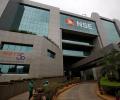
The National Stock Exchange (NSE) has set its initial public offering (IPO) price band at Rs 1,700-1,785 per equity share, with the subscription period running from September 17 to September 21, aiming to raise up to Rs 22,569 crore.
Life insurance industry grew by over 65 per cent to Rs 5,436 crore in September compared to Rs 3,291 crore premium income from new business in July, mainly due to the success of LIC's Varishtha Pension Bima Yojana.

Axis Bank has opened 50 new branches across India, while Abakkus Mutual Fund has surpassed Rs 10,000 crore in AUM. YES Bank launched a new credit card for women, and J&K Bank partnered with HDFC Life to enhance its insurance offerings, showcasing significant growth and strategic developments in the Indian financial sector.
State-owned Life Insurance Corporation of India (LIC) has reported a net profit of over Rs 23,400 crore for the January-March quarter, making it the highest profit-making firm in the Indian financial sector during this period, surpassing major banks like SBI and HDFC Bank.
All the four listed private life insurance companies recorded a drop in value of new business (VNB) margin in the financial year 2023-24 (FY24) as compared to FY23. This is because of a higher share of unit-linked insurance plans (Ulips) in the product mix. VNB is a measure of the economic value of profits expected to emerge from a new business.
The life insurance industry posted 48 per cent growth in July with the Life Insurance Corporation and 12 private insurers mopping up Rs 3,291 crore in premium income, selling about 49 lakh policies during the month.

The Indian government has approved the sale of a 60.72 per cent stake in IDBI Bank Ltd to Canadian billionaire Prem Watsa's Fairfax Financial Holdings Ltd for approximately 52,878 crore, a move that reflects improving India-Canada ties and marks a significant turning point for the bank.
Life insurance companies have yet to see the entry of the younger generation in a big way. This was highlighted by N S Kannan, executive director, ICICI Prudential Life Insurance, while launching an insurance product for cancer.
The National Stock Exchange of India's (NSE) mega Rs 22,569-crore initial public offering (IPO) was fully subscribed on the second day of bidding, driven by strong interest from qualified institutional buyers and non-institutional investors.

A two-day weekend would help employees recover physically and mentally. They would return better prepared for branch work that demands patience, judgment, and accuracy, asserts Tamal Bandyopadhyay.

The National Stock Exchange of India's (NSE) mega Rs 22,569-crore initial public offering (IPO) was subscribed 43 per cent on its first day of bidding, making it India's second-largest public issue after Hyundai Motor India's Rs 27,870-crore IPO in 2024.
