
'Planning for the transfer of assets to the next generation is an important aspect of financial and estate planning.'

The State Commission concluded the insurer could not take advantage of a typographical error on the bank's part to repudiate a legitimate claim, points out Jehangir B Gai.

'We may see little softness in liquidity position after the stabilisation of the government.'

'For me, if I want to buy a house to stay, I don't care about indexation because I don't want to sell that house.' 'The only thing that matters to me as a buyer is that the home price should be within my reach.' 'Any market, when speculators and investors go out, it will benefit the middle class.'

Even under the RTI response, all public sectors banks have washed their hands of any responsibility.
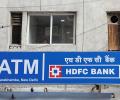
HDFC Bank's market capitalisation (market cap) touched Rs 13 trillion in Thursday's (December 28, 2023) intra-day trades as the largest private sector lender is set to report its sharpest monthly rally in the past two years. At 10:33 AM; HDFC Bank's market cap stood at Rs 13.03 trillion, the BSE data shows. The stock was up 1 per cent at Rs 1,717.90 in intra-day trades on December 29, inching towards its record high of Rs 1,757.80 touched on July 3, 2023.


'Our unsecured loan is not exactly unsecured. It is backed by cash flow of customers.'

'As these segments are growing at 25 per cent for the last three years, credit quality has been extremely good.'

For long-term financial security, millennials must not only provide social security for their young families but also ensure that their financial burdens are not passed down to their families, says Casparus Kromhout.

The need for money among banks, especially for short-term funds, may turn more intense in the last month of the financial year to feed the demand for capital for tax payments and meet year-end targets. The mobilisation of funds via the certificate of deposits (CDs) has seen a threefold increase to over Rs 60,000 crore in the fortnight that ended February 23 from around Rs 20,000 crore in the fortnight of January 26, 2024, according to the Reserve Bank of India (RBI) data.

With India's inclusion in global bond indices starting next financial year, the central government believes there will be greater scope for shifting to borrowings via long-term government securities (G-sec) from short-term instruments. This change may be factored into the FY25 interim Budget. "While this has been our focus, the inclusion of India in global bond indices gives us the opportunity to accelerate the shift towards longer tenure G-secs," an official said, requesting anonymity.
After introducing the controversial nuclear liability bill in the Lok Sabha amid opposition protests, the government on Friday said it hopes to bring it for consideration in the Monsoon session of Parliament.
Former Atomic Energy Commission Chairman P K Iyengar on Wednesday raised a red flag over certain provisions of the nuclear liability bill, including keeping civil courts off limits in case of a nuclear accident.
As part of government's efforts to reach out to the Bharatiya Janata Party over the nuclear liability bill, National Security Adviser Shivshankar Menon met senior leaders of the main opposition party on Wednesday, to allay their apprehensions but failed to convince them.

According to an Andhra government statement, Naidu 'reposed confidence' in the PM's leadership.

The case dates back to August 2017 when the Income Tax department had carried out searches at multiple premises in Delhi as part of its alleged tax evasion probe against Shivakumar, his alleged business associate and liquor trader Sachin Narayan, another associate Sunil Kumar Sharma who operated a fleet of luxury buses, Karnataka Bhawan (Delhi) employee A Hanumanthaiah and former state government employee and caretaker posted at the Karnataka Bhawan Rajendra N.

In a relief to FMCG major Dabur, two of its foreign subsidiaries, Dabur International and Dermoviva Skin Essentials, have been removed as a defendant in multiple lawsuits filed in a US court over allegations that their hair-relaxer products caused ovarian cancer, uterine cancer and other related health issues. However, lawsuits filed against its third international subsidiary Namaste Laboratories LLC, would continue before the US District Court for the Northern District of Illinois, according to a statement from Dabur on Wednesday. Dabur International and Dermoviva were removed and got relief in the multiple suits due to lack of jurisdiction as they have not either manufactured, marketed, distributed or sold hair relaxer products in the US, it added.
Sources in the Prime Minister's Office (PMO) told Business Standard that National Security Advisor (NSA) Shiv Shankar Menon will meet top leaders of the BJP and the CPI(M) to explain the salient features of the Bill.
The much-debated Nuclear Liability Bill, crucial for operationalising the India-US civil nuclear deal, would be tabled in the Rajya Sabha on March 15, Minister of State for Atomic Energy Prithviraj Chavan has said.

The Budget should use the extra RBI surplus to better effect, suggests A K Bhattacharya.

United Kingdom-headquartered pharmaceutical giant AstraZeneca (AZ) has admitted that in 'very rare cases' its Covid vaccine can cause a blood clot related side effect but the causal link is unknown, according to court papers being quoted in the UK media.

The Income Tax department has informed the Delhi High Court that Nokia India and Nokia Corporation owe it Rs 21,153 crore (Rs 211.53 billion) as total tax liability (existing and anticipated), including penalty during a seven-year period from 2006-2013.

A husband has no control over his wife's 'stridhan' (woman's property) and while he may use it during the time of his distress, he has a moral obligation to return it to his wife, the Supreme Court has reiterated while directing a man to pay Rs 25 lakh to a woman in return for her lost gold.

rediffGURU Dev Ashish answers your personal finance and mutual fund queries.

'The approach towards Mallya is not right because his unit could have been turned around earlier with additional funds from his side and the bank's side.'

In August 2021, Nick Read, chief executive of Vodafone Plc at the time, did not mince his words while speaking about the India business in an earnings call. Replying to an analyst's question on Vodafone Idea, a venture with the Aditya Birla Group that had piled on huge debts and worrisome losses, Read described it as a highly stressed situation that "they (Vodafone Idea) are trying to navigate... "We, as a group, try to provide them as much practical support as we can, but I want to make it very clear, we are not putting any additional equity into India.''
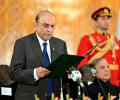
Pakistan's newly-elected President Asif Ali Zardari on Tuesday announced that he would not draw any salary during his tenure as part of his bid to help the cash-strapped country face the challenging economic hardship.

Accusing the Congress of creating obstacles in the path of growth and economy, he declared that the government would try to get the bill passed with the help of parties
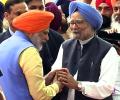
Whether it was the MGNREGS or the NFSA or the Aadhaar-based DBT scheme for cash transfer, the Modi government has built on the basic architecture created by the Singh government. Policy makers in the Modi government, instead of discarding them as products of the previous political regime, worked on them, expanded their scope and reach, and used new tools to improve their performance, explains A K Bhattacharya.

In August, the Reserve Bank of India Governor Shaktikanta Das held a meeting with chief executive officers/ managing directors (CEOs/ MDs) of large non-banking financial corporations (NBFCs). The discussions included diversifying borrowing sources for NBFCs and housing finance companies (HFCs) to contain increasing reliance on bank borrowing, risks associated with high credit growth in retail segment in unsecured loans, prioritising IT upgrades and cyber-security, improving provisioning, monitoring of stressed exposures and slippages, ensuring robust liquidity and asset-liability management, ensuring transparency in pricing, creating robust grievance redress mechanisms.

Ask rediffGURU and tax expert Mihir Tanna your income tax-related questions.

The finance ministry on Thursday sought to clarify that there was no distress in household savings and the data indicated that changing consumer preference for different financial products was the real reason for the change in the pattern of household savings. The clarification comes in the backdrop of Reserve Bank of India data showing that household net financial savings rate is at its lowest in decades, at 5.1 per cent of GDP in FY23 compared to 7.2 per cent of GDP in FY22. The divergence in the data for household gross financial assets and liabilities is not a cause for concern for the government, as the loans have largely been taken to buy real assets or automobiles, the finance ministry said.

e of them requires MPs to follow the norms including the Code of Ethics, which mandates them not to take gifts that may interfere with honest and impartial discharge of their official duties.
The Rs 500 crore cap in the event of an accident, proposed in the controversial nuclear liability bill, could be raised as part of government's efforts to address concerns of the opposition over the issue. Indications to this effect were given by government officials at a meeting of the Parliamentary Standing Committee on Science and Technology and Environment on Tuesady.
23-year-old MBA student-cum-entrepreneur Sidharth Nambiar discusses how he manages both studies and business.
The passing of the nuclear liability bill will be a political and diplomatic victory for Prime Minister Manmohan Singh at a time when he is being seen as getting weaker and his government is drifting on all major national challenges like price rise, Kashmir and Naxalism.

Short-term government bonds fell behind longer-dated securities in demand this month so far due to a liquidity crunch in the banking system and expectations of a delay in a rate cut, said market participants. Investors have favoured longer-tenure government bonds, or g-secs, with insurance companies and pension funds leading the charge by stocking up on those with maturities of 30 years and more. Preference for longer-term securities was strengthened by the conclusion of the borrowing programme, which compelled institutional investors to fulfil their requirements in the secondary market.
