
The Indian economy, severely hit by the coronavirus pandemic, is projected to contract by a massive 10.3 per cent this year, the International Monetary Fund said on Tuesday. However, India is likely to bounce back with an impressive 8.8 per cent growth rate in 2021, thus regaining the position of the fastest growing emerging economy, surpassing China's projected growth rate of 8.2 per cent, the IMF said in its latest 'World Economic Outlook' report.

The IMF believes the farm laws passed by the Indian government have the potential to represent a significant step forward for agricultural reforms, but a social safety net is needed to protect those who might be adversely impacted during the transition to the new system, a spokesperson of the global lender said in Washington.

Bhalla will succeed former RBI deputy governor Subir Gokarn, who died in the US on July 30 after a brief illness.

India's forex reserves jumped by $9.7 billion to an all-time high of $666.85 billion for the week ended July 12, the RBI said on Friday. In the previous reporting week, the kitty had increased by $5.16 billion to $657.16 billion, surpassing the previous high of $655.82 billion for the week ended June 7.

The Reserve Bank of India (RBI) added another 102 metric tonnes to the domestically held gold in the April-September period, as per a disclosure made on Tuesday. The overall quantity of the precious metal stored in local safes stood at 510.46 metric tonnes as of September 30, which was up from over 408 metric tonnes as on March 31, 2024. The central bank said it added another 32 metric tonnes of gold reserves in the six-month period to take the overall tonnage to 854.73 metric tonnes, as per the half yearly report on management of foreign exchange reserves.

The Indian economy is reviving, helped by positive policy actions.

With this subdued forecast, India is likely to record its worst growth performance since the 1991 liberalisation. However, it is among the only two major economies, which will register a positive growth rate in 2020. The other being China, for which the IMF has projected a growth rate of 1.2 per cent.

The question is whether this would mean any change in IMF's policies, particularly on the question of what to forgo out of the impossible trinity of an independent monetary policy, managed exchange rates and a liberal capital account.

User protection and a proposal for a licensing framework for companies seeking to operate in the cryptocurrency area will be part of an upcoming consultation paper on the sector, said a senior industry executive. Even as specific regulations around crypto are yet to take shape, companies are setting up baseline user protection processes, including a redressal mechanism, fraud detection, regular filing of suspicious transaction reports (STRs), among others.

The government's initiative to migrate SEZ data from NSDL software to ICEGATE system for streamlined reporting of import data caused double counting of gold imports, resulting in inflated figures and the issue has now been largely rectified, government sources said. The downward revision has provided the actual picture of trade deficit (difference between imports and exports), which was earlier looking very high. The deficit for November will now be revised downwards from $37.84 billion to about $32.8 billion. Similarly, there will be a revision in overall import numbers as well.

Nepal's macroeconomic performance has been held back by the earthquakes and the recent unrest and disruptions to transportation and trade routes following the promulgation of a new constitution, the IMF said has said.
The International Monetary Fund (IMF) has lowered its real export growth forecast for India for 2008 to 13.2 per cent from its April forecast of 16.3 per cent.

The International Monetary Fund (IMF) said on Thursday that a multilateral response is critical to overcome the COVID-19 pandemic in India and globally as it hailed recent announcements by several countries to provide immediate support to India. India is struggling with a second wave of the pandemic with more than 300,000 daily new coronavirus cases being reported in the past few days, and hospitals are reeling under a shortage of medical oxygen and beds.
India's forex reserves dropped $1.71 billion to $651.99 billion for the week ended June 28, the Reserve Bank of India (RBI) said on Friday. In the previous reporting week, the overall kitty had dropped $2.92 billion to $652.89 billion. The reserves had touched an all-time high of $655.82 billion as on June 7 this year.

IMF said in 2017, India is likely to grow at the rate of 7.2 per cent instead of the earlier projected 7.6 per cent.

Modi for completion of IMF quota reforms at earliest
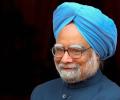
Former Prime Minister Manmohan Singh's 1991 budget unshackled India's economy, significantly enhancing the economic prospects for hundreds of millions of Indians, first deputy managing director of the International Monetary Fund (IMF) Gita Gopinath said on Friday.

The Budget should undertake further reductions in import tariffs and seriously consider an announcement of India's intention to join one or both of the two Asian mega-regional free trade agreements, suggests Shankar Acharya, former chief economic adviser to the Government of India.

Reserve Bank Governor Raghuram Rajan today criticised multilateral institutions like the IMF and the World Bank saying "they are not immune to cognitive capture".
India's forex reserves jumped $5.16 billion to $657.16 billion during the week ended July 5, the Reserve Bank of India (RBI) said on Friday. The forex kitty had declined for the previous two consecutive weeks, dropping $1.71 billion to $652 billion for the week ended June 28. The reserves had touched an all-time high of $655.82 billion as on June 7 this year.

The International Monetary Fund head Dominique Strauss-Kahn has said the Indian economy is recovering well and New Delhi would get higher quota in the IMF board, review of which is currently underway, reflecting its enhanced economic standing.
A continued focus on low inflation will be important to keeping gold imports, IMF said.

India's forex reserves jumped by $816 million to $653.71 billion for the week ended June 21, the RBI said on Friday. In the previous reporting week, the overall reserves had dropped by $2.92 billion to $652.89 billion.

Greece was an opportunity for the IMF to set a precedent for an orderly debt resolution programme.

The IMF proposals will be reviewed by the finance ministers of G-20, whose representatives are in Washington for meetings this week, The Post reported.

India's forex reserves dropped by $2.922 billion to $652.9 billion for the week ended June 14, the Reserve Bank said on Friday. In the previous reporting week, the kitty had jumped by $4.307 billion to $655.817 billion, a new all-time high after consecutive weeks of increase in the reserves.

Ahead of India's annual budget presentation next week, IMF's chief economist Gita Gopinath has favoured the extension of the pandemic support measures, thrust on investment in infrastructure and expanding health sectors programmes like Ayushman Bharat, and a very credible divestment path for commercially viable companies. The Indian government has provided a lot of schemes for small and medium enterprises, most of which is in the form of liquidity support, Gopinath told PTI on Tuesday. "And you want to revisit it and see how effectively that is working and see whether additional support may need to be provided," she said while responding to a question on her recommendations to Finance Minister Nirmala Sitharaman, ahead of her presentation of the annual Union Budget on February 1. It would be a good time for banks and Non-Banking Financial Companies (NBFCs) to raise capital given the attractiveness of financing conditions at this point, she said.

The IMF on Tuesday projected an impressive 12.5 per cent growth rate for India in 2021, stronger than that of China, the only major economy to have a positive growth rate last year during the COVID-19 pandemic. The Washington-based global financial institution, in its annual World Economic Outlook ahead of the annual Spring meeting with the World Bank, said the Indian economy is expected to grow by 6.9 per cent in 2022. Notably in 2020, India's economy contracted by a record eight per cent, the International Monetary Fund (IMF) said as it projected an impressive 12.5 per cent growth rate for the country in 2021.
Horst Koehler, managing director of International Monetary Fund, has announced his resignation after being nominated to become the German President.

the GDP estimates incorporate new source data and modified compilation techniques
Admitting that the economy may be impacted if the monsoon is inadequate, the government on Monday said the growth rate in 2009 will not fall to the levels being projected by international agencies like the IMF and the World Bank.
India's forex reserves dropped by $2.03 billion to $646.67 billion for the week ended May 24, the Reserve Bank said on Friday. In the previous reporting week, the kitty had reached an all-time high of $648.7 billion after a jump of $4.55 billion.

'Will President Dissanayake calibrate his foreign policy taking into account India's immediate security concerns? We need to watch.'
The current Euro-Atlantic Monetary Fund must become an International Monetary Fund.

The country secured a euro 7.16 billion bridge financing from the European Financial Stability Mechanism
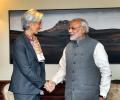
Lagarde had said an Indian could head IMF.

The global lending agency also said that Brexit has resulted in global economic uncertainty.
