
Even as non-life insurers reported muted premium growth in October, standalone health insurers saw a robust 38 per cent year-on-year (Y-o-Y) surge. This growth was driven by pent-up demand in the retail health insurance segment.
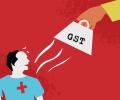
Reduction of GST on health insurance premium from 18% to 0% looks like a straight 18% reduction in what consumers pay. The truth, however, is...

Health insurance premium growth has slowed after touching record highs during the Covid-19 pandemic due to tapering demand from retail consumers amid affordability issues. According to General Insurance Council data, health insurance premiums grew by 10.44 per cent year-on-year (Y-o-Y) in the Apr-Jan period of FY25 in comparison with 20.79 per cent in the year-ago period. It was around 23.57 per cent in FY23, and 25.89 per cent in FY22.

Full exemption for all health insurance premiums and reinsurance or a reduction in the GST rate from 18% to 5% on health insurance services is likely.

Ask rediffGURU and PF expert Milind Vadjikar your insurance, stocks, mutual fund and personal finance-related questions.

New business premium of life insurance companies grew 18 per cent year-on-year (Y-o-Y) to Rs 35,417 crore in February, driven by robust growth at the state-owned Life Insurance Corporation of India (LIC) due to a favourable base.

In a move that will bring cheer to health insurance policyholders, non-life insurers are finalising the contours of a new product that will have a common minimum standard cover and will be renewable and portable across companies.

Govt could cut the GST rate payable every time someone buys a health insurance product; or it could also provide a larger income tax set off for those who buy a health insurance product

As heart disease increasingly impacts young Indians, understanding the complexities of health insurance, including higher premiums, waiting periods, and the benefits of specialised cardiac policies, becomes vital for financial protection.

Both the life and non-life insurance segment posted over 20 per cent premium growth in November for the first time in this financial year (FY26), supported by the reduction in goods and services tax (GST) on premiums from 18 per cent to zero and a favourable base effect.

The Delhi government's Health Department has received an audit report highlighting alleged financial and administrative irregularities within the Delhi Medical Council (DMC) between 2019 and 2025.
Irdai had introduced two Covid specific products in the market - Corona Kavach and Corona Rakshak - that saw huge acceptance among the consumers as these products had lower premiums.
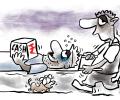
Recent years have been turbulent for the insurance industry due to direct and indirect tax reforms, regulatory overhaul and other external pressures. The events cumulatively slowed growth rate to single digits from the high teens seen earlier.

IRDA suggested that health insurance should cover alternative treatments.

Despite near gender parity in basic bank account ownership, women in India remain significantly underrepresented in the growing platform economy due to gaps in digital financial capability and access to credit, according to a joint report by the International Labour Organization and National Council of Applied Economic Research.

Finance Minister Nirmala Sitharaman on Tuesday said that raising the FDI limit to 100 per cent in the insurance sector will help attract more capital, improve competition and increase insurance penetration by making policies more affordable.

'Applying AI to change the lives of Indians and at population scale -- just like we did with DPI [digital public infrastructure] -- is really where it's going to go.'

The GST Council, in its meeting on Saturday, is likely to decide on reducing tax rates on life and health insurance premiums, while hiking it on high-end wrist watches, shoes and apparels, besides considering a separate 35 per cent tax slab for sin goods. The 55th meeting of the GST Council, chaired by Union Finance Minister Nirmala Sitharaman and comprising state counterparts, is likely to discuss rate rejig in about 148 items, besides, it will also deliberate on bringing Aviation Turbine Fuel (ATF), a major component for airline industry's operation cost, in the Goods and Services Tax (GST) fold.
The Centre has proposed exempting life and health insurance policies for individuals from GST, Bihar Deputy Chief Minister and convenor of insurance GoM Samrat Choudhary said on Wednesday. Currently, health and life insurance premium attracts 18 per cent GST.

In a bid to woo villagers to benefit from the National Rural Employment Guarantee Scheme, the Orissa government on Tuesday decided to offer health insurance and a house under the Indira Awas Yojana to each labourer who completed 100 days work in a year, official sources said.

Nagaland Governor Ajay Kumar Bhalla announced the state government's plans to form an interim council for the Frontier Nagaland Territorial Authority (FNTA) and highlighted key achievements and future priorities across various sectors during the Budget Session.

Health insurance claims are often denied due to exclusions in policy terms. Buyers frequently overlook the fine print or misinterpret clauses.

New India Assurance and Niva Bupa have invested in the Bima Sugam India Federation.
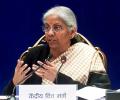
The GST Council on Saturday postponed a decision on cutting tax rate on life and health insurance premiums, officials said. The 55th meeting of the GST Council, chaired by Union Finance Minister Nirmala Sitharaman and comprising state counterparts, decided that some more technicalities needed to be ironed out and tasked the GoM for further deliberations.
Health premiums have picked up again after a slight moderation in growth, taking the non-life insurance industry's growth to 22 per cent in November, and to almost 17 per cent so far this financial year. Health premiums grew by 22.54 per cent in the April-November period, driven largely by group health plans, which have seen good growth due to rationalisation of discounts in premiums caused by adverse claim ratios in prior periods, medical inflation, and enhanced coverage. Health premiums grew by 29 per cent in the same period last year.
The Life Insurance Corporation of India has the wherewithal to acquire a composite license, a top source aware of the development told Business Standard, adding that the insurance behemoth may look into entering the health and general insurance segments. "LIC has the scale, capacity, IT infrastructure, and the distribution reach to take advantage of the composite license. "LIC is looking at organic as well as inorganic growth opportunities.
Some of the key names include: Maruti, M&M, Ashok Leyland, Britannia, Ultratech, JK Cement, Havells, Voltas, Amber, Metro, Trent, LemonTree, Indian Hotels, Niva Bupa, HDFC Life, IGL, Acme Solar, Suzlon, Swiggy, Delhivery, ICICI Bank, HDFC Bank, Bajaj Finance, Shriram Finance," according to a report by Motilal Oswal Financial Services.

The proposed portable health insurance policy, earlier to be sold only to those between 18 years and 40 years, is to now cover individuals from three months to 65 years. The product, which has been in the works for over a year, has been cleared by the General Insurance Council, the industry lobby, which will approach the regulator to approve the product.

Victory wrested from regime that only listens when forced, the TMC said on GST exemption on insurance.

According to the data compiled by General Insurance Council, which is not publicly available, the insurers have settled 508,334 claims amounting to over Rs 4,800 crore.

Term life insurance policies, and senior citizens' health insurance premium are likely to be exempted from GST as most members of a state ministerial panel favoured cutting taxes to benefit the common man, an official said on Saturday. The GoM to decide on GST on health and life insurance premiums in its meeting on Saturday decided to exempt GST on premiums paid by individuals, other than senior citizens, for health insurance with coverage of up to Rs 5 lakh. However, 18 per cent GST will continue to be levied for health insurance cover of over Rs 5 lakh.

A person who has cancer and doesn't have any health insurance will find it difficult to buy a regular hospitalisation cover. An indemnity-based cancer plan may cover them.

Unlike other health insurance policies, which mostly covers hospitalisation expenses alone, the specialised cover is likely to include the cost of treatment during quarantine and payment of cash for incidental expenses.

In its master circular on general insurance products, which takes immediate effect, Irdai specified, 'The customer may be required to submit only those documents directly related to claim settlement.'

The unprecedented rise in Covid-19 infections in the country, which many are terming as the second wave, has also resulted in a rise in Covid-related claims for general and health insurance companies as hospitalisations have gone up. The insurers have received more than a million Covid-related claims as of April, 2021. According to the data compiled by General Insurance Council, the reported claims total 1.014 million, amounting to more than Rs 14,800 crore.
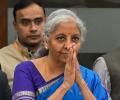
The GST Council on Wednesday approved a two-tier rate structure of 5 and 18 per cent, which will be implemented from September 22.
As many as 121,739 claims settled by insurers so far, amounting to Rs 1,165.81 crore.
To add to the worry of the insurers, non-Covid claims, which were muted in the initial months of the pandemic, have also picked up pace and are more or less at pre-Covid levels.
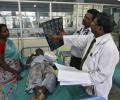
The rationalisation of goods and services tax (GST), announced on Wednesday, directly lowers the cost of everyday medical consumables, and also high-end therapies in oncology and rare diseases, helping reduce out-of-pocket patient expenditure and better adherence to medication.

The four public sector general insurance companies -- New India Assurance, United India Insurance, Oriental Insurance, and National Insurance Company -- have lost 800 basis points (bps) in market share in last five years to their private counterparts, the data from the Insurance Regulatory and Development Authority (Irdai) revealed. In 2018-19, the four had a cumulative market share of 40.04 per cent, with New India Assurance having a market share of 14 per cent and United India Insurance with a market share of 9.63 per cent. But, gradually in the past five years, these state-backed firms have lost their market share to private sector players, due to the declining health of their business.
