
The court has asked UPA not to table the report in Parliament till the court concludes hearing on a petition filed by a relative of a survivor. \n
The court also observed that 'in spite of policemen being present when the incident occurred, they could not identify the accused persons and that if they had taken enough precaution the incident could have been prevented'.
A large number of Muslims, holding the national tricolour, greeted the Gujarat Chief Minister Narendra Modi during his visit to the densely populated Polan Bazaar in Godhra town on Republic Day, president of Ghanchi Muslim Samaj Phirdos Kothi said on Tuesday.

The review plea filed by Ramesh Rupabhai Chandana said the top court erred while passing the impugned order and overruling judgment dated May 13, 2022, passed by another bench of the apex court.

In its order of June 12, which was made available on June 15, the court of additional sessions judge Harsh Trivedi also slammed pseudo-secular media and politicians for claiming that the riots were planned.

'The cases on hand have no genesis in the act of terrorism or waging war against the state,' the court said.
The Gujarat high court on Tuesday granted bail to three people who were sentenced to life imprisonment in the 2002 Godhra train burning case which had triggered communal riots in the state.
The Supreme Court on Monday favoured setting up of designated courts for the trial of the accused in the post-Godhra riot cases in Gujarat. A bench headed by Justice Arijit Pasayat asked the state government and senior advocate Harish Salve, who is assisting the court as an amicus curiae in the matter, to place before it suggestions in this regard by Monday.
The Supreme Court on Tuesday directed that the charges under Prevention of Terrorism Act against 134 accused in the 2002 Godhra train burning incident in Gujarat shall be dropped and the trial can resume against all the accused under the provisions of the IPC.
The clashes occurred during Ganesh festival procession.

They said the agency is also taking steps to bring under its ambit cases registered in various states by the police.
A sadhvi who travelled in the ill-fated Sabarmati Exress told Godhra Commission that the train was stopped for some youths who had been left behind on Godhra station.
Twelve witnesses identified Zabir Bin Yamin Behra, who has been charged under Prevention of Terrorism Act.
The compensation package for Gujarat riot victims will keep them on par with the measures taken in respect of victims of the anti-Sikh riots in 1984. The next of kin of 1,169 people killed in the riots would be paid Rs 3.5 lakh ex-gratia in addition to the amount paid by the state government, Finance Minister P Chidambaram said after the cabinet meeting in New Delhi.
The government had appealed the grant of bail by high court to four accused in the Godhra carnage.
The Gujarat Government has challenged a high court order granting bail to certain accused persons in the Godhra train burning incident.
The incident of burning S-6 coach of Sabarmati Express on February 27, 2002, which triggered off violent riots in Gujarat, was a pre-planned conspiracy and not an accident, according to the first part of the Godhra Commission report.
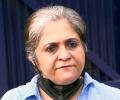
A sessions court had recently rejected her discharge plea in the case, even as the Supreme Court granted her bail after the Gujarat high court denied her relief.
The issue related to the petition filed by the National Human Rights Commission, which sought transfer of the trial of the riots' cases outside Gujarat and re-investigation by an independent agency. The NHRC had filed the petition after several witnesses turned hostile amidst allegations of threat, coercion and inducement to derail the investigation.AA three-member bench said it would pass necessary orders on Wednesday for constituting the SIT.
Sixty-three people, including the main accused Maulvi Hussain Umarji, acquitted in the 2002 Godhra train burning case, on Wednesday reached their hometown in Gujarat after spending almost eight years in prison.
The Gujarat high court on Friday refused to direct the Nanavati Commission, which is probing the post-Godhra riots, to summon Chief Minister Narendra Modi. A division bench of Chief Justice Bhaskar Bhattacharya and Justice J B Pardiwala refused to interfere in the proceedings of the commission.
The prosecution on Friday sought death penalty for all the 31 convicts in the Godhra train carnage case in a special court in Ahmedabad which reserved till March 1 the pronouncement of quantum of punishment for them.
Godhra municipality councillor Salim Abdul Gaffar Sheikh has been accused of being at the spot, armed with lethal weapons, where the Sabarmati Express was burned down.
They were found guilty of killing 14 Muslims in Ginjar village in Ghodasar area on the outskirts of Nadiad on March 3, 2002.
The petition said there was need for constituting a commission of inquiry headed by a sitting judge of the high court, as neither the Centre nor the state government has taken appropriate action over the alleged role of Gujarat Chief Minister Narendra Modi in the incident and the riots in 2002.
Rediff.com's Sheela Bhatt was in the courtroom at the Sabarmati Jail where the judgment in the Godhra train burning case was pronounced on Tuesday. She has also followed and written about the twists and turns in the historic nine-year legal battle. Her impressions and analysis of the verdict.
The Supreme Court has refused to entertain the Narendra Modi government's plea for staying the Gujarat high court's February 8 order to pay compensation to over 500 shrines damaged during the infamous 2002 riots in the wake of the Godhra train carnage. While declining to entertain the plea, a bench of justices K S Radhakrishnan and Dipak Misra also asked the state government to furnish details of the number of religious structures actually damaged.
A former British envoy has deposed before a special court through video conferencing in connection with a post-Godhra riot case, where four persons, including three British nationals, were killed in Sabarkantha district.
The Supreme Court-appointed Special Investigation Team has said that Gujarat Chief Minister Narendra Modi took all possible steps to control the 2002 post-Godhra riots and questioned the motive behind filing a complaint against him by a riot victim four years after the communal violence.
In a relief to Narendra Modi, the Gujarat high court on Wednesday rejected a petition seeking directions to the Nanavati Commission to summon the state chief minister for questioning in connection with the 2002 riots.
The Narendra Modi government was on Wednesday pulled up by the Gujarat high court for "inaction and negligence" on its part during the 2002 post-Godhra riots that led to large-scale destruction of religious structures. A division bench of acting chief Justice Bhaskar Bhattacharya and Justice J B Pardiwala made these observations, while ordering compensation for over 500 religious structures in the state.
A group of activists will mark the tenth anniversary of the Godhra carnage and the ensuing communal riots in Gujarat at the memorial at Gulberg Society in Ahmedabad on February 28.

Now, the chief justice of the high court will allot the case to a new judge.
A local court in Ahmedabad acquitted 29 persons on Tuesday, accused in a 2002 riot case in Abasana village of Detroj taluka of the district, where six people of minority community were killed.
The Nanavati Commission has indicated it may submit its final report with regard to the 2002 post-Godhra riots by the end of March 2012, the state government told the Gujarat high court on Thursday.
The three were part of a crowd that attacked minorities in Madhavpura area of the city and brutally killed a pregnant woman.
The Supreme Court on Monday asked the high-powered Special Investigation Team to probe the role of 64 people, including Gujarat Chief Minister Narendra Modi, in the post Godhra-riots cases. The team has to submit its report to the apex court within three months.
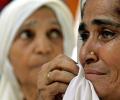
As a consequence of prominence given to the brutality during those few days, a very important aspect of that episode got almost glossed over. This was the intervention by a very significant section of people who restored faith in humanity, and conveyed the message that only a small section of Indians, that too politically backed, were consumed by anti-Sikh majoritarianism. The overlooked facet of the events of 1984 was the story of significant sections of the city's populace, public figures and nondescript ones, stepping out hand-in-hand, to first stand with little but bravery in hands, in the way of attackers, and thereafter to provide immediate relief to those who lives were uprooted and who lost family members in the violence, recalls Nilanjan Mukhopadhyay.
Danseuse Mallika Sarabhai, noted Bengali litterateur Mahashweta Devi and ad guru Alyque Padamsee have sought an independent inquiry into the Gujarat riots.

The Centre on Saturday night announced that the probe into alleged irregularities in the medical entrance exam NEET will be handed over to the CBI for a comprehensive investigation.
