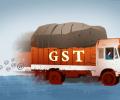
India's Goods and Services Tax (GST) collections soared by 23 per cent year-on-year to over Rs 2.31 lakh crore in October, marking the second-highest monthly mop-up ever, primarily driven by robust festive buying and strong domestic demand.
As India marks a decade of the Goods and Services Tax (GST), the focus is shifting towards enhancing efficiency through artificial intelligence, data sharing, and process simplification. The reform, which unified India's indirect tax system, has significantly broadened the tax base and boosted revenues, with future plans including a streamlined two-tier rate structure and continued technological integration to reduce compliance costs and combat evasion.

These changes certainly bring India's GST a lot closer to what an ideal GST would look like, points out Karan Bhasin.

GST 2.0 may cushion consumers against US tariffs, but like the 2019 corporate tax cut, it risks being another tactical fix rather than a structural growth strategy, expects Debashis Basu.
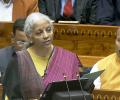
Budget 2026 sticks to fiscal discipline, shuns populist measures despite five key state elections coming up, but ends up rattling stock markets with a higher transaction tax on derivatives trading.
Can this growth in GST collection be sustained in the coming years? asks A K Bhattacharya.
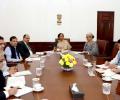
The aim of the exercise was to further simplify GST forms and make the filing process more user-friendly, the finance ministry said in a tweet, reports Dilasha Seth.
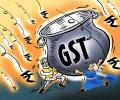
Economic Advisory Council to the Prime Minister (EAC-PM) chairman Bibek Debroy on Tuesday said the government was losing revenue due to the GST, which should be revenue neutral with a single rate. Speaking at an event organised by the Calcutta Chamber of Commerce in Kolkata, he however said that GST has led to a lot of simplification. "The ideal GST is one that has a single rate, and it was meant to be revenue neutral.

GST council may propose a faster refund procedure, deferment of electronic way bill, further simplification of composition scheme

Industry body CII on Thursday made a case for pushing reforms in sectors like land, labour, and agriculture by the Modi 3.0 government to accelerate economic growth, which is estimated to be around 8 per cent in the current financial year. CII president Sanjiv Puri said a lot of policy interventions in the past have put the economy on "a much stronger wicket". "The growth rate is poised to touch 8 per cent during the current year, marking the fourth consecutive year of above 7 per cent + growth.

The fiscal gains from implementing the GST and demonetisation, while almost certain to occur, will probably take time to be fully realised

"India is the best market right now in the world with the digital initiatives the government has implemented

Assembly elections coming up in November and December could offer a window of opportunity to the government to make GST attractive through rate cuts.

Panel formed to simplify return-filing process, take feedback from stakeholders, experts

The goods and services tax will level the playing field for different sectors of industry, including domestic manufacturing.
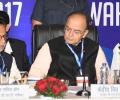
"This rationalisation is 3-4 month exercise," he said, adding that the GST Council decided on the rate cut on the recommendation of a Fitment Committee.
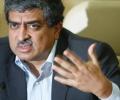
The GoM will meet on Saturday to finalise single-stage, simplified, return filing under the GST; report will be placed before GST Council on March 10.

The Council also discussed process to make return filing simpler with just one return to be filed every month.

'I found it unbelievable that L&T said 45,000 jobs were waiting to be filled because of unavailability of suitable skillsets.' 'So, when the Opposition sweepingly says there are no jobs, I'm sorry... I'm not saying it's raining jobs, but there are jobs. The (skill) gap has to be bridged.'

She has shown shrewdness, sensitivity, and courage. All of these will be needed in ample quantities for the real challenge that will emerge after the elections, notes Shreekant Sambrani.
'We have promised to ensure reduced tax rates.'

The government last fiscal missed its direct tax collection target, and for this financial year it has set a higher revenue mobilisation goal of Rs 13.80 lakh crore.
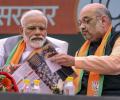
Rediff.com does a quick checklist on what the two manifestos have to say on hot-button issues of the day.

Experts consider Sebi's takeover code in its present form to be on a par with any foreign code governing public mergers and acquisitions.

Honest tax payers need not worry about the new black money law, says finance minister Arun Jaitley.

Indian economy was growing faster than the global average and all other major economies: FM

The Budget would have been the perfect vehicle to introduce some bold initiatives.
That opportunity has been lost through this Budget, observes Shreekant Sambrani.

Indian economy about to take-off

President Pranab Mukherjee on Monday addressed the first joint sitting of Parliament as mandatorily required under the Constitution after the general elections. The address is the political, economic and foreign policy road map of the Narendra Modi government and covers virtually all crucial areas.
