
In trade negotiations, as in chess, sometimes you need to accept a temporary disadvantage to secure a better long-term position, points out Sonal Varma, chief economist (India and Asia ex-Japan) at Nomura.

This period of strong growth not only offers opportunities but also calls for strategic considerations to ensure sustainable development and equitable prosperity in the years to come, suggests Sujan Hajra.
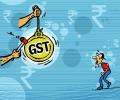
India needs Goods and Services Tax (GST) Council-like common platforms between states and the Centre in areas such as land clearances, power, and water to fast-track infrastructure projects to achieve double-digit growth going ahead, said Praveer Sinha, chief executive officer and managing director of The Tata Power Company.

In Professor Sulochana Gadgil's passing, India has lost a scientific giant, a fierce intellect, and a compassionate soul, remembers Dr Madhavan Nair Rajeevan.

'What India has done will surely embolden more countries to stand up to Trump.'
Defence expenditure was pegged at 1.4 per cent of GDP in the Budget for 2025-26 but it may widen, depending on tensions between India and Pakistan.
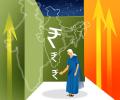
NITI Aayog member Arvind Virmani on Monday said India is set to become the fourth largest economy in the world by the end of 2025, an assertion which came days after NITI CEO BVR Subrahmanyam claimed India has already overtaken Japan to reach that spot. The International Monetary Fund (IMF), in its World Economic Outlook (WEO) report released in April had said that India is expected to be the fourth largest economy in the world with a GDP of $4.19 trillion in 2025, ahead of Japan.

GST 2.0 may cushion consumers against US tariffs, but like the 2019 corporate tax cut, it risks being another tactical fix rather than a structural growth strategy, expects Debashis Basu.

The crisis may not be as visible this time, but the stakes are just as high, points out Rajeswari Sengupta.

'One Chinese interlocutor said India should realise that "China can do without India, but India could not do without China", pointing to its inability to do without Chinese intermediates and components,' former foreign secretary Shyam Saran discovers on a visit to China.

President Droupadi Murmu addressed the nation on the eve of Independence Day, praising the response to terrorism, highlighting achievements in defense self-reliance, and emphasizing unity and progress.

The point to note for India is that we must not panic. The United States may be our largest export destination, but high tariffs will not exactly mean gloom and doom. Sure, we can throw some morsels as we continue negotiating, but we must be firm that some red lines cannot be crossed, no matter what, asserts Shreekant Sambrani.

Since February 2025, the RBI has reduced the policy rate by 100 basis points. In its previous policy review in June, it had trimmed the repo rate by 50 basis points to 5.5 per cent.

The gig economy market is expected to grow at a compound annual growth rate (CAGR) of 17 per cent to reach a gross volume of $455 billion by the end of 2024, according to a white paper by The Forum for Progressive Gig Workers. Estimates suggest the gig economy has the potential to create 90 million jobs and add 1.25 per cent to India's GDP (gross domestic product) over time.

With general government debt now approaching three-quarters of GDP, and only incremental reform efforts visible, Pakistan risks prolonging its economic stagnation unless fundamental governance, regulatory, and industrial overhauls are undertaken.

India's economic growth slowed to a 15-month low of 6.7 per cent in April-June 2024-25, mainly due to poor performance of the agriculture and services sectors, government data showed on Friday. The gross domestic product (GDP) expanded by 8.2 per cent in the April-June quarter of 2022-23. India, however, remained the fastest-growing major economy, as China posted a 4.7 per cent growth in April-June 2024.

Siam argues that a 2040 ban could destabilise ongoing and future investments and threaten millions of jobs in the automotive value chain.
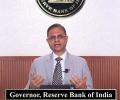
'India has the potential to grow at more than 7%, with the monetary policy providing a supportive hand.'

The Indian services sector growth touched an 11 month high in July, supported by a pickup in new exports orders and sharp rise in overall sales, a monthly survey said on Tuesday. The seasonally adjusted HSBC India Services PMI Business Activity Index was at 60.5 in July, little-changed from 60.4 in June, and the rate of expansion was the best seen since August 2024.
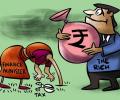
India's 18 largest states, accounting for over 90 per cent of the country's gross state domestic product (GSDP), are likely to record a marginal uptick in revenue growth to 7-9 per cent this year, from 6.6 per cent clocked in 2024-25 (FY25), rating agency Crisil said in a report on Tuesday. This growth, slower than the decadal average of about 10 per cent, would lift these states' cumulative revenue to around Rs 40 trillion in FY26 from Rs 37.26 trillion in FY25.

Stock markets are in for an event-heavy week ahead with a raft of Q1 earnings from blue-chips, the US Fed interest rate decision and foreign investors trading activity driving investors' sentiment, analysts said. Macroeconomic data announcements, monthly auto sales numbers and global market trends would also guide movement in the domestic equities, they said.

Generative AI is transforming workplaces but at a cost -- there are fewer jobs for young workers just entering the workforce, reveals a Goldman Sachs report.

Economists at the country's largest lender SBI on Wednesday said they see Q2 real GDP growth slowing down further to 6.5 per cent in the September quarter of this fiscal year. Amid concerns over the country's economic growth rate and if it is slowing down, the analysts said they expect FY25 growth to come "closer to" 7 per cent. It can be noted that the April-June period saw the real GDP expanding by 6.7 per cent, the lowest in 15 quarters.
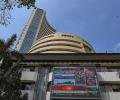
According to data from BSE, the 4,357 companies available for trade had a combined mcap of around Rs 416 trillion on Tuesday against India's GDP at current prices of Rs 296.6 trillion in FY24.

India's GDP growth is likely to moderate from 8.2 per cent in 2023 to 7 per cent in 2024 and 6.5 per cent in 2025 because the pent-up demand accumulated during Covid has exhausted, as the economy reconnects with its potential, the International Monetary Fund (IMF) said on Tuesday. About the global economy, the IMF said the battle against inflation has largely been won, even though price pressures persist in some countries.
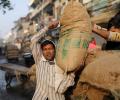
The Asian Development Bank (ADB) on Wednesday lowered India's growth forecast for FY26 to 6.5 per cent from 6.7 per cent on account of trade uncertainty and higher US tariffs that are expected to impact exports and investment. Despite the downward revision from the April 2025 Asian Development Outlook (ADO), India remains one of the fastest-growing major economies in the world.

Gold prices are expected to witness further consolidation in the coming week as investors brace for a slew of events, ranging from central bank meetings, including the US Federal Open Market Committee (FOMC) meeting's outcome, to global trade negotiations, analysts said.

GST, net of refunds, now yields close to 20 trillion to both the Centre's and states' exchequer.
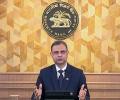
Mixed views were expressed by top economists on the Reserve Bank of India's (RBI) Monetary Policy Committee's (MPC) decision to hold the repo rate at 5.5% and maintain a neutral stance. While some say the decision was as expected and one more rate reduction is expected this fiscal, there is also a view that rate cut by MPC was warranted given the evolving global situation.

Among Sensex firms, Tech Mahindra, HCL Tech, Asian Paints, NTPC, Infosys, Nestle, Sun Pharma, and Tata Steel were the major laggards. Eternal, State Bank of India, HDFC Bank, Larsen & Toubro, Reliance Industries and Bajaj Finserv were the gainers.

President Droupadi Murmu's address to the nation on the eve of the 79th Independence Day.

Foreign investors continue to exhibit confidence in the country's equity market, injecting Rs 19,860 crore in May driven by favourable global economic indicators and strong domestic fundamentals. This positive momentum follows a net investment of Rs 4,223 crore in April, data with the depositories showed.

India's GDP is likely to grow at 6.5 to 7 per cent in the current fiscal year amid global challenges which may impact exports, said Economic Survey 2023-24 tabled in Parliament on Monday. The growth projected for 2024-25 is lower than the economic growth rate of 8.2 per cent estimated for the previous financial year. The Reserve Bank has projected the GDP growth for the fiscal year ending March 2025 at 7.2 per cent.

India's extreme poverty rate declined sharply to 5.3 per cent over a decade from 27.1 per cent in 2011-12 even as the World Bank revised upwards its threshold poverty line to $3 per day.

In an event-heavy week, stock investors will track quarterly earnings of several bluechip firms, the likely outcome of ongoing India-US trade talks, and inflation data for market cues, analysts said on Sunday. Moreover, global market trends and trading activity of foreign investors would also guide movement in equities, they said.

Global home decor and furniture retailer IKEA has ambitions to increase sourcing from India to 50 per cent, Swedish trade minister Benjamin Dousa said on Wednesday. IKEA's sourcing basket includes textiles, plastics, and metals, among others, and the company plans to add more items.

'We need to be very vigilant as we are passing through some fraught times.'

Uddhav Thackeray criticized BJP MP Nishikant Dubey for his controversial remarks amid the Marathi-Hindi language row, accusing him of trying to divide people and disturb harmony.

Office space owners are looking at good times ahead as rentals are expected to rise due to demand for Grade A office spaces outpacing supply that has been sluggish due to construction delays, long gestation periods and developers' interests shifting to residential.

The disbursement of the second tranche comes on a day when the International Monetary Fund is holding virtual discussions on Pakistan's upcoming budget, as the visit of its mission to Islamabad was delayed due to security concerns in the region.
 © 2026 Rediff.com - Advertise with us - Disclaimer - Privacy Policy - Sitemap - Feedback - About us - Terms of use - Grievances