
Fuel loading at India's first prototype fast-breeder reactor in Kalpakkam is expected to start next week, marking a significant step in the country's nuclear program.

India will commission its first 500-Mw fast breeder reactor (FBR) for generating commercial nuclear energy by the end of next year. The reactor, when commissioned, will mark the country's entry into the second phase of its three-stage nuclear energy programme.
Fast breeder reactors not up for inspection
But the father of the French fast breeder reactor programme Dr Georges Vendryes Tueday sounded a note of caution, saying the way forward was now fraught with risks. \n
After three decades of hard work, and despite the devastating tsunami of 2004, the 500 megawatt Fast Breeder Reactor at Kalpakkam is coming up at a furious pace, says Shivanand Kanavi who visited the project site recently. It also happens to be the first tsunami-ready reactor in India.

India's 500 MWe Prototype Fast Breeder Reactor (PFBR) at Kalpakkam in Chennai has achieved first criticality, marking a significant advancement in the country's nuclear energy capabilities and long-term energy security.

In many ways, this is only the beginning -- of a new chapter in India's nuclear story, and of a future where its vast thorium reserves could finally power its ambitions.
'Chinese are going bang, bang, bang building 30-35 reactors.' 'We should announce a programme of 50 new reactors and show that we mean business on the ground and not just announcements.'

Construction major L&T is gearing up to expand its footprint in the global nuclear supply chain, a senior company official has said, while calling for amendments to key legislations on the domestic front to pave the way for the entry of private players and foreign capital necessary for capacity enhancement.

AAERB's permission for RAPP-7 paves the way for the subsequent phases of reactor commissioning leading to its commercial electricity generation.
A 200-tonne safety vessel was successfully lowered into the reactor vault of the 500 MW Prototype Fast Breeder Reactor(FBR) in Kalpakkam in a "historic moment" for the country's indigenous nuclear programme.
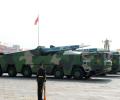
China has more than 500 nuclear bombs in its arsenal and is developing new Inter-Continental Ballistic Missiles (ICBMs) that will significantly improve its nuclear-capable missile forces, the Pentagon said on Thursday.

India has said it is committed to implementing the highest safety standards at its nuclear power plants as it seeks to harness the benefits of atomic energy to meet its growing energy requirements.
Nuke scientists support AEC chief's contention

'Why should we disclose classified information to satisfy those who doubt our Hydrogen Bomb capability?'

Several nuclear power projects held up for the lack of such an insurance pool can now be expected to move forward.

'The biggest lacuna in this agreement is it is called 'full civil nuclear cooperation agreement.' Actually, it is anything but full.'

'If not, we can become frighteningly chaotic, more chaotic than what we are today.' 'In today's environment in the country, we still have a window of opportunity.'
'Decisions on nuclear power have so far been taken by a small select group, primarily interested in profiteering from their actions, stating 'secrecy' as necessary from the national security point.' 'This argument is false, because we are dealing with the 'civilian' nuclear power sector, which is open even to the IAEA,' says Dr A Gopalakrishnan, former chairman of the Atomic Energy Regulatory Board.
'There has definitely been a breakthrough in the nuclear logjam. It is good to see nuclear energy back on the rails,' says Dr Anil Kakodkar, former chairman, Atomic Energy Commission.
