
States will remain "net gainers" of the proposed GST rate rationalisation exercise with their GST revenues, including devolution, estimated to be over Rs 14.10 lakh crore this fiscal, according to an SBI Research report released on Tuesday. It said that, as was evidenced in the earlier exercise of GST rate rationalisation in 2018 and 2019, an immediate reduction in rates can cause a short-term dip of around 3-4 per cent in month-on-month collections (roughly Rs 5,000 crore, or an annualised Rs 60,000 crore), revenues typically rebound with sustained growth of 5-6 per cent per month.

Noting that recent uncertainties created by global tariffs have not impacted the Indian economy severely, Anuradha Thakur, secretary, Department of Economic Affairs, said the central government is hopeful that the recent goods and services tax (GST) rationalisation will ignite the much needed animal spirits in the financial sector.

'I will not be surprised if there is a 7 per cent handle in front of the decimal place for the full financial year.'

The 50 per cent US tariff on Indian goods pose a downside risk to growth but the impact is expected to be short-lived for the economy, and consumption demand could see an uptick after the new goods and service tax (GST) rates are implemented which could even offset the external uncertainty, Chief Economic Advisor (CEA) V Anantha Nageswaran reckoned on Friday.

The weakening of inflation, prospects of economic growth, geopolitical uncertainty and comfortable system liquidity may result in the Reserve Bank of India's (RBI) Monetary Policy Committee (MPC) to cut the repo rate by another 25 basis points, opine top economists. They also said the external economic pressures like trade policies and others would require continued RBI's accommodative stance and policy support for the Indian industry to sustain the growth.

The Centre's fiscal deficit stood at 17.9 per cent of the full-year target at the end of June, according to data released by the Controller General of Accounts (CGA) on Thursday. It was at 8.4 per cent of Budget Estimates (BE) of 2024-25 in the first three months of the previous financial year.

Billionbrains Garage Ventures, the parent company of stock broking firm Groww, on Thursday fixed a price band of Rs 95-100 per share for its upcoming Initial Public Offering (IPO), targeting a valuation of over Rs 61,700 crore (about $7 billion). The company's Rs 6,632 crore IPO would open for public subscription on November 4 and conclude on November 7, according to a public announcement.

4.5 million weddings are expected across India.

Reserve Bank of India (RBI)Governor Sanjay Malhotra on Friday said it was not the regulator's job to take decisions for bank boards, speaking in the context of the wide range of enabling reforms announced for lenders during the October monetary policy review, and emphasised that financial stability remained the regulator's focus.

New-age stocks to buy: Most new-age stocks have turned out to be wealth destroyers in stock markets, so far, in calendar year 2025. Shares of Ola Electric Mobility, for instance, have plunged nearly 50 per cent in the first half of CY 2025, while those of Swiggy, PB Fintech, Paytm, and Eternal (Zomato) have crashed between 6 per cent and 25 per cent, ACE Equity data shows.

Trading sentiment in the equity market will be guided by macroeconomic data announcements, global trends and quarterly earnings from IT major TCS this week, analysts said. Stock markets would also be tracking trading activity of foreign investors who remained net sellers of Indian equities in September.

Bharti Airtel on Monday reported over twofold jump in consolidated net profit at Rs 8,651 crore for September quarter FY26, mainly on account of growth in high-paying smartphone customers and post-paid connections.
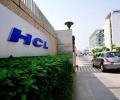
HCLTech on Monday reported a 9.7 per cent decline in consolidated net profit for the April-June quarter of this fiscal year at Rs 3,843 crore as the IT services firm and pegged the revenue growth guidance at 3-5 per cent for FY26. HCLTech had logged a net profit (attributable to owners of the company) of Rs 4,257 crore in the year-ago period, according to a regulatory filing.

Packaged food major Nestle India posted better than expected September quarter results led by strong volume growth across its key segments. While there were margin pressures due to elevated raw material costs, there could be some relief with easing prices in the near term.

Maruti Suzuki will introduce eight SUVs over the next five years taking its overall model range to 28 as it aims to regain 50 per cent market share in the domestic passenger vehicle segment, Suzuki Motor Corporation Representative Director and President Toshihiro Suzuki said on Wednesday.

'In the January-August period, the share of hatchback in the overall PV industry sales was about 22.4 per cent. In the September-October period, the share of hatchbacks has come down to 20.4 per cent. In just October, their share was just 20 per cent. This is simple wholesale data from industry body SIAM.'

Co-working spaces provider WeWork India is aiming for a revenue growth of over 20 per cent for the coming years, even as its initial public offering (IPO) with only an offer for sale (OFS) component gets valued at Rs 3,000 crore at the top of the price band. The IPO opens on October 3, a newspaper advertisement said.

India's housing finance sector is riding a wave of post-pandemic revival, driven by policy support, digital innovation, and growing demand from younger homebuyers in emerging cities.

Between 2015 and 2023, around 543 train accidents occurred, resulting in 805 deaths.

Debt-ridden telecom operator Vodafone Idea on Monday said its consolidated net loss narrowed to Rs 5,524 crore in the second quarter ended September compared to the year-ago period, mainly on account of savings in finance cost on debt from banks and an increase in average revenue per user supported by a tariff hike.
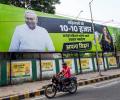
Voters are weighing a stark trade-off -- between preserving a socially driven policy and reversing course to revive revenue, restore fiscal balance, and rein in the underground liquor economy.

LG Electronics India made a dazzling market debut on Tuesday, ending 48 per cent higher than its issue price and surpassing its South Korean parent in market value.

Ahead of the key meeting called by the steel ministry with the industry captains on Monday to discuss the impact of rising steel imports, companies have raised the issue of cheaper 'substandard' inflows from China, Vietnam, and South Korea, saying they are setting the benchmark for domestic prices and squeezing the profitability of Indian producers.

Hindalco's India business, including Utkal Alumina, reported good results for the January-March quarter of the financial year 2024-25 (FY25) and consolidated earnings before interest, taxes, depreciation, and amortisation (Ebitda) also rose. Earnings growth was driven by favourable pricing, lower input costs and lower tax outgo for Novelis.

Jeetendra and his family-backed Balaji Telefilms is focusing on expanding the content slate on its streaming platform Kutingg through micro dramas and long-format binge shows after the recent ban on its subscription-based video-on-demand platform ALTT due to obscene content.

India's real estate investment trust (Reit) sector is set for robust expansion, with at least one new Reit expected to enter the market each year over the next three-five years. This growth trajectory builds on rising occupancies, surging leasing activity, and increasing investor interest.

Tata Motors on Friday reported a 62.2 per cent decline in consolidated net profit to Rs 4,003 crore in the June quarter, impacted by volume decline across segments, drop in JLR profits due to US tariffs and high base effect due to gain from sale of discontinued operations. The auto major had posted a consolidated net profit of Rs 10,587 crore in the April-June quarter of the previous fiscal, Tata Motors Ltd (TML) said in a regulatory filing.

The news that Amazon India has launched diagnostic services in select metro cities in partnership with the unlisted Orange Health Labs has led to a look at the competitive intensity in healthcare services. Listed companies in the space such as Dr Lal Path Labs, Metropolis Health, Thyrocare, Vijaya, and Krsnaa have all seen double-digit stock price corrections over the last 6-9 months.

Net direct tax collection dipped 3.95 per cent to Rs 6.64 lakh crore so far this fiscal, mainly on account on higher refunds, according to government data released on Tuesday. Direct tax includes taxes on income paid by companies, individuals, and by professionals, and other entities.

'Last year, we had about 10 to 12 per cent of Hollywood films as a box-office contribution. This year already, it has jumped up to 24 per cent because the lineup is very strong.'

IT services firm Wipro on Thursday reported a marginal increase in consolidated net profit to Rs 3,246.2 crore in the July-September quarter, even as company CEO and MD Srini Pallia asserted that the demand environment remains robust with discretionary spends shifting towards AI-related projects.

Investors in India's information technology (IT) companies are likely in for more pain ahead as muted earnings for the first quarter of 2025-26 (Q1FY26) play spoilsport at the bourses in the worst-performing sector this year amid macro uncertainties. Investors, analysts suggest, can look for better opportunities in the markets as things stand.

'The kind of reach it has with so many bank branches even in the remotest part of the country, it is one channel which will play a very important role in vision of insurance for all.'

While participants in the domestic financial market are expecting a 25 basis-point policy repo rate cut in the December meeting of the Monetary Policy Committee (MPC) of the Reserve Bank of India (RBI), economists remain torn between a reduction in rate cut and a pause.

Fitch Ratings on Monday affirmed India's sovereign rating at 'BBB-', with a stable outlook, saying a strong record of delivering growth and improving fiscal credibility will drive improvements in structural metrics. "India's ratings are supported by its robust growth and solid external finances," Fitch said, as it forecast GDP growth of 6.5 per cent in the fiscal year ending March 2026 (FY26), unchanged from FY25, and well above the 'BBB' median of 2.5 per cent.

India's corporate bond market, driven by public sector undertaking (PSU) banks and financial institutions last year, is losing momentum since the second quarter of FY26.

Qcom alone is expected to account for a 60 per cent surge in gig hiring, adding 1.5 million to 2 million roles.

From the Sensex firms, Tata Motors jumped the most by 5.54 per cent, followed by Kotak Mahindra Bank, Trent, Sun Pharma, Axis Bank, and ICICI Bank. However, Bajaj Finance, State Bank of India, UltraTech Cement and Tata Steel were among the laggards.

Even if the Reserve Bank of India's Monetary Policy Committee decided to hold interest rates in the October meeting, it acknowledged the scope for further rate cuts while waiting for the impact of the past steps to play out.

New business premiums of life insurance companies dropped 5.2 per cent year-on-year (YoY) in August to Rs 30,959 crore, owing to a double-digit decline reported by state-owned Life Insurance Corporation (LIC), data from the Life Insurance Council showed. LIC recorded a 17 per cent YoY fall in new business premiums to Rs 16,023 crore during the month, while private life insurers reported a 12 per cent YoY increase to Rs 14,936 crore.
