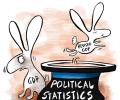
The Economic Survey 2022-23 (FY23), to be presented a day before Union Budget 2023-24 (FY24), is likely to project India's real gross domestic product (GDP) growth between 6 per cent and 7 per cent for FY24, Business Standard has learnt. The broader theme of the Survey could be on how India has dealt with two years of a global pandemic and the ongoing geopolitical disturbance, the strengths and weaknesses that emerged, and what lessons may be learnt. The much-awaited Survey will be the first one by Chief Economic Advisor V Anantha Nageswaran and his team in the finance ministry's economic division.

There are some apparent paradoxes visible in the data from the first quarter of 2025-26 (Q1FY26). The gross domestic product (GDP) delivered a positive surprise with 7.8 per cent year-on-year (Y-o-Y) growth.

In response to the panic triggered by Trump's trade policies, the RBI net sold approximately $43 billion in the second half of FY25 to curb volatility, as the rupee plunged to a low of 87.95 per dollar in February this year.

India's real estate investment trust (Reit) sector is set for robust expansion, with at least one new Reit expected to enter the market each year over the next three-five years. This growth trajectory builds on rising occupancies, surging leasing activity, and increasing investor interest.

'Make-in-India played a key role in India's effective action against terrorism during Operation Sindoor.'

An hour-long disruption could affect around 40 million UPI transactions.

Food delivery aggregator Swiggy saw its loss widen for the fourth quarter (January-March) of financial year 2024-25 (Q4FY25). The firm reported a consolidated loss of Rs 1,081.1 crore for the quarter, compared to a loss of Rs 554.7 crore in the corresponding quarter of FY24.

Eternal (formerly known as Zomato) reported a net profit of Rs 39 crore for the fourth quarter of FY25, down 77.7 per cent year-on-year from Rs 175 crore in the same period a year ago. On a sequential basis, profit was also down 33.8 per cent from Rs 59 crore in the preceding quarter (Q3FY25).

Sebi's probe against Jane Street is part of its efforts to mitigate losses for individual derivative traders.

The move is to align affordable housing finance flows to the increase in property costs and inflation, says Raghu Mohan.

Country's largest lender State Bank of India (SBI) is looking to be among 10 top global banks in market capitalisation terms in the next five years, chairman CS Setty said on Wednesday. "The scope for value creation for the stakeholders is potentially very high. So the larger ambition is if the market supports whether we can be part of the top 10 global banks in terms of the market capitalisation (five years)," he said after listing of shares issued under Qualified Institutional Placement (QIP) at NSE.

Both NDA and INDIA are racing to woo marginalised groups with Assembly polls fast approaching.

IDFC First Bank delivered good results in the first quarter of this financial year (Q1FY24), but some analysts are concerned the bank is fully-valued. So, there has been profit-booking after a price rise. Growth went side-by-side with a focus on cutting interest costs and exposure to high non-performing infrastructure loans. The mortgage book is 28 per cent, of which 24 per cent is home loans and loans against property.

The number of digital financial frauds rose more than four times in FY24 year-on-year to comprise 80 per cent of all financial frauds.

Corporate India's struggle with subdued revenue and earnings growth persisted in the October-December quarter of 2024-25 (Q3FY25). The combined net sales (gross interest earnings for lenders) of listed companies grew in single digits for the seventh consecutive quarter, while their combined net profit rose by a single digit for the third straight quarter.

The share of companies where it would take over 100 years for a median employee to earn the equivalent of their top executive's annual salary rose to 65 per cent in FY24 from 61 per cent in FY19.

The 13th-month persistency rate of life insurers - an important metric indicating the retention of new policies - declined in the first quarter of 2025-26 (Q1FY26). This fall was primarily driven by a lower share of high-value policies, following taxation changes implemented in April 2023.

Bihar is now among the top 10 states in terms of investor base, surging past better-off states like Delhi, Haryana, and Punjab.

Telecom operator Bharti Airtel posted about a five-fold jump in consolidated net profit to Rs 11,022 crore in the March 2025 quarter, mainly due to the tariff hike impact and one-time gain on tax benefits. Bharti Airtel had posted net profit (attributable to owners of the parent company) of Rs 2,071.6 crore a year ago.

GST Reform 2.0, which trims tax slabs from four to two, signals a push for demand-led growth, and together with recent income tax cuts, sets the stage for sustained economic growth, experts said. The Goods and Services Tax (GST) Council on September 3 approved an overhaul of the indirect tax regime by taxing essentials at 5 per cent and other goods at 18 per cent. A new 40 per cent tax will be applicable on luxury and sin items.

A Rs 23,000-crore production-linked incentive (PLI) scheme for electronic components may boost margins and enable a broader product mix.

Exports of high-quality basmati rice from India grew by 22 per cent to $5.2 billion during April 2023-February 2024, amid robust demand, primarily from West Asia. According to data compiled by the commerce department, exports of basmati rice increased to 4.68 million metric tonnes (MMT) in April-February, from 4.1 MMT during the same period a year ago, registering a growth of 14 per cent.

Infrastructure bonds, which were relied upon the most in 2024-25 (FY25) by commercial banks to raise funds through the domestic debt capital market amid lagging deposit growth, seem to have lost their sheen in FY26. So far in FY26, no bank has tapped the domestic debt capital market to raise funds via infra bonds, and the expectation is that the amount raised through this route will be significantly lower than that last year, unless credit demand picks up.

The combined market capitalisation of the country's top five IT firms that are part of the BSE Sensex is down 24 per cent since January and their valuation has slipped to lowest levels in the past five years.

Seafood is one of India's largest agricultural exports after basmati rice and buffalo meat.

India Inc continued to grapple with muted revenue growth in the September 2024 quarter (Q2FY25) and witnessed a decline in margins and profits. The headwinds were especially severe for non-financial companies, while banking, financial services, and insurance (BFSI) firms significantly outpaced the rest of the corporate sector. The total profit of 1,353 listed companies that have released their Q2FY25 results thus far dropped by 0.6 per cent year-on-year (Y-o-Y) - the first cumulative earnings decline in eight quarters.

The net direct tax collection so far this fiscal rose 19.41 per cent to Rs 14.70 lakh crore, reaching about 81 per cent of the full-year target, the income tax department said on Thursday. "The provisional figures of Direct Tax collections up to January 10, 2024, continue to register steady growth," the Central Board of Direct Taxes (CBDT) said in a statement. Direct Tax collection, net of refunds, stood at Rs 14.70 lakh crore which is 19.41 per cent higher than the net collection for the corresponding period of last year.

Sluggish urban demand, a high base effect, and weak sales of hatchbacks and sedans weigh down passenger vehicle sales in FY25.

Companies may foot less of the tax bill for some time yet. The corporate share of net direct tax collections has been lower in 2024-25 than in previous years. The corporate segment accounted for 45.6 per cent of total net direct tax collections as of March 16, compared to 48.1 per cent on the same date in 2023-24 (FY24).

As the poverty rates in the country declined below 5 percent in 2024, a research study by State Bank of India also highlighted that the extreme poverty in the country has been reduced to minimal.

Discrepancies in computation of advance estimates of the country's Gross Domestic Product for 2023-24 stood at Rs 2.59 lakh crore as against (-) Rs 3.80 lakh crore in 2022-23 and (-) Rs 4.47 lakh crore in 2021-22, according to National Statistical Office (NSO). On Friday, the NSO released its first advance estimates of national accounts which showed that the Gross Domestic Product (GDP) or Indian economy will grow at 7.3 per cent in 2023-24, slightly higher than 7.2 per cent in 2022-23.

As fintech major Pine Labs gears up for its initial public offering (IPO), its Draft Red Herring Prospectus has highlighted its top executives' pay and stock options, including those of Chief Executive Officer (CEO) Amrish Rau. Rau's net worth is estimated at Rs 850 crore-1,000 crore following the IPO.

The stocks are largely from sectors such as chemicals, finance and cement, which struggled earlier but the worse seems to be behind them.

Smartphones, for the first time, emerged as India's largest individual export commodity by value over 10 months of any financial year, during the April-January period of FY25, based on harmonised system (HS) codes. During the period under review, smartphone exports from India reached $18.31 billion, according to data from the Department of Commerce, surpassing automotive diesel fuel exports, which stood at $16.04 billion.

Excess earnings of unlisted companies over and above their interest costs are at a record level. The interest-coverage ratio of 2.94 is the highest going back to 1990-91, according to numbers from the Centre for Monitoring Indian Economy (CMIE). The ratio measures earnings relative to every rupee to be paid as interest on outstanding debt.

Co-location attracts institutional investors, which drives volumes for long-dated options, with higher realisations at lower costs.

The more things change, the more they remain the same for corporate India. In the April-June 2025 period (Q1FY26) - for the ninth consecutive quarter - listed companies witnessed only single-digit revenue growth, while their core earnings, excluding other income and one-time gains, contracted for the second time in four quarters. This comes as firms brace for the impact of 50 per cent US tariff on Indian goods.

'Every delay directly increases the cost burden on developers. Land holding charges, financing costs, and compliance expenses escalate as approvals drag on.'

Driven by smartphone, electronics exports have reached $22.5 billion in value in the first eight months of the current financial year (FY25), a near 28 per cent growth over the $17.66 billion electronics exports during the corresponding period of FY24.

"We currently manage collections for over 98 million retail and small-business loan accounts, covering a loan book of about $250 billion," says Rishabh Goel, cofounder and chief executive officer (CEO) of Credgenics, a software-as-a-service platform for debt collection. With more than 700 million smartphone users and over 450 million UPI users, digital access is everywhere.
