
'With this revamp the anonymous journey of the user will begin wherein he will not have to sign in every time he accesses the app.'

ITC Ltd on Friday reported a 23.09 per cent increase in consolidated net profit at Rs 5,070.09 crore for the third quarter ended December 2022, helped by growth momentum across its operating segments. The diversified company had posted a net profit of Rs 4,118.80 crore during the October-December quarter of the previous fiscal, ITC said in a regulatory filing. Its revenue from operations was up 3.56 per cent to Rs 19,020.65 crore during the quarter under review, as against Rs 18,365.80 crore in the corresponding period of the previous fiscal.

Educational technology company Byju's chief financial officer Ajay Goel has quit after completing the audit process for the financial year 2022 and will return to Vedanta, the company said in a statement. The edtech major has roped in industry veteran Pradip Kanakia as senior advisor, and president (finance) Nitin Golani has been given additional responsibility as India chief finance officer (CFO) to handle the finance function of the company.

Listed housing finance companies (HFCs), as a group, posted a 3.7 per cent drop in second-quarter (Q2) profit year-on-year (YoY) to Rs 5,830 crore and 19 per cent sequentially on rise in interest expenses and uptick in provisions and write-offs. Operating income rose 13.7 per cent YoY to Rs 54,086 crore in Q2 of 2022-23 (FY23). Sequentially, income was up 62.3 per cent, from Rs 33,331 crore in the first quarter (Q1) of 2021-22 (FY22).

Adani Power, part of the Adani group, plans to add close to 6 gigawatts (Gw) of new power assets in the next five years, according to an investor presentation by the company. That is clearly meant to ride on India's burgeoning power demand. But there is another side to it: All of this new capacity is expected to be thermal power, or power produced from coal.

Byju's is set to go the way of Housing.com and Zilingo. It is only a matter of time. Indeed, the coup attempted by investors will ensure that, says Debashis Basu.

Eveready Industries India will launch a new category in Financial Year 2024-25 (FY25) as it works to double revenue, said a senior executive of the country's largest dry cell battery maker. It could be an adjacency or a new product under the Eveready brand and a final decision is expected by the end of this financial year. "We are currently working on that exercise; it's on the drawing board," said Suvamoy Saha, managing director of Eveready.

Info Edge (India) reported a good fourth quarter for the 2022-23 financial year (Q4FY23) given depressed conditions in the Key IT segment. The billing growth of 13.7 per cent year-on-year (YoY) in recruitment was well ahead of market expectations. There was solid growth in realisations (up 5.5 per cent) as well as unique customers (up 7.7 per cent).

The information technology services sector will see a sharp fall in revenue growth to 12-13 per cent in FY23 from 19 per cent in FY22, ratings agency Crisil said on Thursday. However, the current depreciation in the rupee, strong demand for new age technologies like artificial intelligence, cloud computing and Internet of Things will help the over $220-billion sector maintain a double digit growth, it said in a report. The moderation from 19 per cent to 12-13 per cent will be the highest in the last eight years, it said and attributed the decline to expected tightening of IT expenditure by corporates amid the inflationary headwinds in the United States and European Union (EU), which together contribute almost 85 per cent to the sector's revenue.

Telecom operator Vodafone Idea on Tuesday reported narrowing of its consolidated losses to Rs 6,563.1 crore for the fourth quarter ended March compared to same period of the previous year, while its realisation per user or ARPU improved sharply on a sequential basis. The losses were at Rs 7,022.8 crore in the year-ago period, according to a company filing. Its revenue from operations rose 6.6 per cent year-on-year to Rs 10,239.5 crore in Q4 FY22.

With the rise in interest rates, bond yields have been on the rise; this will dent banks' treasury profits. Also, many retail borrowers may find it difficult to service their loans when the loan rates rise, points out Tamal Bandyopadhyay.

For the startup ecosystem in India, the scorecard so far has been a mixed bag, observes Akhil Gupta.

Under the new model, the surplus distribution in the participating policyholders' fund has been modified to 90:10 in a phased manner, wherein 90 per cent will go to policyholders and 10 per cent to shareholders. Further, 100 per cent of the surplus generated out of the non-participating business will be available for distribution to all shareholders.

The government's decision to impose a 20 per cent export duty on parboiled rice and a $1,200 per tonne minimum export price (MEP) on basmati rice has pulled down overseas shipments of the former by almost 83 per cent and around 30 per cent of basmati exports in a month. Data sourced from various trade agencies and shippers showed that between August 25 and September 20, export of basmati rice has shrunk from 342,605 tonnes in 2022 to around 241,083 tonnes in 2023. Similarly, export of parboiled rice, after the imposition of 20 per cent duty during the same period, has dropped from 1.16 million tonnes in 2022 to just around 204,190 tonnes in 2023.

By any economic theory or doctrine, this is no Budget that supports economic recovery, whether through supporting aggregate demand, or through expansionary stimulus, declares Rathin Roy.

The retail industry witnessed robust top-line growth for the greater part of the previous financial year, but demand has started to show signs of fatigue seen in the January-March quarter (fourth quarter, or Q4) of 2022-23 (FY23), especially in the apparel and innerwear segments. Jewellery, however, has managed to hold on to demand in the quarter. "In the discretionary space, demand moderation in urban markets is expected to impact the quick-service restaurant and apparel categories the most, while paint, luggage, and jewellery should see resilient growth," Systematic Institutional Equities observed in its preview of the sector.

The two IT majors -- Infosys and TCS -- delivered disappointing results for the fourth quarter of the 2022-23 financial year (Q4FY23). Poor macro conditions and weak sentiment in the banking, financial services and insurance (BFSI) space accounted for the miss. For TCS, revenue in constant currency (CC) terms grew at 0.6 per cent on a quarter-on-quarter (QoQ) basis. Weakness was visible in North America, primarily due to deferred discretionary spending.

At a time when banks are engaged in a fierce battle to gain market share in the credit card segment, Citibank India has been losing its share, both in terms of outstanding cards and spends in the last few years. Still, average spends on Citi cards are higher than any other Indian bank. Last year, the global banking behemoth announced exit from its consumer banking franchises in 13 markets across Europe, Middle East and Asia, including India, citing lack of scale.

"We will raise Rs 300 crore via bonds of two-, three- and five-year tenures. This will be our maiden bond issuance and is part of our effort to widen funding sources," says Vimal Bhandari, executive vice-chairman and chief executive officer (CEO), Arka Fincap. The firm, a subsidiary of Kirloskar Oil, is only five years old and small (assets of around Rs 5,000 crore with an "AA" rating), but the response to this float will be closely watched: It would be the first by a non-banking finance company (NBFC) after Mint Road upped the risk weights on bank exposures to them by 25 percentage points. The move by the Reserve Bank of India (RBI) has caught NBFCs off guard even though the issue had been flagged by Governor Shaktikanta Das with their corner-room occupants (and that of banks) in July and August 2023 - on consumer credit and the dependency on bank borrowings.

Online food delivery platform Zomato has decided to narrow its focus on three key areas of food ordering and delivery; supplies to restaurants through 'Hyperpure' and quick commerce, company Chairman Kaushik Dutta said on Tuesday. In his address to shareholders at the company's annual general meeting, Dutta said the move was part of strategy to focus "only on areas that have the potential to become meaningfully large businesses ten years from now". In FY22, he said Zomato was able to achieve strong top line growth while keeping its "adjusted EBITDA burn under control", despite multiple challenges such as disruptions due to Covid-19 pandemic, macro-economic uncertainty, rising inflation, fuel prices, among others.

India's aviation industry could return to profitability in 2023-24 for the first time since the pandemic. The industry may pare aggregated net loss by 75-80 per cent year-on-year (YoY) to between Rs 3,500 crore and Rs 4,500 crore in 2022-23 (FY23), compared with Rs 17,500 crore of net losses in 2021-22 (FY22). A combination of recovery in passenger volumes and easing cost pressures due to stable fuel and foreign exchange (forex) costs could spark a turnaround. CRISIL says domestic and international passenger traffic recovered to 90 per cent and 98 per cent, respectively, of pre-pandemic traffic (2019-20, or FY20), in April-December 2022, compared with April-December 2019.
Vedanta Limited (Vedanta) helping its parent and group holding company Vedanta Resources to deleverage its balance sheet has started to strain its balance sheet. Vedanta's gross debt (consolidated) was up 24.3 per cent year-on-year (YoY) in FY23 and reached a six-year high of Rs 66,628 crore by the end of March. Similarly, its net debt went up 20.3 per cent YoY to Rs 45,706 crore at the end of FY23, up from Rs 38,228 crore a year ago; it was the highest since FY20.

A 25 per cent year-on-year (Y-o-Y) increase in budget allocation towards the roads sector for FY24 has led to renewed interest among investors. However, a combination of escalating costs for Bharatmala and unseasonal rains to some extent have impacted progress. Bharatmala's cost has nearly doubled from Rs 5.35 trillion to Rs 10.6 trillion and the finance ministry has asked MoRTH to go slow until Cabinet approval is received.

The engineering and construction (E&C) sector delivered an excellent performance in the last two financial years (FY2021-22 or FY22 and FY23's nine-months) and there's reason to believe that FY24 will also see outperformance. The sector has emerged from the pandemic with stronger balance sheets and more rational cost structures. It has a big order book and it should see new order flows accelerate in FY24.

'Rather than visiting famous monuments, travellers now prefer "experiential activities" such as biking, trekking/hiking, camping, river rafting, yachting, parasailing and zip lining; safaris and jungle adventures; and wellness holidays to rejuvenate themselves.'

Infosys on Thursday posted a 13.4 per cent year-on-year increase in consolidated net profit at Rs 6,586 crore for the December quarter and the IT major raised its full year revenue guidance to 16-16.5 per cent. The net profit (after minority interest) stood at Rs 5,809 crore in the third quarter of FY22. The Bengaluru-based IT firm logged a 20 per cent year-on-year increase in consolidated revenue in the third quarter of the current fiscal at Rs 38,318 crore.

There hasn't been any dramatic moment in the first act (the Budget) but nobody would complain. It's par for the course as long as the figures don't change in the main Budget, which will be presented after general elections.

After the second wave of the pandemic, general and health insurers have seen a fall in their outgo of Covid-related health claims. In the July-September quarter (Q2 of FY22), insurers settled a little over Rs 5,000 crore worth of Covid health claims. This is 35 per cent lower than the Rs 7,700 crore worth of claims they settled in Q1, sources said.

UltraTech Cement's results for the fourth quarter results of the 2022-23 financial year (Q4FY23) were broadly in line with the Street estimates. The consolidated revenue, operating profit and net profit stood at Rs 18,700 crore, Rs 3,300 crore and Rs 1,670 crore, respectively, which were up 18 per cent, 8 per cent and 13 per cent YoY, respectively.

Earnings growth, attractive valuations and change in FPI flows from negative to positive over the next 12 months are some of the key triggers for an upside. "A poor monsoon, high inflation and further rate hike are some of the key risks

After the hit of the pandemic, India Inc is now worried about the adverse impact of inflation and higher commodity prices on their revenues and margins. The inflation scare is the strongest among manufacturers of consumer goods such as automobiles, consumer durables, and fast-moving capital goods (FMCG). Companies across sectors fear they will not be able to pass on the hike in input costs to their consumers due to weak demand, which, in turn, would lead to a hit on margins and profitability in the forthcoming quarters.

Billionaire Gautam Adani's group is planning to build 10 GW of integrated solar manufacturing capacity by 2027, as it looks to capture energy transition business, sources close to the company said. Adani Group currently has a solar manufacturing capacity of 4 GW. Adani Solar has a confirmed order book of over 3,000 MW in exports that are to be serviced over the next 15 months, they said, adding Adani, recently, raised $394 million for solar manufacturing from Barclays PLC and Deutsche Banks AG through a trade finance facility.

Maruti Suzuki, Hyundai and Tata Motors reported their highest-ever dispatches to dealers last fiscal, enabling the domestic passenger vehicle industry to log in best-ever performance to date. The country's largest carmaker Maruti Suzuki India reported its highest wholesales to date at 19,66,164 units, up 19 per cent from 16,52,653 units in 2021-22. Its domestic dispatches rose to 17,06,831 units in 2022-23, up 21 per cent from 14,14,277 units in 2021-22 fiscal.Hyundai Motor India said its overall wholesales last fiscal were the highest ever since commencing operations in the country.

That's a big change that was made possible due to corporate tax cuts. Corporation tax collection in FY22 will be lower than even the FY18 levels, reports

At a time when Apple delivered its flagship line of new products on schedule despite battling a year of supply-chain turmoil, India could account for at least 12 per cent of the free-on-board (FoB) value of Apple Inc's iPhones manufactured by its vendors globally by 2025-26 (FY26). The number represents a significant shift for the Cupertino-based company's over-dependence on China, where 95 per cent of its phones are still being made. India's growing importance can be seen from the fact that in 2021-22 (FY22) - the first year of the production-linked incentive (PLI) scheme (the scheme was extended by a year due to the pandemic) - the FoB value of iPhones made in the country was $1.75 billion, translating into less than 2 per cent of the global value.

The non-life insurance industry has received over 1 million Covid-related claims in the first quarter of the current fiscal year (Q1FY22), higher than in the entire FY21, indicating the severity of the second wave of the pandemic. According to the General Insurance Council data, which is not publicly available, non-life insurers have received 1.22 million Covid-related claims so far in FY22 and have settled 944,573 of those worth Rs 9,178 crore. In comparison, they had received 986,366 Covid claims in FY21 and settled 849,034.

There are loans to salaried people where the borrower is employed, but has failed to make repayment. Such loans would be identified and sold in a pool to ARCs.

Tax devolution shares, which threaten to create a north-south divide among states, may have more to do with per capita income, and not so much with population.
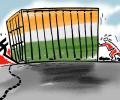
The rising dependence on discounted crude oil has resulted in India's trade deficit with Russia hitting the second-highest place last year, after China, reveals Department of Commerce data. From April through January 2022-23 (FY23), India's maximum trade deficit was with China, at $71.58 billion. This was followed by Russia, where the deficit expanded sevenfold - from $4.86 billion in April-January of 2021-22 (FY22) to $34.79 billion during the same period in FY23.

Bharti Airtel delivered encouraging results for the January-March quarter of the 2022-23 financial year (Q4FY23) as telecom and associated services moved into the 5G zone. In India, Airtel's mobile Q4 revenue and Ebitda (earnings before interest, tax, depreciation and amortisation) were Rs 19,550 crore (up 1 per cent quarter-on-quarter or QoQ) and Rs 10,530 crore (up 1.1 per cent QoQ), respectively. The Ebitda margin was flat at 52.2 per cent.
