
Foreign direct investment (FDI) in India has increased by 16 per cent year-on-year to $27.1 billion during April-August this year, the Commerce and Industry Ministry said on Tuesday. During April-August last year, India had received FDI worth $23.35 billion. The ministry said that the total FDI, which includes reinvested earnings, grew by 13 per cent to $35.73 billion.

The increased tax target comes at a time when consumer spending and sales growth are slowing down and most companies are not investing in new capacities.

The country's exports jumped by 60.29 per cent to $34.45 billion in March even as the outbound shipments contracted by 7.26 per cent during the full 2020-21 fiscal to $290.63 billion. Imports too grew by 53.74 per cent to $48.38 billion in March, but dipped by 18 per cent to $389.18 billion during April-March 2020-21, according to the government data released on Thursday. Trade deficit during March 2021 widened to $13.93 billion from $9.98 billion in March 2020.

India's domestic passenger traffic slipped to a 10-year low at an estimated 53.4 million in the just-concluded financial year, a report said. However, in the previous fiscal there were no passenger flight operations for almost two months due to the pandemic-induced lockdown. During the financial year 2010-11, all domestic air operators together had flown a total of 53.8 million passengers on local routes, according to ratings agency ICRA. The domestic passenger traffic in March 2021 has been estimated at around 77-78 lakh, a marginal decline of about 1 per cent over February during which airlines had flown around 78.30 lakh passengers, it said.

Foodgrains production in 2020-21 is projected to be a record 144.52 million tonnes, which is 0.80 per cent more than the production in 2019-20.

In the state of the economy report, the RBI said bond vigilantes could undermine the recovery, unsettle financial markets, and trigger capital outflows from emerging markets.

About Rs 4,257 crore worth of bids have been received so far and the Centre hopes that retail investors - those investing up to Rs 2 lakh - will place bids worth at least Rs 750 crore.

Employment in India saw a V-shaped recovery after being adversely impacted between April and June 2020 during the Covid lockdown and during April-June 2021, when the second wave struck, said Krishnamurthy V Subramanian, former chief economic advisor, in a paper released on Friday. Subramanian is now serving as executive director of the International Monetary Fund (IMF). From the official survey data of the National Sample Survey Organisation (NSSO), the paper titled 'Employment in India: Data Sources, Facts, and Trends' showed that both worker-population ratio (WPR) and labour force participation rate (LFPR) were higher, while the unemployment rate was lower during October-December 2022 when compared to the corresponding quarter in 2019.

Whether nominal or real, India's investment rate needs to increase by 3 to 4 percentage points of GDP to support 8 per cent real growth, recommends Nikhil Gupta.

The net financial savings of the household sector has moderated to 5.1% of GDP in FY23 from 7.6 per cent in FY20, as households shifted their savings to physical assets amid low interest rates during the pandemic, according to State Bank of India's (SBI) Research report.

Pencilling in a GDP growth in third and fourth quarters, SBI Research on Wednesday revised its contraction forecast for the current fiscal year to 7 per cent. The agency had earlier forecast a 7.4 per cent contraction in 2020-21 GDP numbers. In April-September, the economy contracted 15.7 per cent but the second half may see a surprise 2.8 per cent growth, if the SBI analysis turns out to be correct.

In the year-long crackdown on tax evasion, the GST authorities have unearthed over Rs 35,000 crore of tax fraud committed by misuse of input tax credit provision under the Goods and Services Tax (GST) regime. During the 2020-21 financial year, the CGST zones and the Directorate General of GST Intelligence (DGGI) booked about 8,000 cases involving fake ITC of over Rs 35,000 crore, a statement from CBIC said. Under the GST regime, at the time of paying tax on output, entities can reduce the tax they have already paid on inputs.

A major reason for the decline in the consumption of kerosene was an increase in the number of LPG consumers in rural India after the government launched the Pradhan Mantri Ujjwala Yojana. in 2016.

Uttarakhand saw the sharpest decline (of 11 per cent) in the "total persons engaged" in manufacturing in the worst-hit pandemic year of 2020-21 as industrial units shut shop, according to the latest Annual Survey of Industries (ASI) data, released by the Ministry of Statistics and Programme Implementation (MoSPI). This was followed by the decline in the workforce in states such as Jharkhand (8.9 per cent), West Bengal (8.3 per cent), Kerala (8 per cent), and Karnataka (7.8 per cent). The "total persons engaged" in an enterprise is defined as the sum of directly employed workers, supervisory or managerial workers, and the unpaid family members who might be engaged in the enterprise.

The stock of Crompton Greaves Consumer Electricals has shed about 12 per cent since the start of the month due to a muted near-term outlook. Demand slowdown across segments and pre-buying in cooling products in the June quarter are expected to weigh on revenues going ahead. In addition to pre-buying in the preceding quarter, demand conditions are soft on account of lower consumer spending due to inflationary conditions, weakness in rural demand and the fact that Q2 remains a soft quarter after a strong summer.

As he projected a grim outlook for the economy, RBI Governor said that amidst this encircling gloom, agriculture and allied activities have provided a beacon of hope on the back of an increase of 3.7 per cent in foodgrains production to a new record.

Welcoming the latest round of stimulus announced by Finance Minister Nirmala Sitharaman on Thursday, experts said the measures will support the economic recovery boosting demand, job creation and by providing funds to the MSME and stressed sectors. The fiscal impact of the stimulus is likely to be around 0.25-0.6 per cent of GDP in the current fiscal, they said.

S&P Global Ratings on Monday retained its forecast of 9 per cent contraction in the Indian economy for the current fiscal, saying even though there are now upside risks to growth but it will wait for more signs that COVID infections have stabilised or fallen. S&P, in its report on Asia Pacific, projected the Indian economy to grow at 10 per cent in the next fiscal.

Wall Street brokerage Goldman Sachs has lowered its estimate for India's economic growth to 11.1 per cent in fiscal year to March 31, 2022, as a number of cities and states announced lockdowns of varying intensities to check spread of coronavirus infections. India is suffering the world's worst outbreak of COVID-19 cases, with deaths crossing 2.22 lakh and new cases above 3.5 lakh daily. This has led to demand for imposition of nationwide strict lockdowns to stem the spread of the virus - a move that the Modi government has so far avoided after the economic devastation last year from a similar strategy.

The agency welcomed the Rs 1.70-lakh crore package announced by Finance Minister Nirmala Sitharaman earlier in the day but said more measures like loan forbearances for small businesses and households are necessary.

Reliance Industries Ltd invested over $125 billion in the last ten years as it undertook massive expansion in hydrocarbon and telecom businesses, a report said, estimating that the conglomerate's investments in the next three years would be in relatively less capex-heavy retail and upstream new energy. Reliance is coming out of a series of long and intensive capex cycles (hydrocarbons and telecom).

The airline's 100 per cent shareholding in profit-making budget carrier Air India Express as well as 50 per cent shareholding in equal joint venture Air India SATS Airport Services would also be sold.

The revised estimated expenditure for FY20 has been pegged at Rs 26.99 lakh crore and receipts at Rs 19.32 lakh crore, she said.

For 2021-22, it projected the economy to clock a growth of 10.6 per cent.

In FY23, Indian operations accounted for 41.6 per cent of the consolidated revenue of India's top five multinationals, up from 34 per cent in FY18 and 33.2 per cent and 34.2 per cent in FY21.

As on April 1, income tax arrears have increased to Rs 43 trillion from Rs 24 trillion on April 1, 2023.

India's steel market is out of step with global trends. Global demand is weak with China at a huge supply surplus to its domestic demand, pushing down global steel prices. India's domestic demand for steel is strong, given the continuing infrastructure push and is likely to accelerate as urbanisation improves, and the auto sector continues to grow alongside the infrastructure push.

Wipro Chief Executive Officer Thierry Delaporte drew a pay package of $8.7 million (around Rs 64.3 crore) in the financial year 2020-21, according to a regulatory filing. Delaporte's compensation is for the period from July 6, 2020, to March 31, 2021, and includes components such as a one-time cash award, annual stock grant and one-time grant of RSUs (restricted stock units). The former Capgemini executive had joined the Bengaluru-headquartered Wipro as its chief executive officer and managing director on July 6, succeeding Abidali Neemuchwala.

In the Union Budget for Financial Year 2023-24 (FY24), Finance Minister Nirmala Sitharaman had held forth on the need for better governance and investor protection in the banking sector. She had proposed certain amendments to the Reserve Bank of India Act (RBI Act), 1934; the Banking Regulation Act (BR Act), 1949; and the Banking Companies (Acquisition and Transfer of Undertakings) Act, 1970.

As the total number of bank frauds increased from 6,800 in FY19 to more than 13,500 in FY23, the share of private banks in the occurrence went from 34 per cent to 66 per cent.

RInfra, which is sitting on a debt of over Rs 6,000 crore, has been working towards monetising its assets to reduce debt.

The company has also set a target of achieving Rs 5,000 crore in the next four years, while for the current fiscal the company expect around 15-18 per cent growth in revenue.

The survey, however, said that GDP is expected to revert to growth terrain next year, when it is likely to grow by 7.2 per cent.

Indian companies are generating more cash than ever. The net cash flow from listed firms' operations hit a new high of Rs 11.1 trillion in financial year 2023-24 (FY24), crossing the Rs 10-trillion mark for the first time, according to the Centre for Monitoring Indian Economy (CMIE) data going back to 1990-91. The FY24 figure represents a 19.3 per cent jump over the previous year, even as quite a few companies are yet to release their numbers.

The national real estate market presents an intriguing picture. Lower volumes and flat pricing serve as dampeners. Sales bookings across the top ten markets have seen 6 per cent growth year-on-year (Y-o-Y) between April and August 2024, but sales volume is down 8 per cent Y-o-Y. Unsold inventory is up.

Toyota Kirloskar Motor (TKM) has reported a consolidated net profit of Rs 4,787 crore for 2023-24 (FY24) - more than three times the earnings recorded the previous year. This growth can be attributed to robust demand for its vehicles, particularly hybrid models and cross-badged cars from the Toyota-Suzuki alliance.

Philanthropic contributions made by India's ultra high networth individuals (net wealth of over Rs 1,000 crore), also known as UHNIs, have fallen sharply to Rs 4,230 crore in FY22, from Rs 11,821 crore the previous financial year, according to the India Philanthropy Report 2023 by Dasra and Bain & Co, which was released on Wednesday. The report says that the dramatic fall, almost by a third, was due to the fact that contributions by the Azim Premji Foundation dropped by Rs 9,000 crore due to a share buyback of Wipro, which helped the foundation to access liquidity directly. However, the report laments that even excluding the Premji Foundation's contribution, "Indian UHNI contribution has not kept pace with wealth creation" and is "below par, with a 5 per cent contraction in FY2022".

India's macroeconomic situation is improving fast and the country's GDP growth will turn positive in the third and fourth quarters of the current financial year, eminent economist Ashima Goyal said on Sunday. Goyal in an interview to PTI said the management of the COVID-19 pandemic and gradual unlocks announced by the government have helped in avoiding multiple COVID-19 peaks. The growth estimates by different agencies are being continuously revised, she said.
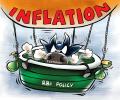
RBI Governor Shaktikanta Das on Friday said that inflation is on a declining trajectory, as it has fallen by 170 basis points from its January 2020 peak. Retail inflation fell to four-month low of 5.91 per cent in March over the previous month, mainly due to easing food prices.

Shareholders of industry giants Adani Enterprises, Reliance Industries, and Tata Motors - the latter two are part of the Sensex - will decide on combined related-party transactions of more than Rs 2.68 trillion proposed for this financial year and later. Related-party transactions for BSE 500 companies touched at least a six-year high of Rs 42.1 trillion in FY23, the Capitaline data shows. The Rs 42.1 trillion includes related-party transactions both at balance-sheet and profit-and-loss levels.
