
Emkay Share and Stock Brokers said that over the last couple of months, there has been a lot of disturbance in the telecom sector due to the regulatory issues on spectrum allocation, resulting in the gross under performance of the telecom shares.
Infosys had bid at 600 pence a share for the UK company. Infosys will get the one per cent inducement fee that Axon has to pay to the party unable to close the deal.

'It was because of the huge selloff in the Indian equities that the rupee fell so sharply against the dollar on Friday.'

Monsoons have had limited effect on market returns for a given year, report Sachin Mampatta and Sundar Sethuraman.

From its all-time peak of 38,989.65 scaled on August 29 this year, the Sensex has fallen by 2,921.32 points, or 7.5 per cent, to 36,068.33.

Kotak Bank was the top gainer in the Sensex pack, ending 4.31 per cent higher. PowerGrid, TCS, ICICI Bank, SBI, HCL Tech, NTPC, Infosys, Bajaj Finance, HDFC duo, ONGC, Vedanta and IndusInd Bank too rose up to 2.84 per cent.
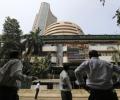
Other losers included HCL Tech, Yes Bank, IndusInd Bank, TCS, ONGC, Bajaj Finance, PowerGrid, Vedanta, Asian Paints, NTPC and Hero MotoCorp, which shed up to 4.07 per cent.

'The years after the financial crisis of 2008 were tough for brokers as volumes dwindled and retail investors stayed away.'
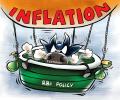
Currently, the retail inflation is well below the RBI's comfort level. The government has asked the central bank to keep inflation in the range of 4 per cent.

The retail inflation, which is factored in by the RBI to arrive at its monetary policy, has been on decline since last month. The previous low was 5.54 per cent in November 2019. The government has asked the RBI to restrict the inflation around 4 per cent, with a margin of 2 per cent on the either side.
Avinash Gorakshakar discusses his favourite picks
Most of the action in the markets now lie in the midcaps and smallcaps

All sectoral indices on the BSE and NSE ended in the red, led by realty, banking, metal, pharma, pharma and financial stocks.
Anish Damania of Emkay Shares and Stock Brokers gives his view on certain stocks post their results

Seasonal weakness may result in modest sequential revenue growth for large Indian IT firms in the January-March 2016 quarter, analysts said.

During the dot-com bubble, it had touched a high of 1.9.
Pratik Dalal of Emkay Share Brokers gives his favourite picks in the hotel sector and the reasons why he is bullish on them.

There was broad-based rally with participation across sectors creating enormous wealth for investors but starting 2018, the rally got concentrated into select large-cap companies with under performance in broader markets.

About 55 per cent of the public offers that hit the market since 2008 are still trading below their issue price.

Investors are anxious over the US-China trade tension, a sharp devaluation in yuan and uncertainty over Kashmir issue.

The buyback price is at around 28 per cent premium to the current market price of Rs 67 on the Bombay Stock Exchange

Build up inflation rate in the financial year so far was 2 per cent compared to a build up rate of 4.56 per cent in the corresponding period of the previous year. Inflation in food articles as a group rose to 11.08 per cent during the month as against 9.80 per cent in the previous month, mainly driven by exorbitantly high onion prices, the rates of which spiked by over 172 per cent from a year-ago. The annual rate of inflation, based on monthly wholesale price index was at 0.16 per cent in October.
During the month, inflation in vegetables shot up to 35.99 per cent, as against 26.10 per cent in October. Likewise, the prices of cereals and eggs grew at a faster pace of 3.71 per cent.

Check out some of the stocks that will react on the basis of their numbers in the near term.

Among Sensex components, shares of Reliance Industries, India's largest company by market value, stole the show by surging 1.61 per cent to their highest in over three months.

Some of the popular brands that would be impacted include Phensedyl (Abbott), Tixylix (Abbott), Gluconorm PG (Lupin), Ascoril D (Glenmark), Solvin Cold (Ipca), D Cold Total (Paras Pharma).
In the Sensex kitty, ITC turned star performer by surging 2.45 per cent, followed by NTPC rising 2.19 per cent.

The Union government will gain close to Rs 1.6 lakh crore in additional revenues this fiscal from a record hike in excise duty on petrol and diesel that has pushed the total incidence of taxation on auto fuels to 70 per cent of the price. Late on Tuesday evening, the government hiked excise duty on petrol by Rs 10 per litre and that on diesel by Rs 13 a litre to mop up gains arising from international oil prices falling to a two-decade low.
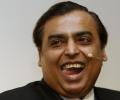
Analysts expect RIL to report consolidated revenue of Rs 1.40 trillion and 10 analysts expect RIL's net income to be Rs 9,629 crore

Analysts now expect India Inc to report a decline in both top line and bottom line for the September quarter.

The internals of the food inflation are worrying, given a broad-based uptick across categories that tend to be sticky, such as proteins, and a narrower-than-expected reduction in inflation for vegetables.

The fall was led by L&T, IndusInd Bank, PowerGrid, NTPC, TCS, ICICI Bank, Axis Bank, Hero MotoCorp, Bharti Airtel and SBI, declining up to 2.64 per cent.

With their net debt estimated at Rs 1.15 trillion, the merged entity will not be in much of a position to dole out freebies, says Romita Majumdar.

Kerala floods take a toll on small businesses, NBFCs brace for losses

Despite the onset of wedding season, the situation in apparel retail market remained unchanged and saw sharp decline in sales

According to estimates, if the companies are not allowed to raise petrol rates at least Rs 5 a litre by the first fortnight of September, they might begin to suffer underrecoveries on this decontrolled auto fuel, too -- for the first time this financial year.

Among Sensex constituents, HCL Tech suffered the most by diving 2.26 per cent, followed by HDFC shedding 2.10 per cent.

Crisis of growth is worsened by the challenging global environment and policy missteps. Returning to 9 per cent growth trajectory will be a tall order.
