
India's total purchase of oil from Russia in a month is probably less than what Europe does in an afternoon, External Affairs Minister S Jaishankar said.

In December 2019, the India arm of Deloitte Touche Tohmatsu surprised many with its ultra-competitive bid to become the transaction advisor for the country's largest strategic divestment in Bharat Petroleum Corporation (BPCL). The multinational major quoted just Rs 1; the second-highest bidder, SBI Caps, reportedly quoted Rs 15-17 crore. For Deloitte, the motivation was to bag a prestigious deal adding a national energy company to its portfolio. No doubt, it expected BPCL to go to a marquee buyer in quick time.

'If the third wave of Covid infections is as bad as the second one, the market may get very polarised with a preference for blue-chips with low volatility.'

Billionaire Mukesh Ambani on Wednesday pitched for using the USO Fund to subsidise smartphones for select groups to help penetrate the digital revolution and said India should make the rollout of 5G or the fifth-generation technology standard for broadband cellular networks a national priority. As much as 5 per cent of the licence fee paid by telecom operators goes to the Universal Service Obligation (USO) Fund, which was set up in April 2002 for achieving universal service objectives by providing access to telephone services in rural and remote areas and creation of infrastructure for mobile services and broadband in these areas. However, according to the CAG, less than half of the funds so collected are transferred for the said purpose.

The most immediate challenge for growth is the disruption of the global economy brought about by the Ukraine war and related sanctions, the Covid shutdowns in China and the rising tide of inflation, points out Nitin Desai.

Reliance Industries Ltd on Thursday announced a Rs 75,000 crore investment in new energy business over the next three years as the operator of the world's largest oil refinery pivots towards a greener and cleaner version. Reliance will build solar manufacturing units, a battery factory for energy storage, a fuel cell-making plant and an electrolyzer unit to produce green hydrogen as a part of the business, chairman Mukesh Ambani said at the company's annual general meeting with shareholders on Thursday. It will also set up 100 gigawatts (GW) of solar power generation capacity by 2030 and invest in setting up a carbon fibre plant.
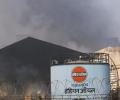
India's largest oil firm IOC will build the nation's first 'green hydrogen' plant at its Mathura refinery, as it aims to prepare for a future catering to the growing demand for both oil and cleaner forms of energy. Indian Oil Corporation (IOC) has drawn a strategic growth path that aims to maintain focus on its core refining and fuel marketing businesses while making bigger inroads into petrochemicals, hydrogen and electric mobility over the next 10 years, its chairman Shrikant Madhav Vaidya said. The company will not set captive power plants at all its future refinery and petrochemical expansion projects and instead use the 250 MW of electricity it produces from renewable sources like solar power, he told PTI in an interview.
Reliance Industries will by 2030 create or enable capacity to generate at least 100 gigawatts of electricity from renewable sources, which can be converted into carbon-free green hydrogen, its chairman Mukesh Ambani said Friday as he outlined a 1-1-1 vision to bring down the cost of hydrogen to under $1 per 1 kg in 1 decade. The focus on generating electricity from renewable sources of energy such as solar and wind -will help cut carbon emissions in the world's third-largest greenhouse gas emitter. The same electricity, when converted into green hydrogen, can replace petrol and diesel in automobiles and other fuels in the industry, helping cut down on the use of fossil fuels, carbon emissions and reduce import dependence.

Amazon

'Rising Covid cases and localised lockdowns are being closely monitored.'

'It won't help being complacent about the momentum and valuations of equities that currently exist.'

bp had last year bought 49 per cent stake in the 1,400-odd petrol pumps and 31 aviation turbine fuel stations owned by RIL for $1 billion.

For deciding which vehicles are to be scrapped, the setting up of fitness centres and regulating them would be a humongous task.

Pollution is not merely the price to be paid for growth; it is also a drag on the same growth.

The target is called Intended Nationally Determined Contributions.

'If every city had the strongest tools that are currently available only to a few, the world's climate prospects would glow far more brightly.'

Studies suggest net benefits of hydro-power, nuclear energy or natural gas as sources of electricity are greater than those of wind and solar.

CLP saw early that the pollution caused by China's rush for industrial growth would lead inevitably to demands for cleaner electricity.

'Greenpeace has been brutal in targeting both India and the Manmohan Singh government. The push to go after Indian coal is driven by its long-term agenda. What is surprising is that China has not been meted out the same treatment, despite the fact that the rise of China as an economic power has been built around generating power from coal. 'Being richer and more affluent, yet far less democratic, there is less room for an NGO such as Greenpeace to drive home a complicated global agenda, so there is more of a tendency to go along with anything the Chinese offer despite China being the biggest by far with regard to coal use. But for India, it reserves tougher prescriptions, notably for its middle class, says Srinivas Bharadwaj.

Developed and developing countries are very different and they are different from variety of reasons on climate change.
