
Nearly three months after his house arrest, Lashkar-e-Tayiba founder Hafiz Mohammad Saeed was produced before a court in Lahore on Monday for the first time in connection with the Mumbai attacks by Pakistani authorities which sought extension of his detention.

The banned Jamaat-ud-Dawah head has hired Lahore-based law firm -- Mirza and Mirza Law Associates -- to file the petition.
Pakistan has said it cannot arrest outlawed Jamaat-ud-Dawah chief Hafiz Mohammad Saeed, linked by India to the Mumbai terror attacks, since there is no proof of his involvement in the 26/11 assault.

Saeed made the remarks while addressing a Friday prayer congregation at a mosque in Gujranwala in Pakistan's Punjab province on Saturday.
Senior Jamaat-ud-Dawah leader Nazir Ahmed, who has been under house arrest since early December in the wake of the Mumbai terror attacks, has been shifted from Rawalpindi to Lahore.A retired colonel in the Pakistan army, Ahmed was detained along with over 50 militant leaders in December last year, when the government launched a crackdown on the Jamaat and its parent organisation, the outlawed Lashker-e-Tayiba, in the wake of the Mumbai attacks.
Pakistan on Thursday said it had detained 71 members of outlawed militant groups and put under surveillance 124 others, besides shutting down five "training camps" of Jamaat-ud-Dawah and banning its websites, in the wake of the Mumbai attacks.
Lashkar-e-Tayiba's operations commander and alleged mastermind of the Mumbai terror attacks, Zakiur Rehman Lakhvi, who was detained last month during Pakistan's crackdown on military groups, is reportedly furious at the Jamaat-ud-Dawah leadership's U-turn to publicly disown him.
Pakistan has no evidence linking the banned Jamaat-ud-Dawah chief Hafiz Mohd Saeed to the Mumbai terror attacks but was detained in the interest of 'national security,' a top legal official said on Friday.
The release of banned outfit Jamaat-Ud-Dawah Chief Hafiz Mohammed Saeed by a Lahore Court today may embolden the Lashker-e-Toiba cadres operating in India who may themselves plan a strike or do it on the orders of their master, security experts here feel.
Jamaat-ud-Dawah chief Hafiz Mohammad Saeed is a free man now. Arrested after the Mumbai terror attacks, Saeed was released by the Lahore court on Tuesday.
Aggressive diplomacy and a well prepared case against the JuD, parent organisation of Lashkar-e-Tayiba, led to Security Council's decision to call for worldwide freezing of its assets and putting four LeT leaders on a list of terrorists subject to sanctions, including ban on foreign travel. The case prepared by India was so convincing that even China, which bailed out Pakistan and prevented ban being imposed on earlier occasions, decided to go along.
The ten terrorists were told they were targeting enemies of Islam.
"There was a resolution in the United Nations Security Council. If Pakistan had not taken steps under that, then they could have declared Pakistan a terrorist state. They could have crippled Pakistan's economy," Defence Minister Chaudhry Ahmed Mukhtar said.
The United Nations Security Council has placed sanctions on Pakistan-based Jamaat-ud-Dawa, the front organisation of banned Lashkar-e-Tayiba, declaring it a terrorist organisation.Four top leaders of LeT including Hafiz Muhammad Saeed, Zaki-ur-Rehman Lakhvi, Haji Muhammad Ashraf and Zaki-ur-Bahaziq have also been declared as terrorists by the UNSC.Imposing the sanctions, the Council asked all member states to freeze their assets and impose travel ban and arms embargo.
The crackdown by the Pakistani security forces on the Lashkar-e-Toiba, which has been linked to the Mumbai carnage, will not cripple the banned organisation, a coordinator of the militant group has said.
Lashkar-e-Tayiba terrorist Zakiur Rehman Lakhwi, accused of masterminding the Mumbai attacks, is among over 20 members of the group arrested by Pakistani security forces during a crackdown in Pakistan occupied Kashmir. The security forces, including the army, on Sunday launched a crackdown on the Lashkar and its front organisation, the Jamaat-ud-Dawah, in PoK and other parts of Pakistan. Helicopters were used in the operation in Muzaffarabad, the capital of PoK.
Lashkar-e-Tayiba terrorist Zakiur Rehman Lakhwi, accused of masterminding the Mumbai attacks, is among over 20 members of the group arrested by Pakistani security forces during a crackdown in Pakistan occupied Kashmir. The security forces, including the army, on Sunday launched a crackdown on the Lashkar and its front organisation, the Jamaat-ud-Dawah, in PoK and other parts of Pakistan. Helicopters were used in the operation in Muzaffarabad, the capital of PoK.
Pakistan on Thursday said it was "disturbed" by reports that India could be preparing for additional nuclear tests and hoped a unilateral moratorium on testing would remain in place in the region.
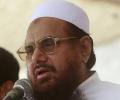
A Pakistani court has asked the Punjab government to explain under what authority it has detained Jamaat-ud-Dawah chief Hafiz Saeed "without a trial".
Pakistan will be in 'great trouble' if President-elect Asif Ali Zardari does not change the policies of his predecessor Pervez Musharraf, which have 'derailed the Kashmir issue', the founder of the outlawed Lashker-e-Taiba has said.Militant ideologue Hafiz Muhammad Saeed, who now heads the Jamat-ud-Dawah, called on the people of Pakistan to gather at the Line of Control to show solidarity with the residents of Jammu and Kashmir.
Jamaat-ud-Dawah, the frontal organisation of the Lashkar-e-Tayiba, which is blamed for the Mumbai attacks, has written to the United Nations claiming that it was not associated with the Al-Qaeda and Taliban and that the Security Council's sanctions on it were 'unjustified'.
Pakistani authorities have extended by two months the detention of Jamaat-ud-Dawah chief Hafiz Mohammed Saeed and seven other activists of the front organisation of Lashkar-e-Tayiba, blamed for the Mumbai terrorist attacks.A spokesman for the Punjab government told reporters that the province's home department had on Saturday extended the detention of Saeed and the seven other JuD leaders by 60 days.Saeed and other Jamaat leaders were placed under house arrest for a month.
India has informed Pakistan that it has not engaged in any sort of troop build-up along the frontier and sought firm action against terrorist camps and groups operating from the Pakistani soil. New Delhi has also told Islamabad that it has no plans for a military action, but wanted a combination of 'executive action and judicial processes' against terrorist elements like the LeT and its front organisation Jamaat-ud-Dawah, which have been linked to the Mumbai attacks.
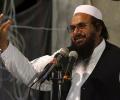
The interior ministry had opposed enlisting of the MML as a political party, arguing that it is an offshoot of the banned JuD.

India on Tuesday raised the Mumbai terror attack at the United Nations and demanded that the world body ban Pakistan-based Jamaat-ud-Dawa, the front organization of Lashkar-e-Toiba(LeT) blamed for the carnage, and other such organisations and impose effective sanctions against them.
The counsel for Hafiz Mohammad Saeed, chief of the banned Jamaat-ud-Dawah, today told a court hearing a petition challenging his detention that the group was not linked to the Taliban and that the UN Security Council had not asked Pakistan to detain its leaders.
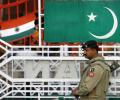
Pakistan has been scrambling in recent months to avoid being added to a list of countries deemed non-compliant with anti-money laundering and terrorist financing regulations.
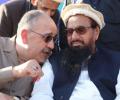
"The Palestine government has told Ali that he was not anymore its envoy to Pakistan," Haija said.
JuD official Ahmad Nadeem later said that the statement 'erroneously' mentioned China's name regarding terrorism in Pakistan.
A statement issued by the Interior Ministry also said the crackdown on Jaish 'has been taken in line with the decision of the NSC meeting'.
The sanctions committee of the Council had circulated a note to its members that the United States, backed by Britain and France, had tried to add JuD chief Hafiz Mohammed Saeed to the list of individuals and organisations connected to terrorism last May, but was blocked by China, according to a note circulated in the UNSC on Wednesday.
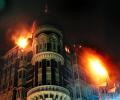
For the seventh time in a row, a Pakistani anti-terrorism court trying the seven accused in the 2008 Mumbai attacks case adjourned the hearing on Wednesday till September 3 as the judge has gone on a summer vacation.
Jammat-ud-Dawah chief and Mumbai attack mastermind Hafiz Saeed on Tuesday warned Pakistan Prime Minister Nawaz Sharif against extending a hand of friendship to India.
He also slammed Prime Minister Nawaz Sharif for holding a meeting with his Indian counterpart Narendra Modi in Paris, saying it has hurt the sentiments of 'Kashmiri Muslims'.

A Pakistani court has issued a notice to the Jamat-ud-Dawah, led by the 2008 Mumbai attack mastermind Hafiz Saeed, for running a Taliban-style parallel judicial system in Lahore.
The interesting observation by Saeed, who has been blamed for many terrorist attacks in India and figured top of the list of wanted persons, was made during a sermon at a prayer meeting in Lahore on Friday.

In its third summons, issued last week, the NIA promised him security.

Just days after his organisation was declared a terror outfit by the US, Jamaat-ud-Dawah chief Hafiz Saeed, who orchestrated the 2008 Mumbai terror attacks, addressed a seminar at the Lahore High Court spewing venom on India and America.
Addressing a large gathering at the Gaddafi Stadium, the Lashkar-e-Tayiba founder called for unity among Muslim community "to fail the design of infidels".

Khan had said in January 2018 that meeting Trump would be a 'bitter pill' to swallow.
